
Chef Juliette
John Dory (St. Pierre)
John Dory has the delicacy of sole and the firmness of turbot. A light flouring, a quick butter sauté, and nut-brown beurre noisette show exactly why looks never mattered.
A cooking platform built around craft, culture, and the stories behind what we eat.
Created by Chef Juliette
Based on No. 1146, Pièce de Bœuf à la Bourguignonne, from Le Guide Culinaire (1907) by Auguste Escoffier
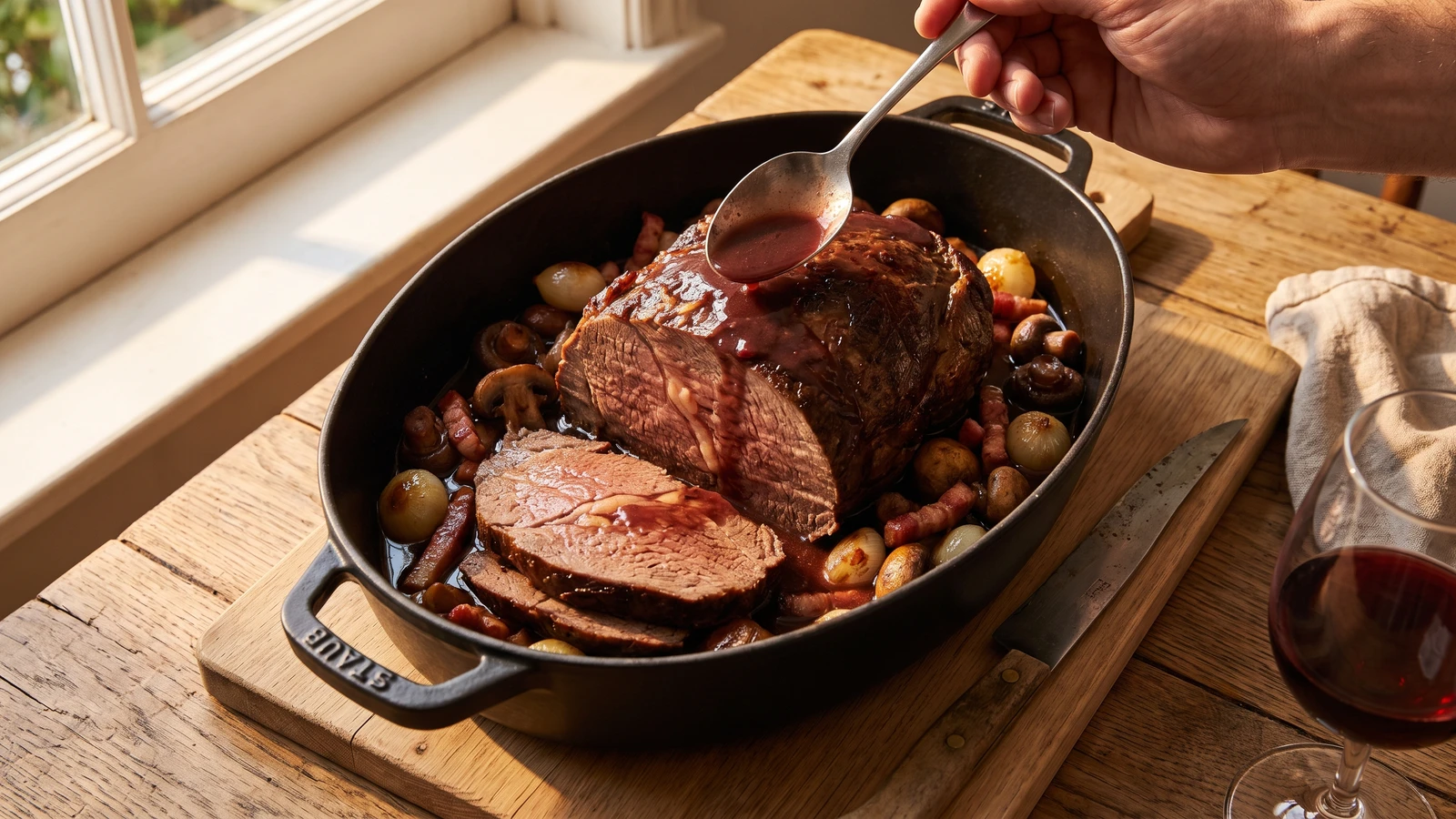
A whole piece of beef, larded and browned hard, then braised in red wine with mushrooms, bacon, and glazed onions until the meat yields and the sauce shines dark garnet.
Pièce de Bœuf à la Bourguignonne (a whole beef roast braised Burgundy-style) teaches one truth before you touch the pan: the fond, the browned glaze left by the beef, is the whole sauce. C'est la même grammaire as every great brown braise. Colour the meat deeply, reduce the wine honestly, and keep the cooking liquor at a bare tremble.
The brigade around this dish could count on a larding needle, a saucier keeping Espagnole ready, a stockpot never off the fire, and a salamander close by, though the original sends its glaze to the oven. At home, a narrow knife and chopstick make the larding channels, prepared Espagnole and gelatin-rich stock supply the sauce, one snug cocotte replaces two saucepans, and the broiler supplies the finishing heat. The second clean pan was brigade scaffolding, so we wipe and reuse the cocotte. The larding, wine reduction, separately buttered garnish, and final glaze are the dish, and they stay. One cook, one stove, one evening.
Brown the beef to deep mahogany, never black, and don't turn it until each face releases willingly from the pot. Everything afterward can be adjusted with stock, reduction, or gentler heat. That first colour cannot be added later.
Pièce de Bœuf à la Bourguignonne belongs to Burgundy's wine-braising tradition, but its whole-piece form records the passage from regional pot cooking into the classical kitchen: the beef is larded, braised intact, glazed, and surrounded with separately finished garnishes. It is not merely boeuf bourguignon left uncut, since keeping the piece whole changes both the service and the need for careful basting. Mushrooms, bacon, and small onions form the codified garniture bourguignonne that carried the wine braise between formal dining rooms and generous family tables.
Quantity
1 roast (3 lb / 1.4 kg)
tied into an even piece
Quantity
About 1½ cups (350 ml / 225 g)
cut into long ¼-inch batons
Quantity
¼ cup (60 ml / 15 g)
finely chopped
Quantity
¼ teaspoon (1 ml / 0.5 g)
Quantity
2¼ teaspoons (11 ml / 14 g)
divided
Quantity
1 teaspoon (5 ml / 2 g)
divided
Quantity
1¾ cups (440 ml / 440 g)
Quantity
¼ cup (60 ml / 57 g)
Quantity
⅔ cup (160 ml / 90 g)
thickly sliced
Quantity
⅔ cup (160 ml / 90 g)
thickly sliced
Quantity
1
parsley stems, thyme, bay leaf, and 1 garlic clove
Quantity
About 4½ cups (1.1 litres / 450 g)
trimmed and halved or quartered, parings reserved
Quantity
2 tablespoons (30 ml / 28 g)
Quantity
3½ cups (875 ml / 875 g)
divided
Quantity
2 teaspoons (10 ml / 7 g)
Quantity
¾ cup (180 ml / 180 g)
Quantity
About 1¼ cups (300 ml / 170 g)
cut into ½-inch lardons
Quantity
18 onions (about 2 cups / 300 g)
peeled
Quantity
6 tablespoons (90 ml / 85 g)
divided
Quantity
1 teaspoon (5 ml / 4 g)
Quantity
1 cited preparation (No. 168)
consulted for cold-marination handling
| Ingredient | Quantity |
|---|---|
| boneless top-round or rump beef roasttied into an even piece | 1 roast (3 lb / 1.4 kg) |
| chilled unsmoked fatback or fatty salt porkcut into long ¼-inch batons | About 1½ cups (350 ml / 225 g) |
| flat-leaf parsleyfinely chopped | ¼ cup (60 ml / 15 g) |
| freshly grated nutmeg | ¼ teaspoon (1 ml / 0.5 g) |
| fine saltdivided | 2¼ teaspoons (11 ml / 14 g) |
| freshly ground black pepperdivided | 1 teaspoon (5 ml / 2 g) |
| dry red Burgundy wine | 1¾ cups (440 ml / 440 g) |
| brandy | ¼ cup (60 ml / 57 g) |
| carrotthickly sliced | ⅔ cup (160 ml / 90 g) |
| yellow onionthickly sliced | ⅔ cup (160 ml / 90 g) |
| bouquet garniparsley stems, thyme, bay leaf, and 1 garlic clove | 1 |
| small button mushroomstrimmed and halved or quartered, parings reserved | About 4½ cups (1.1 litres / 450 g) |
| clarified butter | 2 tablespoons (30 ml / 28 g) |
| rich veal gravy or gelatin-rich unsalted veal stockdivided | 3½ cups (875 ml / 875 g) |
| powdered unflavoured gelatin (optional) | 2 teaspoons (10 ml / 7 g) |
| prepared Espagnole sauce | ¾ cup (180 ml / 180 g) |
| unsmoked slab baconcut into ½-inch lardons | About 1¼ cups (300 ml / 170 g) |
| small pearl onionspeeled | 18 onions (about 2 cups / 300 g) |
| unsalted butterdivided | 6 tablespoons (90 ml / 85 g) |
| granulated sugar | 1 teaspoon (5 ml / 4 g) |
| Cooked Marinade for Venisonconsulted for cold-marination handling | 1 cited preparation (No. 168) |
| Ordinary Braisingsscaled to this whole roast | 1 cited preparation (No. 247) |
| Blanchingsused for the bacon garnish | 1 cited preparation (No. 273) |
Toss the chilled fatback batons with the parsley, nutmeg, ¼ teaspoon of the pepper, and 1 tablespoon of the brandy. With a narrow knife, make eight evenly spaced tunnels from alternating ends of the beef, running parallel to the grain. Widen each gently with a clean chopstick or metal skewer, then push in a fat baton. This replaces the larding needle without changing its purpose: the lean roast receives fat through its centre rather than merely wearing it on top. Retie the beef if its shape has loosened.
Season the larded beef with 2 teaspoons of the salt and another ¼ teaspoon of pepper. Place it in a snug nonreactive dish with the wine and remaining brandy. Follow the cold handling set out in Cooked Marinade for Venison (No. 168): the liquid and vessel stay refrigerated, and the meat is turned several times. For this entry, keep the specified red-wine and brandy marinade and stop at exactly three hours. Longer marinating can give the surface a cured, slightly chalky texture.
Lift the beef from the marinade and let it drain for 30 minutes, reserving every drop of liquid. Pat the meat completely dry. Heat the clarified butter in a snug 5 to 6-quart cocotte over medium-high heat, then brown the beef on every face until it is deep mahogany and the pot floor carries a rich brown fond. Work patiently and turn only when the meat releases. If the fond races toward black, pull the pot from the heat and loosen it immediately with a spoonful of reserved marinade. Ça se rattrape before it burns; black fond is bitter and must be wiped away.
Transfer the browned beef to a plate. Lower the heat, add the carrot and yellow onion, and cook them in the remaining fat until coloured on several surfaces without scorching. Pour in the reserved marinade, scrape the fond from the pot, and boil briskly until the liquid is reduced to a syrupy glaze. This is Ordinary Braisings (No. 247) brought down to home scale. Add the bouquet garni, mushroom parings, 3 cups of the veal gravy, and the Espagnole sauce. If the stock is loose rather than gelatinous, bloom the optional gelatin in a little cold stock and whisk it in. Return the beef and bring the liquor to a full boil, skimming any grey foam. In this snug pot the liquid should reach the top of the meat; add a little reserved stock only if needed.
Cover the cocotte and place it in a 300°F / 150°C oven. Hold the sauce at the barest tremble for about 1 hour 45 minutes, turning and basting the beef every 30 minutes. The first phase is complete when a narrow knife enters the outer portion readily but still meets definite resistance near the centre. Do not wait for full tenderness yet, because the meat must finish among its garnish.
While the beef braises, prepare the three garnishes separately. Treat the bacon according to Blanchings (No. 273), then drain and dry it thoroughly before tossing it in 1 tablespoon of butter until its edges colour. Sauté the mushrooms in 2 tablespoons of butter over high heat until browned and dry at the edges. Put the pearl onions in a small pan with 2 tablespoons of butter, the sugar, a pinch of the remaining salt, and enough reserved stock to come halfway up their sides; cover and cook gently until half-tender, then uncover and roll them through the reducing butter until glossy. Keep everything separate until the sauce has been strained.
Lift the beef onto a plate and discard the bouquet garni. Strain the braising liquor through a fine sieve without forcing the spent vegetables through, then skim the surface fat. The old service transferred everything to a second clean saucepan; wipe the cocotte and reuse it. Set the beef back inside, arrange the mushrooms, lardons, and onions around it, and pour over the strained sauce. Cover and return to the oven for 45 to 60 minutes, basting every 15 minutes, until a knife passes through the centre with almost no resistance. If the meat becomes tender before the sauce is ready, lift it out. Never dry the beef merely to save the sauce; the sauce can finish alone.
Transfer the beef to a rimmed heatproof platter. Raise the oven to 450°F / 230°C or heat the broiler, the home equivalent of a salamander's concentrated top heat. Brush the meat with a thin coat of sauce and expose it to the heat for about 2 minutes, just until the coating adheres and shines. Repeat two or three times, watching closely so the glaze darkens without burning. Rest the finished beef for 10 minutes.
Lift the garnish into a warm serving dish with a slotted spoon. Boil the sauce briskly until it coats the back of a spoon in a glossy, wine-dark layer. If it is thin, keep reducing; if it tightens too far, loosen it with a spoonful of reserved stock. If fat gathers at the edges, let the sauce settle for a minute and skim it rather than whisking the grease back in. Taste for salt and pepper. Set the glazed beef whole among the mushrooms, lardons, and onions, pour over enough sauce to make everything gleam, and serve the rest alongside. Carve across the grain at the table. À table!
1 serving (about 630g)
Culinary guides, cultural storytelling, and the editorial depth that makes cooking meaningful.
Discover Culinary ExplorerChef Juliette
John Dory has the delicacy of sole and the firmness of turbot. A light flouring, a quick butter sauté, and nut-brown beurre noisette show exactly why looks never mattered.

Chef Juliette
Fresh haddock proves its delicacy in the meunière pan: a fine flour crust, moist pearly flakes, and beurre noisette sharpened with lemon and parsley, ready from one skillet in half an hour.
Chef Juliette
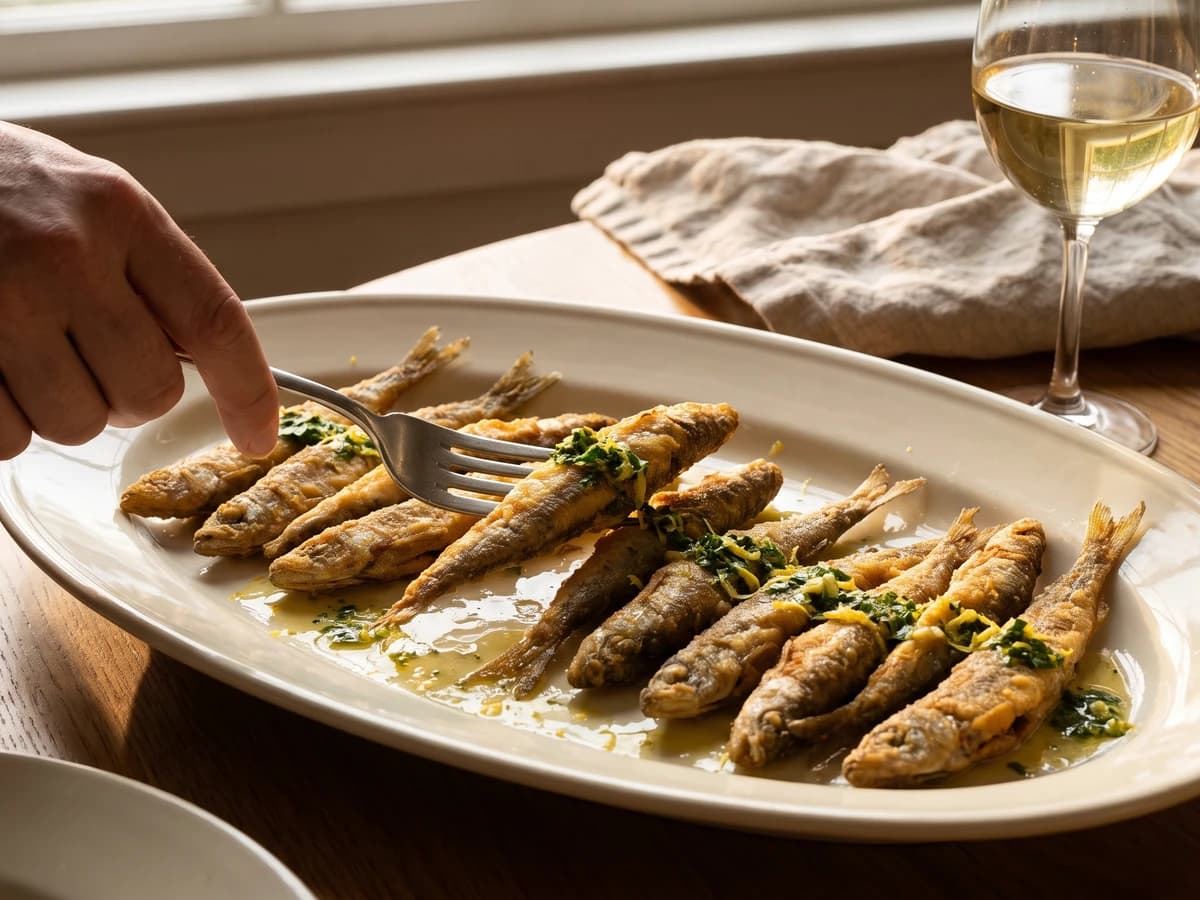
Éperlans à l’Anglaise turns small fish into a lesson in disciplined coating: boned smelts under a close, crisp crumb, pan-fried in clarified butter and finished with bright, half-melted maître d’hôtel butter.

Chef Juliette
Tiny smelts, shallot, mushrooms, white wine, gratin sauce, and fine bread raspings meet a fierce oven, where the fish must turn tender in the same breath the buttered crust bronzes.