
Chef Juliette
John Dory (St. Pierre)
John Dory has the delicacy of sole and the firmness of turbot. A light flouring, a quick butter sauté, and nut-brown beurre noisette show exactly why looks never mattered.
A cooking platform built around craft, culture, and the stories behind what we eat.

Created by Chef Juliette
Based on No. 1004, Éperlans au Gratin, from Le Guide Culinaire (1907) by Auguste Escoffier
Tiny smelts, shallot, mushrooms, white wine, gratin sauce, and fine bread raspings meet a fierce oven, where the fish must turn tender in the same breath the buttered crust bronzes.
Éperlans au Gratin (smelts baked under a gratin crust) teaches one exact lesson: the fish and the crust must finish in the same moment. Smelts are so small that a moderate oven gives the sauce time to reduce only by turning the fish dry. Fierce heat is not bravado here, it is the timing mechanism.
The professional kitchen assumed a saucier on staff, a stock never off the fire beneath the prepared gratin sauce, brigade-sized dishes, and a range with a salamander ready to correct the surface. At home, begin with the finished, cross-referenced sauce, use one shallow metal dish, and preheat a heavy sheet pan in a 500°F oven. The broiler stands ready only for the last few seconds. Maintaining separate finishing stations is brigade scaffolding and can go; bringing a properly made sauce and truly fierce heat cannot. One cook, one stove, one evening.
For four people, sixteen smelts fit in one close layer. The whiting preparation gives two cooked mushroom caps to each fillet; this version keeps two per serving, because two on every little smelt would bury the fish and slow the crust. That is the single proportional change, made to preserve the balance rather than decorate it. Fully preheat the oven before assembling. That is the step that decides the dish.
Éperlans au Gratin sits in the Parisian classical fish repertory, whose kitchens received smelts from the Seine estuary and Normandy's Channel ports. Although these little fish often appeared as friture, the grand kitchen carried the complete-gratin method from larger whiting to smelts by changing the heat rather than the flavorings. The dish also corrects a common misconception: au gratin need not mean cheese, and this crust is made from fine bread raspings and butter over reduced sauce.
Quantity
16 (about 1½ pounds / 680 g)
scaled if needed, gutted, heads and tails left on, rinsed quickly and dried thoroughly
Quantity
5 tablespoons (75 ml / 70 g)
divided
Quantity
3 tablespoons (45 ml / 30 g)
finely chopped
Quantity
1¼ cups (300 ml / about 315 g), called for in Filets de Merlan au Gratin (No. 1018) and used for Gratins (No. 268)
warmed to a loose coating consistency
Quantity
2½ cups (590 ml / 225 g)
8 caps left whole and the remainder thinly sliced
Quantity
⅓ cup (80 ml / 80 g)
divided
Quantity
½ cup (120 ml / 45 g)
Quantity
2 tablespoons (30 ml / 8 g)
roughly chopped
Quantity
1 tablespoon (15 ml / 15 g)
Quantity
1 teaspoon (5 ml / 6 g)
Quantity
¼ teaspoon (1.25 ml / 0.5 g)
| Ingredient | Quantity |
|---|---|
| whole smeltsscaled if needed, gutted, heads and tails left on, rinsed quickly and dried thoroughly | 16 (about 1½ pounds / 680 g) |
| unsalted butterdivided | 5 tablespoons (75 ml / 70 g) |
| shallotsfinely chopped | 3 tablespoons (45 ml / 30 g) |
| prepared gratin saucewarmed to a loose coating consistency | 1¼ cups (300 ml / about 315 g), called for in Filets de Merlan au Gratin (No. 1018) and used for Gratins (No. 268) |
| small button mushrooms8 caps left whole and the remainder thinly sliced | 2½ cups (590 ml / 225 g) |
| dry white winedivided | ⅓ cup (80 ml / 80 g) |
| fine dry bread raspings | ½ cup (120 ml / 45 g) |
| flat-leaf parsleyroughly chopped | 2 tablespoons (30 ml / 8 g) |
| fresh lemon juice | 1 tablespoon (15 ml / 15 g) |
| fine sea salt | 1 teaspoon (5 ml / 6 g) |
| finely ground white pepper | ¼ teaspoon (1.25 ml / 0.5 g) |
Set a rack in the upper third of the oven and place a heavy rimmed sheet pan on it. Heat the oven to 500°F (260°C) for at least 25 minutes, giving the sheet pan time to become thoroughly hot. Do not assemble the gratin until the oven holds its full heat. A merely warm oven cooks the smelts before it bronzes the crumbs, and no amount of patience can reverse dry fish.
Separate the 8 whole mushroom caps from the sliced mushrooms. Melt 1 tablespoon of the butter in a small skillet over medium-high heat, add the caps, and cook for 3 to 4 minutes, turning once, until just tender and glossy but not deeply browned. Set them aside. Leave the sliced mushrooms raw; their moisture will mingle with the wine and reduce during the fierce oven finish, exactly as the source preparation intends.
Use 1 tablespoon of the butter to coat a shallow 12 by 8-inch (30 by 20 cm) gratin dish generously. Spread about ⅓ cup of the prepared gratin sauce over the bottom and scatter on the shallots, following the arrangement of Filets de Merlan au Gratin (No. 1018). Season the thoroughly dried smelts with the salt and white pepper, then arrange them in one close layer, alternating heads and tails so the thickness stays even. Surround the fish with the raw mushroom slices without blanketing their upper surfaces. Place the cooked caps over the dish, two to each serving, and pour ¼ cup of the wine around the edges.
Check the remaining gratin sauce before it touches the fish. It should fall from a spoon in a broad ribbon and veil the surface without sitting like paste; if it has tightened, loosen it with the reserved wine, one teaspoon at a time. Spoon the sauce thinly and evenly over the smelts. Scatter the bread raspings across the whole dish, melt the remaining 3 tablespoons of butter, and drizzle it evenly over the crumbs. The sauce, raspings, and butter are the complete-gratin structure described in Gratins (No. 268); keep each layer light enough that the fierce heat can reach the fish.
Set the gratin dish directly on the blazing sheet pan and bake without opening the oven for the first 6 minutes. Begin checking at 7 minutes. The dish is ready when the sauce bubbles briskly around the rim, the crumbs are deeply golden, and the smelt flesh looks opaque where it meets the backbone, about 7 to 9 minutes in all. The thickest fish should reach 145°F (63°C). If the surface darkens before the fish are ready, shield it loosely with foil and give it another minute. If the fish are done while the crumbs remain pale, ça se rattrape: place the dish under a fully heated broiler for 20 to 40 seconds, watching without looking away. If the sauce remains watery once the fish are cooked, spoon the loose liquid into the mushroom skillet, boil it briefly until glossy, and return it to the dish. Do not leave little fish in the oven to correct a slow sauce.
Sprinkle the parsley over the gratin and flick the lemon juice evenly across the crust. Let the dish settle for 2 minutes, no longer, so the reduced sauce gathers beneath the fish without losing its heat. Carry the gratin to the table in its baking dish and serve each person four smelts with mushrooms, crust, and a generous spoonful of sauce. À table!
1 serving (about 295g)
Culinary guides, cultural storytelling, and the editorial depth that makes cooking meaningful.
Discover Culinary ExplorerChef Juliette
John Dory has the delicacy of sole and the firmness of turbot. A light flouring, a quick butter sauté, and nut-brown beurre noisette show exactly why looks never mattered.

Chef Juliette
Fresh haddock proves its delicacy in the meunière pan: a fine flour crust, moist pearly flakes, and beurre noisette sharpened with lemon and parsley, ready from one skillet in half an hour.
Chef Juliette
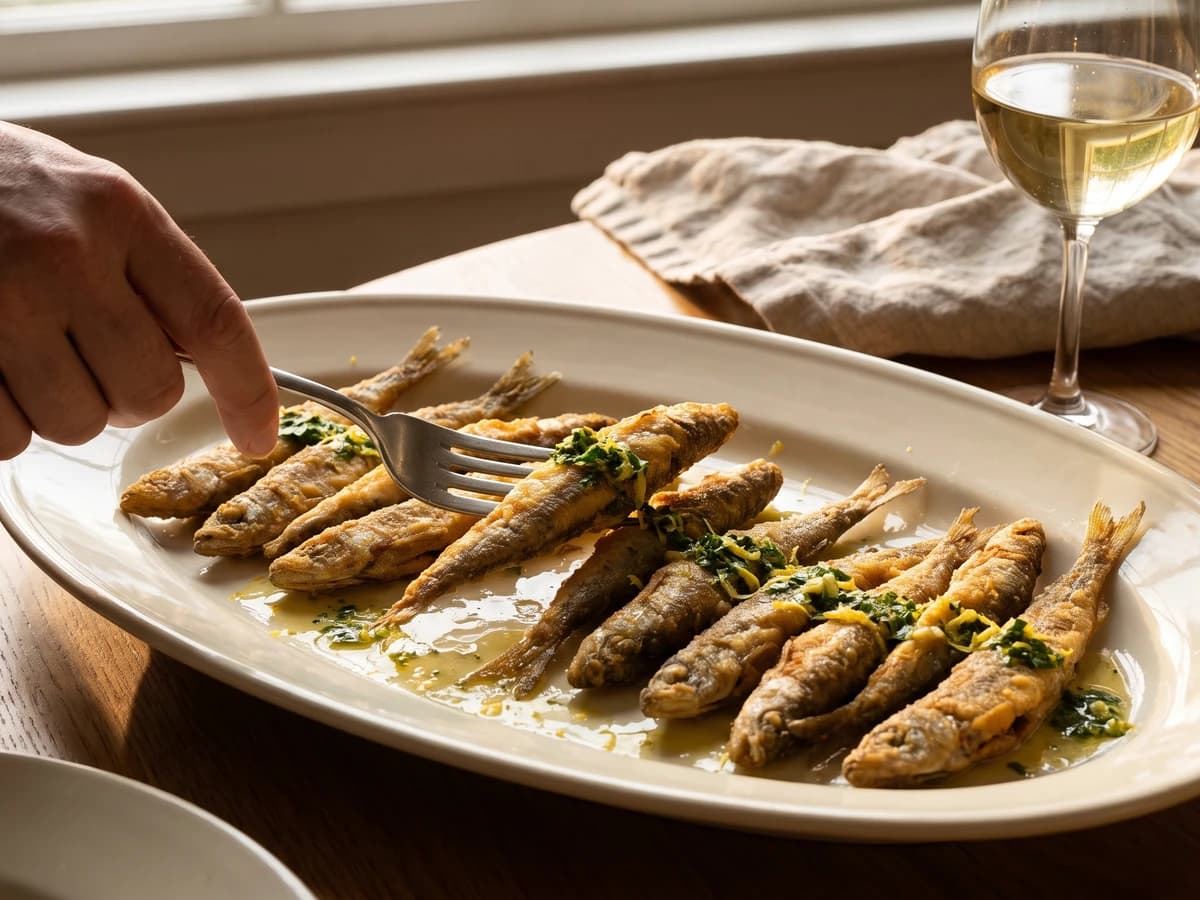
Éperlans à l’Anglaise turns small fish into a lesson in disciplined coating: boned smelts under a close, crisp crumb, pan-fried in clarified butter and finished with bright, half-melted maître d’hôtel butter.

Chef Juliette
Éperlans Grillés make delicacy from discipline: smelts opened along the back, partly boned, floured and buttered, then broiled in minutes and served with lemon, crisp parsley, and beurre maître d’hôtel.