
Chef Juliette
John Dory (St. Pierre)
John Dory has the delicacy of sole and the firmness of turbot. A light flouring, a quick butter sauté, and nut-brown beurre noisette show exactly why looks never mattered.
A cooking platform built around craft, culture, and the stories behind what we eat.

Created by Chef Juliette
Based on No. 951, Mousselines de Homard, from Le Guide Culinaire (1907) by Auguste Escoffier
Mousselines de Homard turn raw lobster, egg white, and cream into warm, tender little moulds, poached under cover so their delicate structure sets without tightening or losing its sweetness.
Mousselines de Homard (warm lobster moulds lightened with cream) teach the cold discipline behind the lightest warm forcemeat. One true thing before you touch a pan: the raw lobster mixture must stay cold from first stir to filled mould, because warmth loosens its emulsion before the egg white can set it. The finished mousselines should tremble under the fork, rich with cream yet unmistakably lobster.
The original entry assumed its forcemeat had been pounded and sieved elsewhere, ranks of dariole-moulds, a saucier on staff, a stock never off the fire, and a salamander waiting to glaze the chosen finish. At home, a food processor stands in for the mortar when you make the linked formula, eight buttered ramekins replace special moulds, and a covered roasting-pan bain-marie steadies the oven. Prepare one referenced finish before the ramekins go in, using the broiler in place of the salamander only if that finish calls for glazing. The constant stockpot and extra hands were brigade scaffolding. Cold emulsification and gentle covered poaching are the dish, and they stay.
The ramekins solve what the book says plainly: crustacean forcemeat is too flimsy for spoon-shaping, and forcing it into quenelles only bruises the texture. Fill without beating, keep the water below a boil, and watch the centre rather than the clock. That gentle poach is the step that matters most.
Mousselines de Homard belong to the classical service of Parisian grand dining rooms, where cooks refined raw shellfish with egg white and cream, then served the mixture warm in individual dariole-moulds. The vocabulary corrects a common confusion: for crustaceans, mousses were generally cold, while mousselines were warm preparations moulded as individual portions. Their passage to the home table requires no change of intent, only ramekins for the special moulds and a covered bain-marie for the regulated poaching oven.
Quantity
1 full recipe, about 4 cups (950 ml / 980 g), prepared from raw lobster according to Fine Chicken Forcemeat or “Mousseline” (No. 195)
well chilled
Quantity
2 tablespoons (30 ml / 28 g)
softened, for the moulds
Quantity
5 cups (1.2 L / 1.2 kg), or as needed
for the bain-marie
| Ingredient | Quantity |
|---|---|
| raw lobster mousseline forcemeatwell chilled | 1 full recipe, about 4 cups (950 ml / 980 g), prepared from raw lobster according to Fine Chicken Forcemeat or “Mousseline” (No. 195) |
| unsalted buttersoftened, for the moulds | 2 tablespoons (30 ml / 28 g) |
| just-boiled waterfor the bain-marie | 5 cups (1.2 L / 1.2 kg), or as needed |
| prepared sauce-and-garnish finish | 1, chosen from Mousseline Alexandra (No. 798) or Mousseline de Saumon à la Tosca (No. 799) |
Heat the oven to 325°F (160°C) with a rack in the lower middle. Keep the raw lobster mousseline forcemeat prepared according to Fine Chicken Forcemeat or “Mousseline” (No. 195) over a bowl of ice while you work, without letting meltwater enter it. Brush eight 4-ounce (120 ml) ramekins generously with the softened butter, coating the bases, sides, and rims.
Divide the cold forcemeat among the ramekins, about 1/2 cup (120 ml / 122 g) in each. Fill in two additions, pressing the first gently into the bottom to exclude large air pockets, then smooth the tops without beating. The mixture is supposed to be too soft to hold a spoon-shaped quenelle; that softness is precisely why the book sends it into moulds. If the edges turn glossy or leave greasy streaks, stop and return the bowl to the ice for 10 minutes, then fold gently until uniform. Do not stiffen it with flour or crumbs.
Arrange the ramekins in a deep roasting pan without letting them touch. Pour the just-boiled water around them until it reaches halfway up their sides, taking care not to splash the forcemeat. Cover the entire pan tightly with foil. The mousselines need enclosed, moderate heat rather than the dry blast of an uncovered oven.
Poach for 24 to 30 minutes. Begin checking at 24 minutes: the centres should rise only faintly, quiver as one piece when nudged, and reach 160°F (71°C) in a test mould. There should be no browning at this stage. If the bath begins bubbling, pull out the pan, replace about 1 cup (240 ml / 240 g) of its water with cool water, lower the oven to 300°F (150°C), and finish gently. Ça se rattrape if you act before the centres set; boiling makes the proteins tighten and squeeze out the cream.
Lift the ramekins from the bath and let them stand for 5 minutes. Loosen only the upper edge with a thin knife, invert each mousseline onto a folded clean towel for a moment, then move it with a thin spatula to the warmed serving dish. If one clings, return its ramekin upright and wrap the outside in a hot damp towel for 10 seconds. Do not dig at the sides; warmth and patience release it cleanly.
Have the chosen finish ready as the mousselines leave their moulds. For the Alexandra service, reach for Mousseline Alexandra (No. 798); for the Tosca service, reach for Mousseline de Saumon à la Tosca (No. 799). Choose one, not both, and coat and garnish the mousselines exactly as its linked entry directs. Serve two warm mousselines per person without delay. À table!
1 serving (about 340g)
Culinary guides, cultural storytelling, and the editorial depth that makes cooking meaningful.
Discover Culinary ExplorerChef Juliette
John Dory has the delicacy of sole and the firmness of turbot. A light flouring, a quick butter sauté, and nut-brown beurre noisette show exactly why looks never mattered.

Chef Juliette
Fresh haddock proves its delicacy in the meunière pan: a fine flour crust, moist pearly flakes, and beurre noisette sharpened with lemon and parsley, ready from one skillet in half an hour.
Chef Juliette
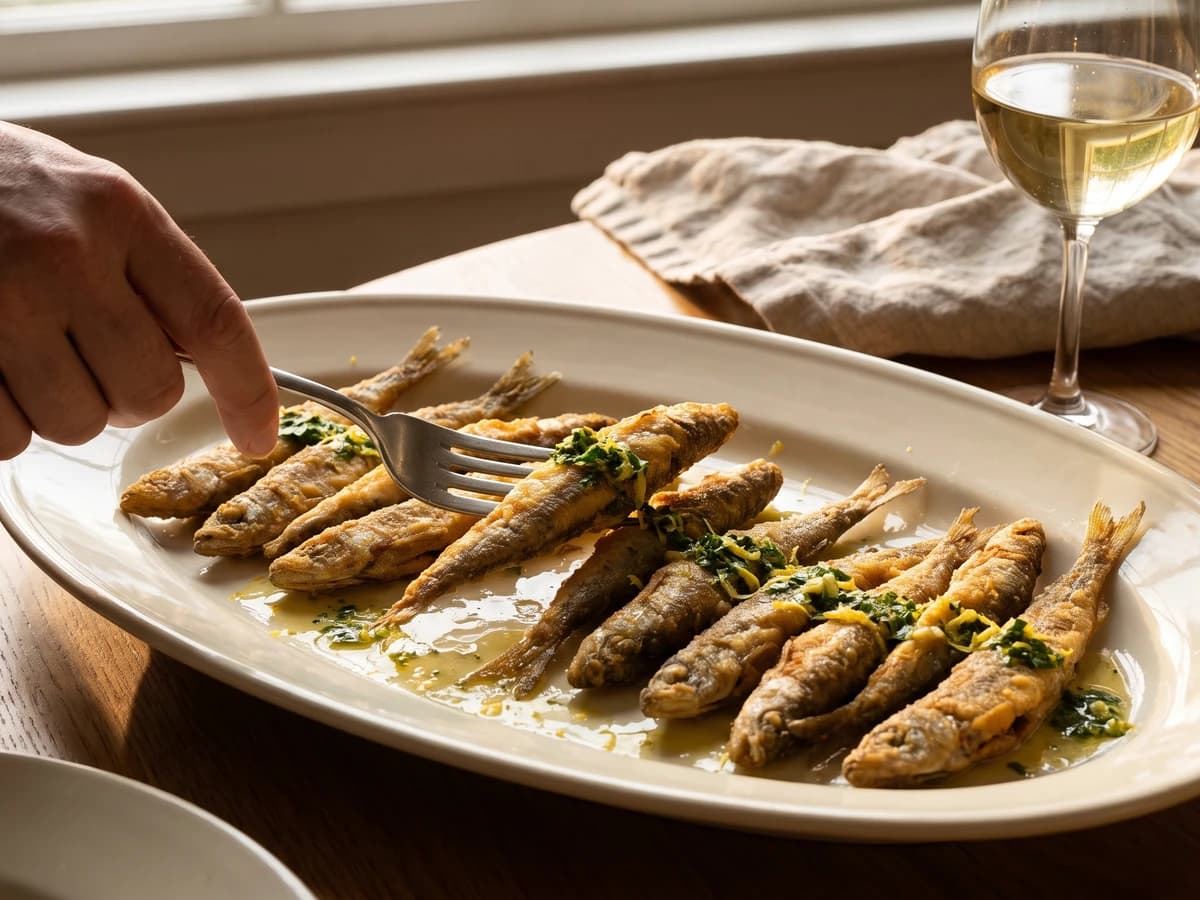
Éperlans à l’Anglaise turns small fish into a lesson in disciplined coating: boned smelts under a close, crisp crumb, pan-fried in clarified butter and finished with bright, half-melted maître d’hôtel butter.

Chef Juliette
Tiny smelts, shallot, mushrooms, white wine, gratin sauce, and fine bread raspings meet a fierce oven, where the fish must turn tender in the same breath the buttered crust bronzes.