Chef Juliette
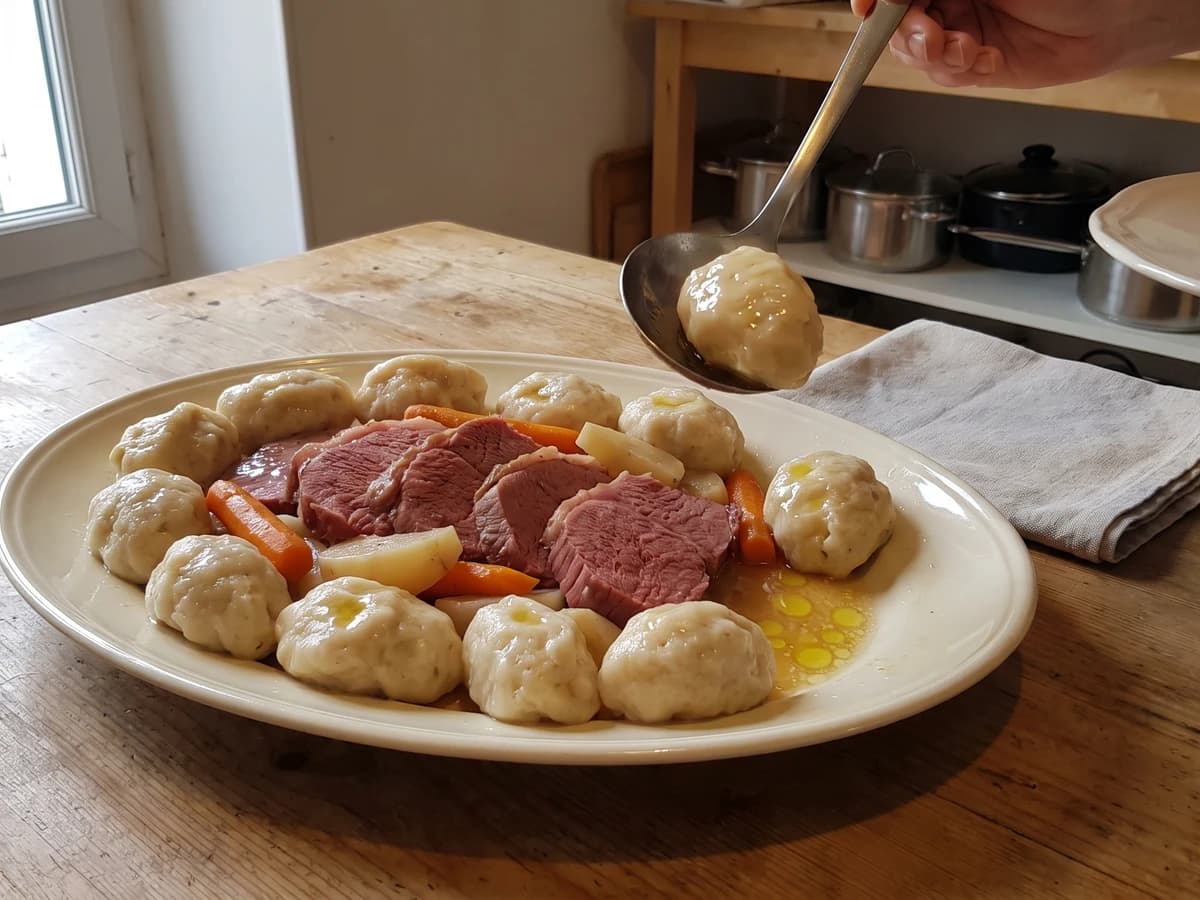
Suet Dumpling
Boulettes au suif, poached beside salt beef, turn equal weights of flour and finely chopped suet into tender, rich dumplings. Keep the beef liquor at a bare tremble and the old garnish works beautifully at home.
A cooking platform built around craft, culture, and the stories behind what we eat.

Created by Chef Juliette
Based on No. 195, Fine Chicken Forcemeat or “Mousseline”, from Le Guide Culinaire (1907) by Auguste Escoffier
Farce mousseline turns chicken, egg white, and cold cream into one satin-smooth emulsion, delicate enough for soup quenelles and strong enough to bind a generous stuffing.
Farce mousseline de volaille (fine chicken forcemeat) teaches one hard, useful principle: temperature is an ingredient. Chicken, egg white, and cream form a fine emulsion only while they stay cold. Let them warm and the cream escapes, the paste turns grainy, and its remarkable delicacy is lost.
The original formula assumed a commis at the mortar, a fine sieve, and a broad vegetable-pan kept over ice. For one cook, one stove, one evening, the mortar becomes a chilled food processor and the vegetable-pan becomes a metal bowl nested in ice. The formula is cut exactly in half, enough for a dinner-party stuffing or twelve small Mousselines, while its proportions and sequence remain untouched. The pounding and oversized pan were brigade scaffolding. The sieve and the ice are the dish.
There is no panade here, no bread or flour to conceal careless work. Albumen from the chicken and egg white holds an astonishing measure of thick cream, producing a pale, satin-smooth farce suited to poultry, shellfish, soup quenelles, or individual poached portions. Before anything else, chill the chicken, cream, blade, and bowl. The cold is the step that decides everything after it.
Farce mousseline belongs to the classical Parisian grand kitchen rather than any single provincial table, where one smooth forcemeat could become a poultry stuffing, a soup garnish, or a shellfish preparation without changing its grammar. Unlike coarser farces held with panade, it relies on the albumen of meat and egg white to absorb cream, which accounts for both its delicacy and its insistence on cold handling. In the book's vocabulary, Mousselines are this same preparation molded in small individual portions, a service form that carried the technique from grand kitchens to bourgeois tables.
Quantity
8 ounces (225 g; about 1½ cups cubed)
tendons, fat, and connective tissue removed; cut into 1-inch cubes
Quantity
2⅓ teaspoons (½ ounce / 14 g)
Quantity
⅛ teaspoon (0.25 g)
Quantity
1 small pinch (1/16 teaspoon / 0.1 g)
Quantity
1
Quantity
1 cup (8 fluid ounces / 240 ml / 240 g)
Quantity
4 cups (20 ounces / 560 g)
| Ingredient | Quantity |
|---|---|
| boneless, skinless chicken breasttendons, fat, and connective tissue removed; cut into 1-inch cubes | 8 ounces (225 g; about 1½ cups cubed) |
| fine sea salt | 2⅓ teaspoons (½ ounce / 14 g) |
| finely ground white pepper | ⅛ teaspoon (0.25 g) |
| freshly grated nutmeg | 1 small pinch (1/16 teaspoon / 0.1 g) |
| large egg white | 1 |
| cold heavy cream, at least 36% fat | 1 cup (8 fluid ounces / 240 ml / 240 g) |
| ice for the ice bath | 4 cups (20 ounces / 560 g) |
Put the food processor bowl, metal blade, fine sieve, and smaller mixing bowl in the cold for 20 minutes. Keep the chicken and cream refrigerated. Fill the larger bowl with the ice and nest the smaller bowl securely inside it. Every surface touching the farce must feel sharply cold before you begin.
Inspect the chicken closely and cut away every tendon, membrane, fatty edge, and bruised patch. Put the cold cubes in the processor with the salt, white pepper, and nutmeg. Process in short pulses, scraping down the bowl often, until the chicken becomes a dense, sticky paste with no visible pieces. If the bowl begins to feel warm or the paste develops a greasy shine, stop and chill everything for 10 minutes before continuing.
Beat the egg white just enough to loosen it, without making it foamy. Add it to the chicken paste in three small additions, processing briefly after each until it disappears completely. Scrape the bowl between additions. The finished paste should be pale, cohesive, and elastic enough to cling heavily to the scraper.
Set the chilled sieve over the bowl nested in ice. Press the chicken paste through with a firm flexible scraper, working a few spoonfuls at a time, and discard the stringy residue that refuses to pass. This is laborious, but it is not ceremonial fuss: the sieve removes the last fibers and gives the mousseline its fine, even texture.
Work the sieved paste with a wooden spoon for 1 to 2 minutes while it remains over ice. Add the cold cream in six small additions, stirring each one fully into the paste before adding the next. Turn the bowl as you work and scrape its sides clean. The mousseline will soften into a satin-smooth cream that holds a rounded furrow from the spoon. If cream beads appear at the edge or the paste suddenly turns slack, stop. Ça se rattrape: spread it against the cold bowl, leave it over ice for 10 minutes, then stir gently from the center until cohesive and continue by teaspoons. Pouring faster only warms and breaks it.
Bring a small saucepan of water to 175 to 180°F (79 to 82°C), where the surface barely trembles. Drop in a rounded teaspoon of mousseline and poach gently for 3 to 4 minutes, until its center reaches 165°F (74°C). Cut it open. The interior should be moist, fine-grained, and free of liquid pockets. Taste for white pepper and nutmeg, adjusting the raw mixture if needed. If the test leaks cream, return the bowl to the ice and restore the emulsion before shaping anything else.
For individual Mousselines, shape 12 small ovals between two wet tablespoons and poach them at 175 to 180°F (79 to 82°C), turning once, for 6 to 8 minutes or until each center reaches 165°F (74°C). Never boil them; hard bubbling makes them coarse and ragged. Alternatively, spoon the raw mousseline into prepared poultry, vegetables, or shellfish and cook the filled preparation immediately until the center of the farce reaches 165°F (74°C). Serve the poached Mousselines warm, or carry the stuffing directly into its finished dish. À table!
1 serving (about 125g)
Culinary guides, cultural storytelling, and the editorial depth that makes cooking meaningful.
Discover Culinary ExplorerChef Juliette
Boulettes au suif, poached beside salt beef, turn equal weights of flour and finely chopped suet into tender, rich dumplings. Keep the beef liquor at a bare tremble and the old garnish works beautifully at home.

Chef Juliette
Bread, flour, frangipane, and rice become four cool, supple panades for binding forcemeats, each changing body and flavor while preserving tenderness. The finest Mousselines need none, and knowing that distinction is the lesson.

Chef Juliette
Panade au pain is bread, milk, salt, heat, and attention: stir until the paste releases cleanly, butter it against a skin, and you have the quiet binder behind tender French farces.

Chef Juliette
Panade de farine teaches the drying stroke behind pâte à choux: flour meets boiling buttered water, then stays over the fire until the paste gathers, smooths, and quits the pan cleanly.