Chef Juliette
Suet Dumpling
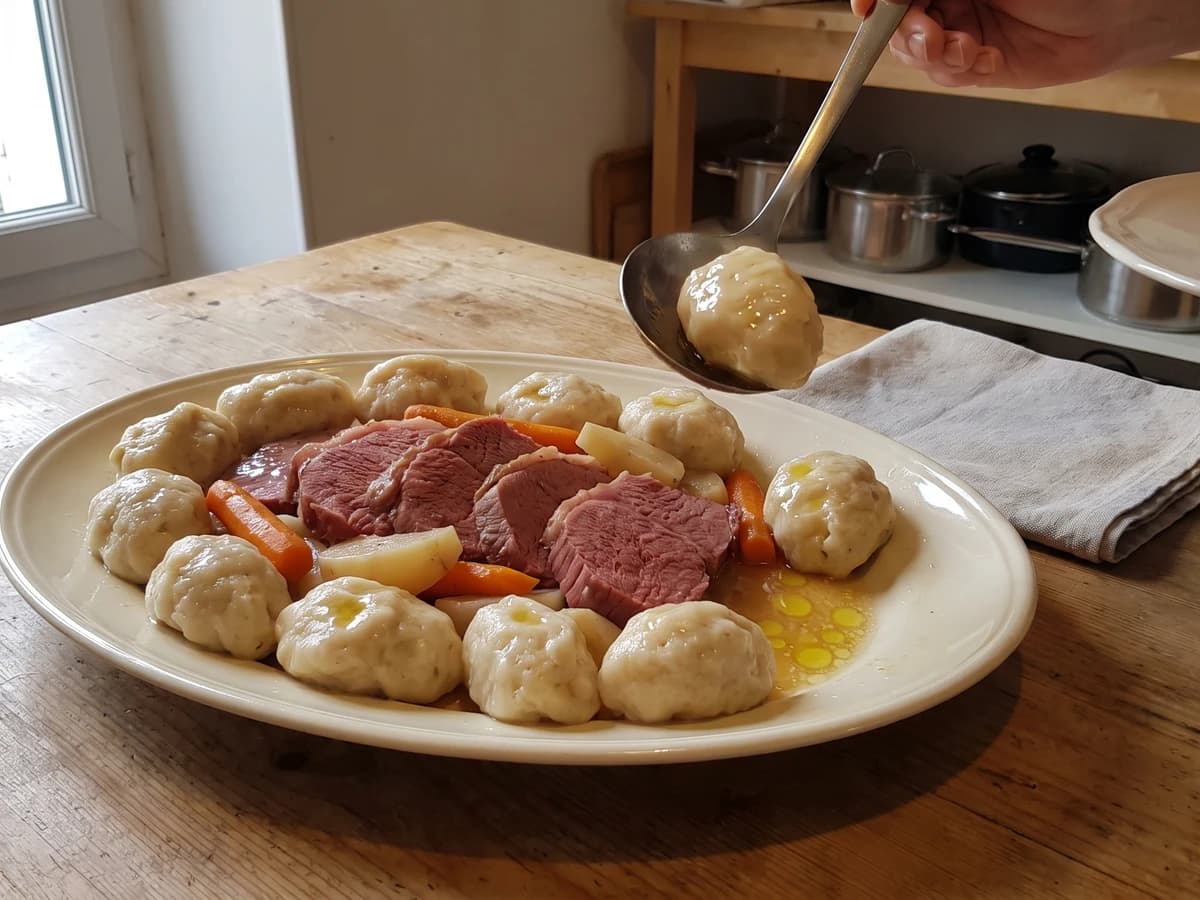
Boulettes au suif, poached beside salt beef, turn equal weights of flour and finely chopped suet into tender, rich dumplings. Keep the beef liquor at a bare tremble and the old garnish works beautifully at home.
A cooking platform built around craft, culture, and the stories behind what we eat.

Created by Chef Juliette
Based on No. 191, B. Flour Panada, from Le Guide Culinaire (1907) by Auguste Escoffier
Panade de farine teaches the drying stroke behind pâte à choux: flour meets boiling buttered water, then stays over the fire until the paste gathers, smooths, and quits the pan cleanly.
Panade de farine (flour panada) teaches one true thing: adding the flour makes a paste, but drying that paste makes the panade. The flour must meet fully boiling buttered water in one decisive addition, then be worked over the fire until the mass turns smooth, firm, and willing to leave the saucepan behind.
The original formula assumed a practiced brigade hand stirring over a brisk stove and a preparation waiting to receive the panade. It needed neither a saucier nor a stockpot, only speed and judgment. A heavy small saucepan and a sturdy spoon are the honest home equivalents. The source batch is already compact enough for one cook, so its ratio and sequence remain intact; only the measures, modest salt quantity, and useful heat cues have been made explicit. One cook, one stove, one evening.
The vague brisk fire is brigade scaffolding and can go. What must stay is the boiling liquid, the all-at-once flour, and the patient dessécher, drying over heat, until the paste quits the pan without browning. Watch the saucepan rather than the clock: that clean release is the step that decides the preparation.
Panade de farine belongs to the French classical garde-manger rather than to one regional table, where cooked starch pastes gave moisture and structure to forcemeats, quenelles, and stuffings. Its method also forms the opening grammar of pâte à choux, though panade stops after the flour paste is dried and choux continues with eggs. The source's comparison to bread panada names the required firm, smooth consistency; bread panada is not an ingredient in this preparation.
Quantity
1 cup plus 3 tablespoons plus 1 teaspoon (285 ml / 285 g)
Quantity
¼ teaspoon (1.25 ml / 1.5 g)
Quantity
4 tablespoons (60 ml / 57 g)
Quantity
1 cup plus 2 tablespoons (265 ml / 142 g)
sifted
Quantity
1 teaspoon (5 ml / 5 g)
softened, for coating the surface
| Ingredient | Quantity |
|---|---|
| water | 1 cup plus 3 tablespoons plus 1 teaspoon (285 ml / 285 g) |
| fine salt | ¼ teaspoon (1.25 ml / 1.5 g) |
| unsalted butter | 4 tablespoons (60 ml / 57 g) |
| all-purpose floursifted | 1 cup plus 2 tablespoons (265 ml / 142 g) |
| unsalted buttersoftened, for coating the surface | 1 teaspoon (5 ml / 5 g) |
Sift the flour onto a sheet of parchment or into a bowl with a pouring lip. Measure everything before the saucepan goes over the heat, because the flour must enter the liquid in one quick addition. Lightly butter a shallow plate or small tray with a little of the softened coating butter and keep the remainder nearby.
Put the water, salt, and 4 tablespoons of butter into a 1½-quart heavy-bottomed saucepan. Bring them to a full boil over medium-high heat, swirling once or twice so the butter melts completely. As soon as bubbles cover the surface, proceed; prolonged boiling throws away water and changes the source ratio.
Tip in all the sifted flour at once while stirring hard with a sturdy wooden spoon. The mixture will look rough, then seize into a thick mass. Keep beating and pressing it against the sides until no dry flour remains. If small flour pockets appear, don't dilute the mixture. Ça se rattrape: crush each pocket firmly against the hot side of the saucepan while the paste is still soft, then beat it back into the mass.
Continue over medium to medium-high heat, turning, smearing, and gathering the paste for 3 to 5 minutes. This is dessécher, drying the paste over heat. It is ready when it forms one smooth ball, quits the sides cleanly, and leaves a thin dry film across the bottom of the saucepan. It should smell gently of cooked flour and butter but take no colour. If the bottom begins to catch, lift the clean paste into a fresh saucepan without scraping up the browned film, lower the heat, and finish the drying there.
Scrape the panade immediately onto the prepared plate or tray and spread it about 1 inch thick so it cools evenly. Rub the remaining softened butter in a thin, complete film over the exposed surface. This is not extra richness for its own sake; it is the original cooling precaution that prevents a leathery skin. If a skin forms at an uncovered edge, peel that tough piece away rather than beating it into the smooth paste beneath.
Let the panade cool until it is no warmer than room temperature, about 20 to 30 minutes. It should be firm, supple, and entirely smooth. Use it as the preparation calling for it directs, or cover it closely once cool and refrigerate promptly. Do not add eggs here: eggs turn this foundation toward pâte à choux, which is a separate finished preparation.
1 serving (about 450g)
Culinary guides, cultural storytelling, and the editorial depth that makes cooking meaningful.
Discover Culinary ExplorerChef Juliette
Boulettes au suif, poached beside salt beef, turn equal weights of flour and finely chopped suet into tender, rich dumplings. Keep the beef liquor at a bare tremble and the old garnish works beautifully at home.

Chef Juliette
Bread, flour, frangipane, and rice become four cool, supple panades for binding forcemeats, each changing body and flavor while preserving tenderness. The finest Mousselines need none, and knowing that distinction is the lesson.

Chef Juliette
Panade au pain is bread, milk, salt, heat, and attention: stir until the paste releases cleanly, butter it against a skin, and you have the quiet binder behind tender French farces.

Chef Juliette
Panade frangipane turns flour, yolks, butter, and milk into a silken classical binder. Strain before heat, whisk through five gentle minutes, then cover the surface closely as it cools.