
Chef Juliette
John Dory (St. Pierre)
John Dory has the delicacy of sole and the firmness of turbot. A light flouring, a quick butter sauté, and nut-brown beurre noisette show exactly why looks never mattered.
A cooking platform built around craft, culture, and the stories behind what we eat.

Created by Chef Juliette
Based on No. 925, Turbotins (Chicken-Turbots), from Le Guide Culinaire (1907) by Auguste Escoffier
Whole turbotin, neatly gashed at the backbone, bakes straight and tender beneath its prepared gratin crown: a precise lesson in fish cookery, translated from brigade service to one gratin dish.
Turbotins au gratin (small whole turbot baked beneath a gratin finish) teach the discipline of preparing a flatfish whole: cut the backbone before heat touches it. That single gash releases tension at the thickest part, so the fish stays flat, cooks evenly, and arrives with tender white flesh rather than a buckled center.
The classical kitchen assumed a poissonnier to trim the fish, a saucier to keep the Gratins (No. 268) ready, and a salamander for swift, controlled color. At home we choose one of the entry's many paths, scale it to one fish for four, prepare the linked component ahead, and use the upper oven with a brief broiler finish. Those extra brigade hands are scaffolding. The prepared gratin and the spine cut are the dish, and they stay. One cook, one stove, one evening.
Keep your attention on the fish's center. The crown may color before the flesh is ready; shield it, finish the fish gently, then return the surface to high heat. Ça se rattrape. Before you touch the pan, make the backbone cut cleanly and free the flesh just beside it.
Turbotin is the French market name for a small turbot from the Atlantic and Channel coasts, prized for white flesh delicate enough to serve whole. From the ports of Normandy and Brittany it passed into Parisian fish kitchens, where cooks boiled, grilled, fried, braised, prepared it meunière, or covered it with a gratin according to its size. Chicken-turbot does not mean poultry; the name marks youth and size, while the classical spine cut lets the flatfish reach the table without buckling.
Quantity
1 fish, 2½ to 3 pounds (1.1 to 1.4 kg)
gutted, gilled, and fins trimmed
Quantity
1 teaspoon (5 ml / 6 g)
Quantity
1 tablespoon (15 ml / 14 g)
softened, for the dish
Quantity
1 prepared batch Gratins (No. 268), scaled for 4 servings and 1 whole fish
| Ingredient | Quantity |
|---|---|
| whole small turbot (turbotin)gutted, gilled, and fins trimmed | 1 fish, 2½ to 3 pounds (1.1 to 1.4 kg) |
| fine sea salt | 1 teaspoon (5 ml / 6 g) |
| unsalted buttersoftened, for the dish | 1 tablespoon (15 ml / 14 g) |
| Gratins, prepared according to its own entry | 1 prepared batch Gratins (No. 268), scaled for 4 servings and 1 whole fish |
Heat the oven to 425°F (220°C) with a rack in the upper third, leaving enough space that the gratin will not sit directly beneath the heating element. Butter a shallow gratin or roasting dish large enough to hold the fish flat. Bring the prepared Gratins (No. 268) to the stage its own entry specifies for receiving the fish; keep that preparation whole, because its method belongs to its formula.
Lay the turbot dark side up on a nonslip board. At the thickest point in the middle of the back, make a 2-inch (5 cm) incision along the center line until the backbone is exposed. Snip through the backbone once with heavy fish shears, then run the knife tip for about 1 inch (2.5 cm) along each side of the exposed spine, releasing the flesh slightly from the bone. Do not divide the fish. This cut prevents deformation and helps heat reach the thick center, which is the principle the whole preparation rests upon.
Rinse only if the fish needs it, then dry the skin, cavity, and backbone incision thoroughly. Season both sides and the cavity with the salt. Place the turbot dark side up in the buttered dish, spreading it naturally rather than pressing it flat; the severed backbone will let it settle as it cooks.
Use the prepared Gratins (No. 268) exactly as its own entry directs for a whole fish, coating the turbot evenly and carrying the preparation to the edges without hiding the outline of the fins and tail. The linked gratin is a finished component, not a loose handful of improvised crumbs or cheese, so do not thin it or rebuild it here.
Bake for 18 minutes, then begin checking every 3 minutes. The turbot is ready when the flesh beside the backbone incision has turned opaque, separates from the bone with gentle pressure, and registers 145°F (63°C) at the thickest point. If the crown browns before the center is ready, cover it loosely with foil and move the dish down one rack. If the fish is cooked but the surface remains pale, remove the foil and place it beneath a fully heated broiler for 30 to 60 seconds. Ça se rattrape. Watch without looking away, because gratin passes from bronze to burnt quickly.
Rest the turbot in its dish for 5 minutes. To serve, slide a broad fish slice between the upper fillets and the backbone, lifting the flesh away in generous pieces. Remove the exposed backbone, then portion the lower fillets and spoon the gratin and its collected juices over each serving. Bring the dish itself to the table while its butter-gold surface still gleams. À table!
1 serving (about 220g)
Culinary guides, cultural storytelling, and the editorial depth that makes cooking meaningful.
Discover Culinary ExplorerChef Juliette
John Dory has the delicacy of sole and the firmness of turbot. A light flouring, a quick butter sauté, and nut-brown beurre noisette show exactly why looks never mattered.

Chef Juliette
Fresh haddock proves its delicacy in the meunière pan: a fine flour crust, moist pearly flakes, and beurre noisette sharpened with lemon and parsley, ready from one skillet in half an hour.
Chef Juliette
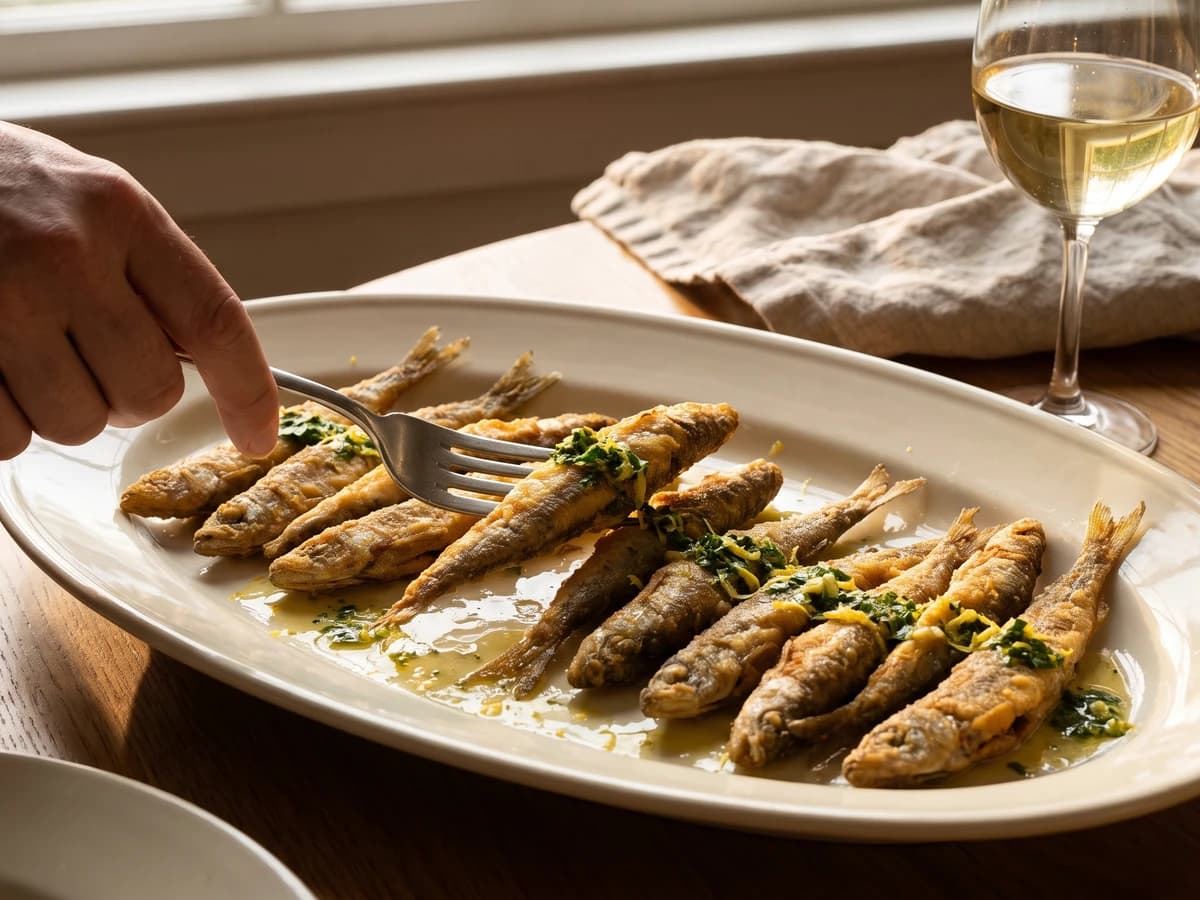
Éperlans à l’Anglaise turns small fish into a lesson in disciplined coating: boned smelts under a close, crisp crumb, pan-fried in clarified butter and finished with bright, half-melted maître d’hôtel butter.

Chef Juliette
Tiny smelts, shallot, mushrooms, white wine, gratin sauce, and fine bread raspings meet a fierce oven, where the fish must turn tender in the same breath the buttered crust bronzes.