
Chef Juliette
John Dory (St. Pierre)
John Dory has the delicacy of sole and the firmness of turbot. A light flouring, a quick butter sauté, and nut-brown beurre noisette show exactly why looks never mattered.
A cooking platform built around craft, culture, and the stories behind what we eat.

Created by Chef Juliette
Based on No. 797, Mousseline de Saumon, from Le Guide Culinaire (1907) by Auguste Escoffier
Four feather-light salmon mousselines, shaped with ordinary tablespoons, capped with fine raw slices, and poached at a bare tremble: the lesson that cold forcemeat and gentle heat make tenderness possible.
Mousseline de Saumon (feather-light salmon dumplings) teaches the discipline behind every delicate forcemeat: cold gives structure, and gentle heat preserves it. Before you touch a pan, know the one true thing. The salmon mixture, the bowl, and even the working spoons must stay cold enough that the cream remains bound. Lose that chill and the mousselines spread; keep it, and they swell into tender, silken ovals.
The book assumed a mortar and pestle, a fine sieve, a bowl held on ice, and enough hands to pound, strain, mould, and poach without pause. Your home equivalent is the finished salmon version of Fine Chicken Forcemeat or “Mousseline” (No. 195), made in its own preparation, a chilled pan, two ordinary tablespoons, and the spoon-moulding and poaching method from Forcemeat Balls or Quenelles (No. 205). The string rig, piping bag, and rolled methods are brigade scaffolding here; the tablespoon shape, raw salmon cap, and barely trembling poach are the dish and must stay. One cook, one stove, one evening.
Each portion is one large mousseline, not a scatter of garnish quenelles. Shape decisively, lay the fine salmon slice over the crown, then keep the water below a simmer. If the mixture softens while you work, stop and chill it. Ça se rattrape. The cold bind is the step that matters most.
Mousseline de saumon belongs to the national French classical kitchen, especially the grand dining rooms of Paris, rather than to one regional household table. Its family tree runs through the quenelle, strongly associated with Lyon, but the mousseline form is lighter with cream, moulded as an individual portion, and finished with a fine slice of the same fish. Not every salmon quenelle is a mousseline; in the canon, the name belongs to the exceptionally light forcemeat and its large spoon-moulded service.
Quantity
2½ cups (600 ml / 600 g) Fine Chicken Forcemeat or “Mousseline” (No. 195)
prepared with salmon and kept thoroughly cold
Quantity
1 prepared method of Forcemeat Balls or Quenelles (No. 205)
use the tablespoon-moulding and poaching method
Quantity
4 fine slices (about 3½ oz / 100 g)
skinless and pin-boned
Quantity
1 tablespoon (15 ml / 14 g)
melted
Quantity
6 to 7 cups (1.4 to 1.7 litres / 1.4 to 1.7 kg)
Quantity
1 tablespoon (15 ml / 18 g)
| Ingredient | Quantity |
|---|---|
| Fine Chicken Forcemeat or “Mousseline”prepared with salmon and kept thoroughly cold | 2½ cups (600 ml / 600 g) Fine Chicken Forcemeat or “Mousseline” (No. 195) |
| Forcemeat Balls or Quenelles methoduse the tablespoon-moulding and poaching method | 1 prepared method of Forcemeat Balls or Quenelles (No. 205) |
| raw salmonskinless and pin-boned | 4 fine slices (about 3½ oz / 100 g) |
| unsalted buttermelted | 1 tablespoon (15 ml / 14 g) |
| water | 6 to 7 cups (1.4 to 1.7 litres / 1.4 to 1.7 kg) |
| fine sea salt | 1 tablespoon (15 ml / 18 g) |
Set the Fine Chicken Forcemeat or “Mousseline” (No. 195), prepared with salmon, over a bowl of ice while you organize the pan. It should be cold, thick, and softly mounded, not flowing. Chill the shallow pan for 10 minutes as well. If the forcemeat has warmed enough to look glossy or loose, return it to the cold before shaping; forcing ahead only breaks the cream-bound structure.
Brush the cold pan generously with the melted butter, including the sides, then chill it until the butter sets. Arrange the tablespoon-moulding setup prescribed by Forcemeat Balls or Quenelles (No. 205): the cold forcemeat on one side, the buttered pan in front, and a cup of hot water for rinsing the working spoon. Ordinary tablespoons are correct here. Cooking well is not cooking fancy.
Divide the forcemeat into four equal portions. Following the spoon method, turn each portion between two tablespoons until it forms a plump, smooth oval, then release it into the buttered pan. Dip the working spoon in hot water and shake it nearly dry between portions so the forcemeat releases cleanly without being diluted. If an oval slumps before the next is shaped, stop and chill the whole pan for 10 minutes. Ça se rattrape.
Lay one fine raw salmon slice lengthwise over each mousseline, pressing only enough to make contact. The slice should follow the crown without hanging heavily over the sides. Keep the finished pan cold while the salted water comes to a boil.
Dissolve the salt in the water and bring it to a boil, then pour it slowly down the side of the pan so the mousselines are generously surrounded without dislodging their salmon caps. Apply the poaching method from Forcemeat Balls or Quenelles (No. 205), holding the liquid at a bare tremble for 14 to 18 minutes. The mousselines are ready when they have swollen slightly, feel softly firm, and reach 145°F (63°C) at the centre. Never let the water boil hard. If it does, lift the pan off the heat and add a small measure of cooler water from the stated amount; if an edge begins to split, turn off the heat and leave the pan undisturbed for 3 minutes so the gentler residual heat can set it.
Lift each mousseline with a broad slotted spoon and drain it on a folded clean towel for 30 seconds, taking care not to disturb the salmon cap. Arrange the four portions on a warmed oval platter and serve immediately, while their surfaces remain moist and their centres yield delicately under the fork. À table!
1 serving (about 175g)
Culinary guides, cultural storytelling, and the editorial depth that makes cooking meaningful.
Discover Culinary ExplorerChef Juliette
John Dory has the delicacy of sole and the firmness of turbot. A light flouring, a quick butter sauté, and nut-brown beurre noisette show exactly why looks never mattered.

Chef Juliette
Fresh haddock proves its delicacy in the meunière pan: a fine flour crust, moist pearly flakes, and beurre noisette sharpened with lemon and parsley, ready from one skillet in half an hour.
Chef Juliette
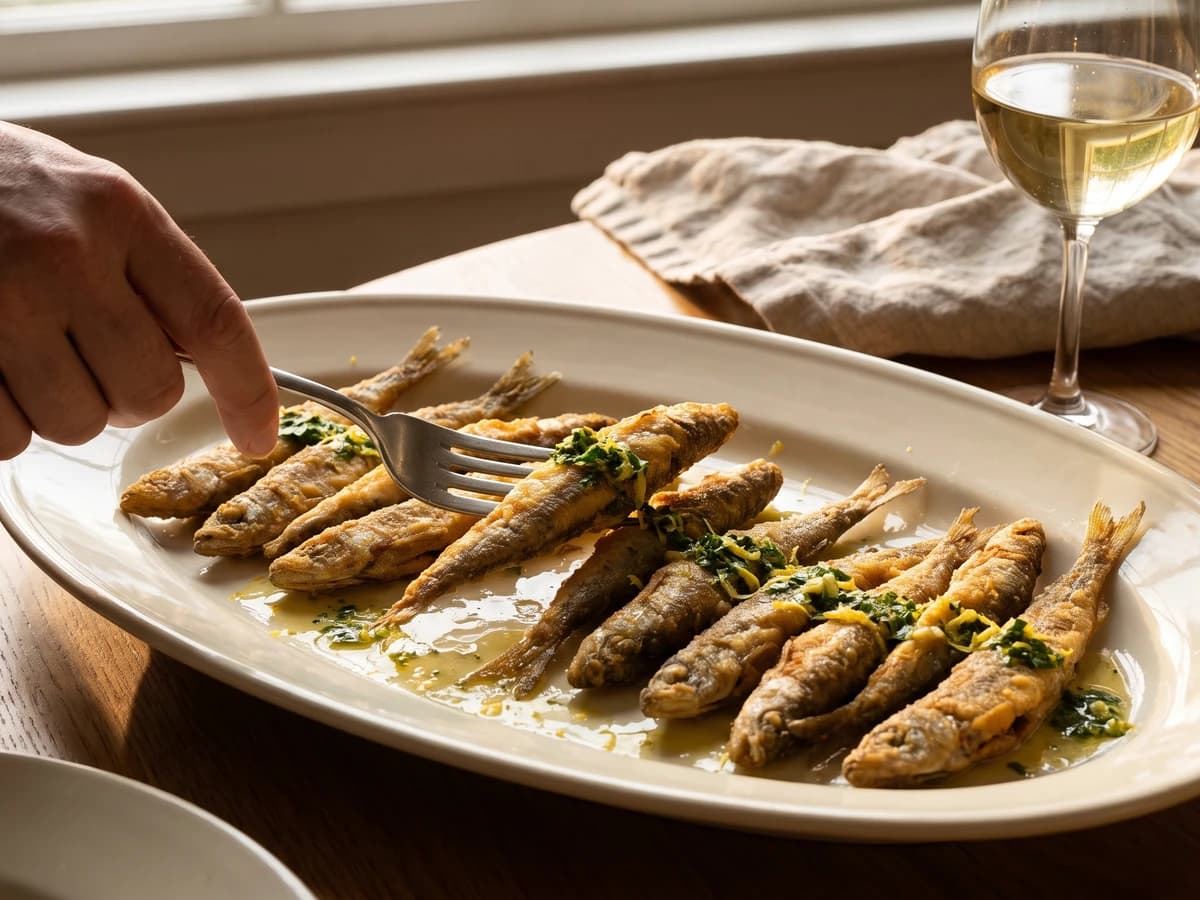
Éperlans à l’Anglaise turns small fish into a lesson in disciplined coating: boned smelts under a close, crisp crumb, pan-fried in clarified butter and finished with bright, half-melted maître d’hôtel butter.

Chef Juliette
Tiny smelts, shallot, mushrooms, white wine, gratin sauce, and fine bread raspings meet a fierce oven, where the fish must turn tender in the same breath the buttered crust bronzes.