
Chef Juliette
John Dory (St. Pierre)
John Dory has the delicacy of sole and the firmness of turbot. A light flouring, a quick butter sauté, and nut-brown beurre noisette show exactly why looks never mattered.
A cooking platform built around craft, culture, and the stories behind what we eat.

Created by Chef Juliette
Based on No. 765, Fresh-water Herrings, from Le Guide Culinaire (1907) by Auguste Escoffier
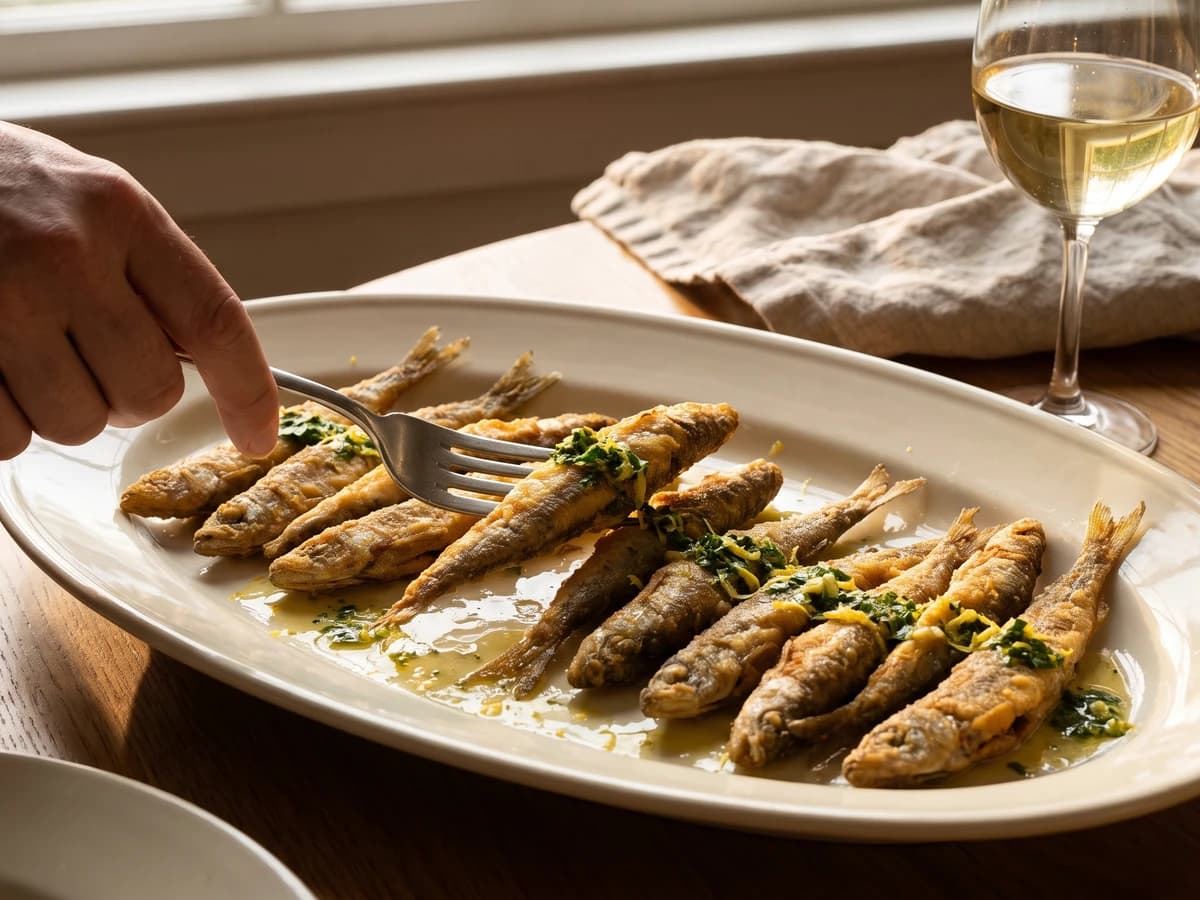
The scarce lake fish of Savoy meets meunière: flour at the last moment, cook in butter to a crisp, butter-gold crust, then finish with lemon, parsley, and beurre noisette while the flesh stays delicate.
Harengs d’Eau Douce à la Meunière (fresh-water herrings, lightly floured and cooked in butter) teaches the cleanest grammar in the fish canon: the fish must be dry, the flour must go on at the last moment, and the butter must brown without burning. Meunière is not a sauce poured over careless fish. The word carries the technique from the first dusting of flour to the final spoonful of beurre noisette.
The source entry gives no quantities because it assumes a fish cook who already knows that grammar, clarified butter waiting beside the stove, and a warm platter at the pass. There is no stockpot, saucier, or salamander hiding behind this dish. For one cook, one stove, one evening, four small fish go through one wide skillet in two batches, while a low oven keeps the first pair ready. Brigade holding is scaffolding and can go; last-minute flouring, properly heated butter, and an immediate finish are the dish itself and must stay.
Done well, each fish arrives butter-gold at the edges, moist along the backbone, and glossed with lemon, parsley, and nutty butter. Dry the fish until paper comes away clean, then flour it only as the skillet becomes ready; that is the step that decides the dish.
Harengs d’eau douce belonged to the markets around the Swiss and Savoyard Alpine lakes, where the name covered small coregonid lake fish, close kin to the féra, rather than the oily sea herring of the Atlantic. Their scarcity away from the lake fisheries carried them into the grand-kitchen repertoire as prized local catch, treated à la meunière because flour and butter protected the delicate flesh without concealing it. Cisco or vendace therefore keeps closer faith with the dish than ordinary sea herring when the original lake fish cannot be found.
Quantity
4 whole fish, about 8 oz (225 g) each
scaled, gutted, gills removed, and fins trimmed
Quantity
3/4 cup (180 ml / 90 g)
for dredging
Quantity
1 1/2 teaspoons (7.5 ml / 9 g)
Quantity
1/2 teaspoon (2.5 ml / 1 g)
Quantity
12 tablespoons (180 ml / 170 g)
8 tablespoons for clarifying and 4 tablespoons for finishing
Quantity
2 tablespoons (30 ml / 28 g)
kept cold as a rescue reserve
Quantity
2
1 juiced to yield about 3 tablespoons (45 ml / 45 g), 1 cut into wedges
Quantity
1/4 cup (60 ml / 15 g)
finely chopped
| Ingredient | Quantity |
|---|---|
| whole fresh-water herringsscaled, gutted, gills removed, and fins trimmed | 4 whole fish, about 8 oz (225 g) each |
| plain flourfor dredging | 3/4 cup (180 ml / 90 g) |
| fine sea salt | 1 1/2 teaspoons (7.5 ml / 9 g) |
| freshly ground white or black pepper | 1/2 teaspoon (2.5 ml / 1 g) |
| unsalted butter8 tablespoons for clarifying and 4 tablespoons for finishing | 12 tablespoons (180 ml / 170 g) |
| unsalted butter (optional)kept cold as a rescue reserve | 2 tablespoons (30 ml / 28 g) |
| medium lemons1 juiced to yield about 3 tablespoons (45 ml / 45 g), 1 cut into wedges | 2 |
| flat-leaf parsleyfinely chopped | 1/4 cup (60 ml / 15 g) |
Check each fish for stubborn scales, wipe the cavities clean, and dry the fish inside and out until fresh paper comes away dry. Make two shallow diagonal cuts through the skin on each side, stopping before the bone, then season the cavities and surfaces with the salt and pepper. Set a serving platter in a 200°F (95°C) oven. A wet fish steams beneath its flour and loses the fine crust that defines meunière, so don't hurry this first step.
Melt 8 tablespoons of the butter gently in a small saucepan without stirring. Skim away the white foam, let the milky sediment settle, then pour the clear golden fat through a fine sieve, leaving the sediment behind. This is beurre clarifié, clarified butter, and it gives the flour time to turn gold without scorching the milk solids. Divide it roughly in half for the two frying batches.
Spread the flour in a wide shallow dish. Dredge only the first two fish, pressing flour lightly into the slashes, then shake them firmly so no loose or chalky layer remains. Flour absorbs surface moisture as it waits, so coating all four fish now would replace a delicate crust with paste. The pan should already be coming to temperature when the fish meets the flour.
Heat half the beurre clarifié in a heavy 12-inch (30 cm) skillet over medium-high heat until it flows easily and shows a clear shimmer. Lay in two fish with their better-looking side down and cook without disturbing them for 3 to 4 minutes, until the flour is crisp, deeply golden, and releases from the pan. Turn once with a fish spatula and cook the second side for another 3 to 4 minutes, spooning the butter over the thicker shoulders. If a fish clings, don't pry at it; give the crust another 30 seconds and it will usually release. If the fat darkens or smells bitter before the fish colors, lift the fish out, wipe the skillet, lower the heat, and continue with fresh beurre clarifié. Ça se rattrape.
Transfer the first fish to the warmed platter and keep them uncovered so their crust remains crisp. Flour the remaining two fish only now, add the rest of the beurre clarifié to the skillet, and cook them in the same way. The fish are ready when the flesh beside the backbone is opaque and separates readily, or reaches 145°F (63°C) at its thickest point. Fresh-water fish must be cooked through, but take them off promptly once they reach that point.
Wipe the skillet clean and add the remaining 4 tablespoons of fresh butter. Cook over medium heat, swirling as it foams, until the milk solids turn hazelnut brown and the aroma becomes distinctly nutty. This is beurre noisette, hazelnut-brown butter. Pull the skillet from the heat at once. Sprinkle the fish with the lemon juice and parsley, then spoon the beurre noisette over them from close to the platter. If the butter crosses from brown to black or smells acrid, discard it and begin again with the reserved butter; burnt butter cannot be hidden by lemon, but the dish can still be rescued. Serve immediately with the lemon wedges. À table!
1 serving (about 200g)
Culinary guides, cultural storytelling, and the editorial depth that makes cooking meaningful.
Discover Culinary ExplorerChef Juliette
John Dory has the delicacy of sole and the firmness of turbot. A light flouring, a quick butter sauté, and nut-brown beurre noisette show exactly why looks never mattered.

Chef Juliette
Fresh haddock proves its delicacy in the meunière pan: a fine flour crust, moist pearly flakes, and beurre noisette sharpened with lemon and parsley, ready from one skillet in half an hour.
Chef Juliette
Éperlans à l’Anglaise turns small fish into a lesson in disciplined coating: boned smelts under a close, crisp crumb, pan-fried in clarified butter and finished with bright, half-melted maître d’hôtel butter.

Chef Juliette
Tiny smelts, shallot, mushrooms, white wine, gratin sauce, and fine bread raspings meet a fierce oven, where the fish must turn tender in the same breath the buttered crust bronzes.