
Chef Juliette
John Dory (St. Pierre)
John Dory has the delicacy of sole and the firmness of turbot. A light flouring, a quick butter sauté, and nut-brown beurre noisette show exactly why looks never mattered.
A cooking platform built around craft, culture, and the stories behind what we eat.
Created by Chef Juliette
Based on No. 764, Lampreys, from Le Guide Culinaire (1907) by Auguste Escoffier
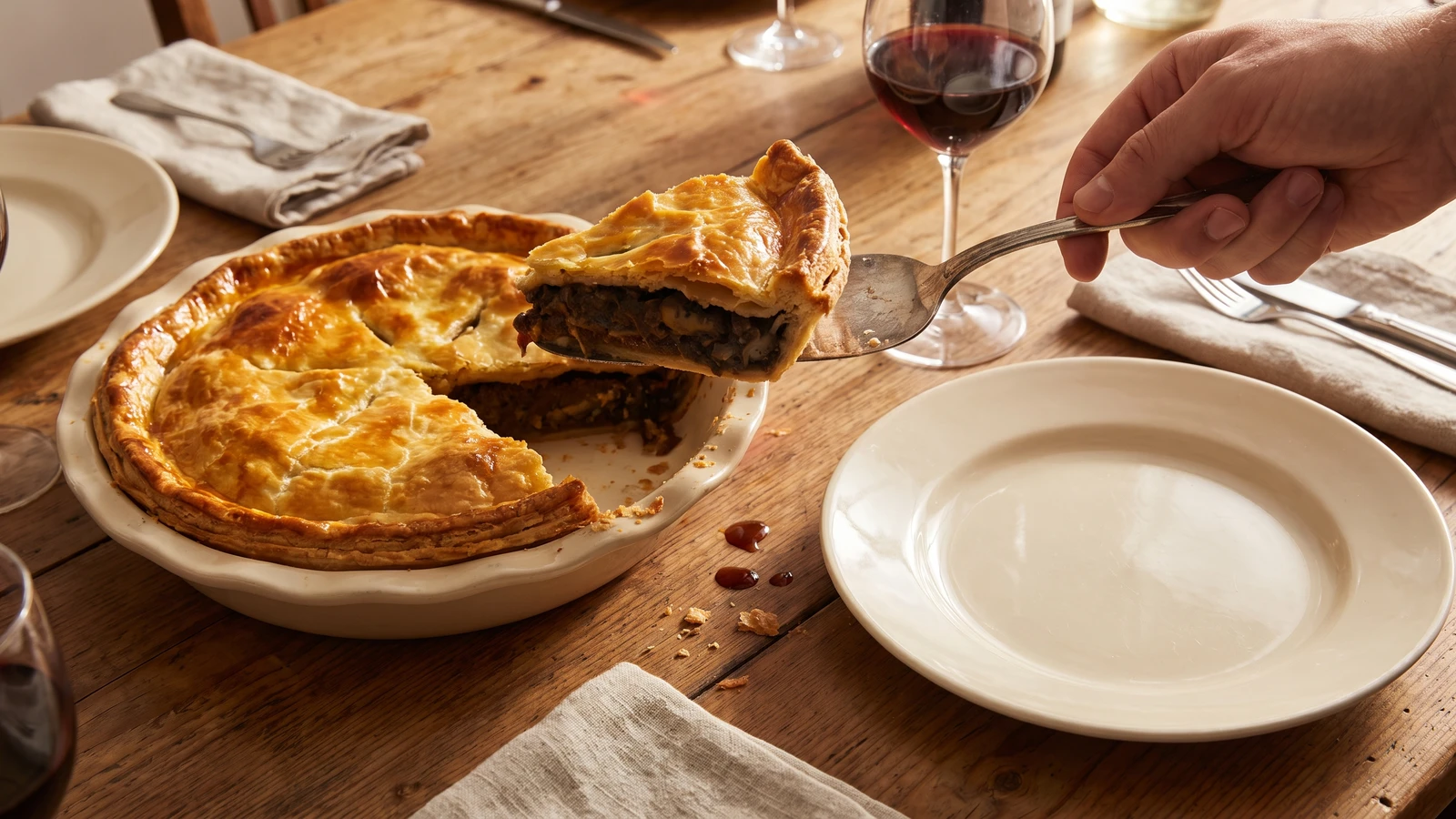
Cold filling, cold pastry, and a hot oven turn the canon’s lamprey cross-reference into a generous tourte, its burnished crust holding the linked eel-pie preparation for one cook and four diners.
Tourte de lamproie (lamprey pie) teaches one hard and useful truth: a pie is only as good as the temperature of its filling. Put warm filling beneath butter-rich pastry and the fat runs before the layers can set. Chill it fully and the crust rises crisp around a generous, savory center. Cold filling is the one thing to settle before touching the rolling pin.
The source gives lamprey no separate sauce or seasoning. It sends the cook directly to Eels (No. 755), assuming that preparation is already understood, a pastry cook is nearby, and the fish arrives properly dressed. At home, the separate pastry station is scaffolding and goes. The finished referenced preparation stays whole, dressed lamprey replaces the eel, and bought all-butter puff pastry stands in honestly for the pastry bench. Nothing Bordelais is imported because the entry does not call for it.
This scales to one 9-inch tourte: one cook, one stove, one evening, provided the linked filling is ready and cold. Keep the filling chilled, handle the pastry briefly, and give the base strong heat from the first minute. If the pastry softens, stop and chill it. Ça se rattrape.
Lamprey has two distinct classical lives: around Bordeaux and the lower Garonne, lamproie à la bordelaise simmers with red wine and leeks, while the source entry sends the fish into a pie modeled on Eels (No. 755), a preparation admired in coffee-shops along the Thames. Lamprey only resembles an eel; it is a jawless fish, and this tourte follows the source’s pastry branch without importing the Bordelais blood-thickened sauce.
Quantity
1 chilled batch Eels (No. 755), using 2 lb (900 g) dressed lamprey
prepared exactly as its own entry directs, with lamprey replacing eel, then cooled completely
Quantity
1 package (1.1 lb / 500 g)
thawed but cold
Quantity
2 tablespoons (30 ml / 16 g)
for rolling
Quantity
1 tablespoon (15 ml / 14 g)
softened
Quantity
1
Quantity
1 tablespoon (15 ml / 15 g)
| Ingredient | Quantity |
|---|---|
| finished referenced pie fillingprepared exactly as its own entry directs, with lamprey replacing eel, then cooled completely | 1 chilled batch Eels (No. 755), using 2 lb (900 g) dressed lamprey |
| all-butter puff pastrythawed but cold | 1 package (1.1 lb / 500 g) |
| plain flourfor rolling | 2 tablespoons (30 ml / 16 g) |
| unsalted buttersoftened | 1 tablespoon (15 ml / 14 g) |
| large egg | 1 |
| cold water | 1 tablespoon (15 ml / 15 g) |
Buy lamprey already killed, skinned, cleaned, and cut by a licensed fishmonger, observing any local restrictions on its sale. Have the finished Eels (No. 755) preparation ready, made exactly as that entry directs but with 2 lb (900 g) dressed lamprey replacing the eel. Spread the filling in a shallow dish and refrigerate it until cold throughout, below 40°F (4°C). Do not attempt to dress a live lamprey at home; careful cleaning and thorough cooking belong to the preparation.
Set a heavy rimmed baking sheet on the lower rack and heat the oven to 425°F (220°C). Butter a 9-inch (23 cm) deep pie dish. The hot sheet gives the bottom crust the fierce first heat once supplied by a dedicated pastry oven.
Divide the cold pastry into two pieces, one slightly larger than the other. On a lightly floured surface, roll the larger piece about 1/8 inch (3 mm) thick and wide enough to line the dish with a 1-inch (2.5 cm) overhang. Ease it into the corners without stretching, because stretched pastry shrinks back in the oven. Refrigerate the lined dish while you roll the lid.
Spoon the completely chilled Eels (No. 755) preparation into the pastry shell, distributing the lamprey evenly and leaving about 3/4 inch (2 cm) below the rim. Warm filling melts the pastry’s butter before the layers set. If yours has lost its chill, stop and refrigerate both shell and filling for twenty minutes. Ça se rattrape.
Beat the egg with the cold water. Brush the pastry rim lightly, lay the rolled lid over the filling, and press the two layers together. Trim the excess, fold the edge inward, and crimp firmly. Cut three small vents in the center and brush the top with egg wash. If the pastry tears, patch it with a thin scrap and a touch of egg wash; do not gather and reroll the whole lid. Chill the sealed tourte for ten minutes if the pastry feels soft.
Set the tourte on the hot baking sheet and bake for 15 minutes. Lower the oven to 375°F (190°C) and continue for 30 to 35 minutes, until the crust is deeply golden, the filling bubbles at the vents, and the center reaches 165°F (74°C). If the rim darkens before the center is hot, shield only the rim with foil and keep baking; a pale bottom needs another five minutes on the lowest rack.
Rest the tourte for 15 minutes before cutting. This lets the filling settle while the pastry keeps its crisp layers. If a little sauce escapes from the first slice, spoon it back over the filling and carry on with confidence. Never apologize at your own table. À table!
1 serving (about 425g)
Culinary guides, cultural storytelling, and the editorial depth that makes cooking meaningful.
Discover Culinary ExplorerChef Juliette
John Dory has the delicacy of sole and the firmness of turbot. A light flouring, a quick butter sauté, and nut-brown beurre noisette show exactly why looks never mattered.

Chef Juliette
Fresh haddock proves its delicacy in the meunière pan: a fine flour crust, moist pearly flakes, and beurre noisette sharpened with lemon and parsley, ready from one skillet in half an hour.

Chef Juliette
Éperlans à l’Anglaise turns small fish into a lesson in disciplined coating: boned smelts under a close, crisp crumb, pan-fried in clarified butter and finished with bright, half-melted maître d’hôtel butter.

Chef Juliette
Tiny smelts, shallot, mushrooms, white wine, gratin sauce, and fine bread raspings meet a fierce oven, where the fish must turn tender in the same breath the buttered crust bronzes.