
Chef Juliette
Bouillabaisse à la Marseillaise
Marseille's great fish stew, saffron-gold and garlic-scented, proves that a hard boil can be the careful choice: it binds olive oil into broth before the whole pot meets bread.
A cooking platform built around craft, culture, and the stories behind what we eat.

Created by Chef Juliette
Based on No. 733, Potage Petit Duc, from Le Guide Culinaire (1907) by Auguste Escoffier
Woodcock gives itself twice to this potage, first as a deep game velouté, then as tender royale and butter-seared fillet, finished with foie gras, cream, and burnt brandy.
Potage Petit Duc (woodcock velouté with foie gras, royale, and seared fillet) teaches concentration without violence. The roasted bird gives its substance to an essence-rich velouté during a covered bain-marie (hot-water bath), then butter, foie gras, cream, and burnt brandy round the extraction into satin. Know one thing before touching a pan: once those enrichments enter, the soup must never boil.
The original recipe assumed a saucier on hand, game velouté drawn from a stockpot never off the fire, a heavy mortar, a tammy, and rows of dariole-moulds. At home, two birds make one dinner-party tureen of about two quarts; poultry shears and a mallet open the carcasses, two careful strainings replace the tammy, and small heatproof cups stand in for the moulds. The dedicated pounding station was brigade scaffolding and can go. The thirty-five-minute extraction, fine straining, foie gras finish, royale, and last-minute fillet are the dish, so they stay.
The finished Potage Petit Duc should be tawny ivory, lightly coating the spoon, with butter gloss across the surface and little cubes of royale beneath thin slices of woodcock. Warm it patiently and finish it only when the bowls are ready. Guard that final heat; this is the step that decides the potage.
Potage Petit Duc belongs to the Parisian classical potage repertoire and the game-season table, where woodcock was carried through roasted bird, essence, velouté, and garnish so that a small bird could perfume an entire course. It is not a rustic regional soup; it is the grand-kitchen refinement of older game purées, strained fine and enriched only at service. The royale and last-minute fillet preserve the bird’s identity after the carcass has given its depth to the soup.
Quantity
2 birds (about 10 to 12 oz / 280 to 340 g each)
from a lawful, traceable source, livers and hearts retained if sound
Quantity
1/2 cup (120 ml / 113 g)
divided into 1 tablespoon for roasting, 1 tablespoon for searing, and 6 tablespoons for finishing
Quantity
4 small dariole-moulds (about 1 cup / 240 ml / 240 g total) of Game Royale (No. 209)
prepared with the 2 cooked woodcock fillets removed after roasting
Quantity
7 1/4 cups (1.7 L / 1.7 kg)
heated just below a simmer
Quantity
6 tablespoons (90 ml / 85 g)
Quantity
3 tablespoons (45 ml / 45 g)
Quantity
3 tablespoons (45 ml / 42 g)
burnt before finishing the soup
Quantity
1/2 teaspoon (2.5 ml / 3 g)
| Ingredient | Quantity |
|---|---|
| whole oven-ready woodcockfrom a lawful, traceable source, livers and hearts retained if sound | 2 birds (about 10 to 12 oz / 280 to 340 g each) |
| unsalted butterdivided into 1 tablespoon for roasting, 1 tablespoon for searing, and 6 tablespoons for finishing | 1/2 cup (120 ml / 113 g) |
| Game Royaleprepared with the 2 cooked woodcock fillets removed after roasting | 4 small dariole-moulds (about 1 cup / 240 ml / 240 g total) of Game Royale (No. 209) |
| game velouté prepared with essence of woodcockheated just below a simmer | 7 1/4 cups (1.7 L / 1.7 kg) |
| cooked foie gras purée | 6 tablespoons (90 ml / 85 g) |
| heavy cream | 3 tablespoons (45 ml / 45 g) |
| fine liqueur brandyburnt before finishing the soup | 3 tablespoons (45 ml / 42 g) |
| fine salt (optional) | 1/2 teaspoon (2.5 ml / 3 g) |
Heat the oven to 450°F (230°C). Check each woodcock carefully for shot, damaged tissue, or traces of bile, then pat it dry. With a narrow boning knife, remove one breast fillet from each raw bird and refrigerate these two reserved fillets immediately; they are the garnish seared at the last moment. Leave the second fillet attached to each carcass for roasting.
Rub the two birds with 1 tablespoon (15 ml / 14 g) of the butter and use a little of the measured salt. Set them breast-side up in a snug roasting pan and roast for 7 to 9 minutes, just until the attached fillets are warm, lightly coloured, and still deep rose within, about 122 to 125°F (50 to 52°C). They are deliberately underdone because every part cooks again, either in the royale or during the soup extraction; none is ready to eat at this stage. Rest for 5 minutes.
Lift the remaining roasted breast fillet cleanly from each bird. Use these 2 cooked fillets as the game meat for the Game Royale (No. 209), following that preparation’s own method and scaling it to fill four dariole-moulds (small straight-sided moulds) of about 2 fluid ounces (60 ml) each. Poach, unmould, and chill the royale until firm enough to dice cleanly. Small heatproof espresso cups are the honest home equivalent if dariole-moulds are not in your cupboard.
Strip the remaining soft meat, sound liver, and heart from the roasted carcasses and pulse them to a fine paste in a small processor. Cut the carcasses into thumbnail-sized sections with poultry shears, place them between folded sheets of sturdy baking parchment, and crack each section with a meat mallet. This replaces the brigade mortar without asking a food-processor blade to fight bone. Put the paste and cracked carcasses into a 3-quart ovenproof casserole, then add the hot game velouté prepared with essence of woodcock.
Cover the casserole tightly and set it inside a deep roasting pan. Pour very hot water into the outer pan until it reaches halfway up the casserole, then transfer the bain-marie to a 325°F (165°C) oven. Cook for exactly 35 minutes once the mixture is thoroughly hot. The potage should quiver gently but never boil, and its centre must reach at least 165°F (74°C); the water bath extracts the pounded bird without turning its flesh coarse or clouding the velouté.
Pass the hot mixture first through a sturdy fine-mesh sieve, pressing the soft flesh firmly with the back of a ladle while leaving every hard fragment behind. Pass the liquid a second time through a very fine sieve lined with damp muslin or cheesecloth, without pressing bone grit through the cloth. The soup must feel perfectly smooth between finger and thumb. If it remains sandy, pass it through fresh damp cloth again; patience here is cheaper than explaining grit at the table.
Pour the brandy into the smallest heavy saucepan and warm it over medium heat until its surface begins to tremble. Move the bottle away, remove the pan from the burner, and ignite the brandy with a long match; let the flame die by itself. Never pour from a bottle near a flame. If open flame is unsuitable in your kitchen, simmer the brandy gently until the harsh alcohol scent disappears and about 2 tablespoons remain. Both methods preserve the source recipe’s intent: fragrance without raw alcoholic heat.
Return the strained potage to a clean saucepan and heat it gently to about 180°F (82°C), never to a boil. In a bowl, loosen the foie gras purée with 3 tablespoons (45 ml / about 45 g) of the hot soup until completely smooth. Take the saucepan off the heat and whisk in the remaining 6 tablespoons (90 ml / 85 g) finishing butter, one small piece at a time, followed by the loosened foie gras, the cream, and finally the burnt brandy. Taste before adding any remaining salt. If beads of fat appear, the pan was too hot. Set its base in cool water for 30 seconds and whisk steadily; if needed, blend briefly with the immersion blender held fully beneath the surface. Ça se rattrape.
Cut the chilled royale into neat 1/4-inch (6 mm) dice and divide it among warmed soup bowls. Melt the final 1 tablespoon (15 ml / 14 g) butter in a small skillet over medium-high heat. Season the 2 reserved raw fillets lightly and sear them at the last moment, turning once, until browned, just firm, and at least 165°F (74°C) at the centre; they are tiny, so remove them the instant they reach temperature. Slice each fillet thinly and arrange it over the royale. Ladle in the potage and serve immediately. À table!
1 serving (about 275g)
Culinary guides, cultural storytelling, and the editorial depth that makes cooking meaningful.
Discover Culinary ExplorerChef Juliette
Marseille's great fish stew, saffron-gold and garlic-scented, proves that a hard boil can be the careful choice: it binds olive oil into broth before the whole pot meets bread.

Chef Juliette
Waterzoi asks fresh, bone-in river fish to thicken its own buttery broth, with parsley root and pepper for company. No flour, no stockpot, just a brisk simmer watched closely.
Chef Juliette
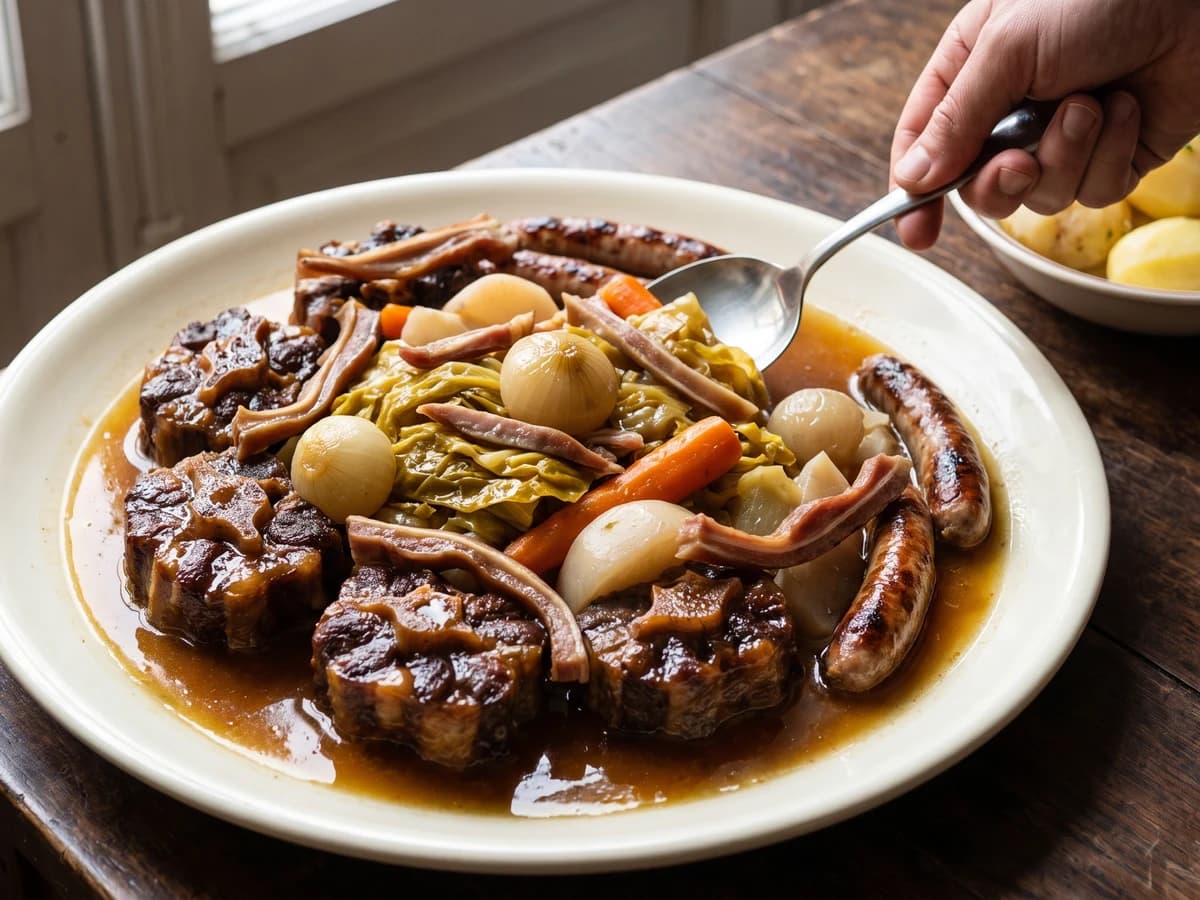
Queue de Bœuf en Hochepot gathers oxtail, pig's trotter and ear, cabbage, roots, and grilled chipolatas around a clear, gelatin-rich broth whose quiet simmer keeps every piece tender and distinct.

Chef Juliette
Beef shoulder larded with bacon, sharpened by red wine and vinegar, then sealed with garlic, vegetables, and dry lemon peel until the low oven turns it yielding and the gravy darkly glossy.