
Chef Juliette
Bouillabaisse à la Marseillaise
Marseille's great fish stew, saffron-gold and garlic-scented, proves that a hard boil can be the careful choice: it binds olive oil into broth before the whole pot meets bread.
A cooking platform built around craft, culture, and the stories behind what we eat.
Created by Chef Juliette
Based on No. 209, Game Royale, from Le Guide Culinaire (1907) by Auguste Escoffier
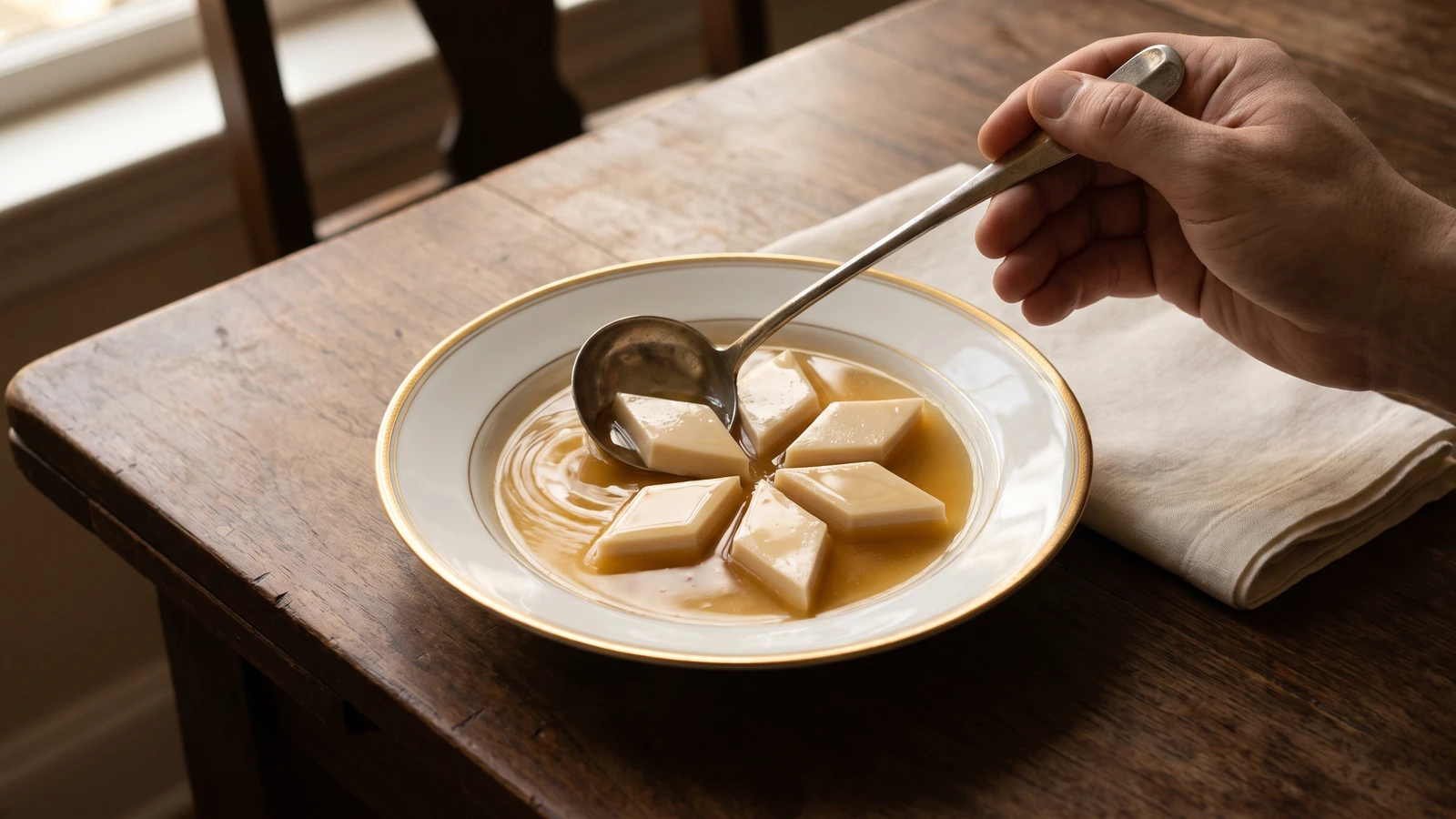
Royale de gibier turns cooked game, cold Espagnole Sauce, cream, and eggs into a silken poached custard, proving that fine texture comes from cold blending and gentler heat, not elaborate equipment.
Royale de gibier (game-meat savory custard) teaches the discipline behind every royale: the water must never boil. A quiet bain-marie gives you a close, silken custard that cuts cleanly; bubbling water drives holes through it and turns tenderness to sponge.
The original kitchen assumed a saucier with cold Espagnole ready, a stockpot never off the fire, a mortar for pounding, and a tammy for straining. At home, use finished cold Espagnole Sauce, a small food processor, a fine-mesh sieve, and the even heat of an oven bain-marie. The mortar and cloth tammy were brigade scaffolding, so those may change. The measured proportions, gradual addition of sauce and cream, fine straining, egg binding, and gentle poach are the dish itself, so they stay exactly where the source put them.
The source quantity is already intimate, enough royale for four bowls, so it needs no inflation. Choose one bird and let it name the preparation: pheasant makes royale de faisan, grouse makes royale de grouse, and partridge makes royale de perdrix. One cook, one stove, one evening. Keep the mixture cold, but watch the poaching water most closely; that quiet surface decides the dish.
Royales belong to the classical soup service of Paris, where egg-bound custards were poached, cut into precise shapes, and placed in clear soups as a tender garnish. Royale de gibier is not itself a cream soup, despite often appearing among soup preparations; its purpose is to carry the flavor of a particular game bird into a silken custard. A pheasant, grouse, or partridge royale traditionally takes its proper name from the bird used, preserving identity rather than blending several kinds of game together.
Quantity
3 oz (85 g / about 1/2 packed cup)
completely cold, with skin, bones, and sinew removed
Quantity
3 tablespoons (45 ml / about 48 g)
Quantity
1/5 imperial pint (114 ml / about 114 g)
divided
Quantity
1 very small pinch (under 1/16 teaspoon / under 0.1 g)
Quantity
1 (about 50 g without shell)
Quantity
3 (about 54 g total)
Quantity
1 teaspoon (5 ml / 5 g)
softened, for the mold
| Ingredient | Quantity |
|---|---|
| cooked meat from one game birdcompletely cold, with skin, bones, and sinew removed | 3 oz (85 g / about 1/2 packed cup) |
| cold Espagnole Sauce | 3 tablespoons (45 ml / about 48 g) |
| cold rich creamdivided | 1/5 imperial pint (114 ml / about 114 g) |
| ground cayenne | 1 very small pinch (under 1/16 teaspoon / under 0.1 g) |
| large egg | 1 (about 50 g without shell) |
| large egg yolks | 3 (about 54 g total) |
| unsalted buttersoftened, for the mold | 1 teaspoon (5 ml / 5 g) |
Chill the food-processor bowl, blade, and game meat for 15 minutes. Heat the oven to 300°F (150°C). Butter an 8 by 4-inch (20 by 10 cm) metal loaf pan very lightly and lay a narrow strip of parchment across its base and long sides, leaving enough overhang to lift the royale later. Set the mold inside a roasting pan and put a kettle of water on to heat.
Process the cold game until it becomes the finest paste the machine can make, stopping several times to scrape the bowl. Add the cold Espagnole Sauce one teaspoon at a time, processing each addition completely into the meat. Reserve 1 tablespoon of the measured cream, then add the remainder in small spoonfuls until the paste is smooth and softly glossy. The gradual addition is essential because it keeps the fat and liquid bound. If the mixture becomes warm, greasy, or smeared around the bowl, stop and chill it for 10 minutes, then pulse in the reserved cold cream. Ça se rattrape.
Add the very small pinch of cayenne and pulse once or twice. Taste the paste now, before the raw eggs enter; the cayenne should warm the finish without announcing itself. Press the mixture firmly through a fine-mesh sieve with a flexible scraper, leaving every visible fiber behind. A modern sieve replaces the tammy, but the straining itself cannot go. It is what turns pounded game into a royale rather than a coarse forcemeat.
Whisk the whole egg and three yolks only until no separate streaks remain. Stir them gradually into the strained game paste with a spatula, keeping the motion calm so you don't beat in bubbles. The finished mixture should fall in a thick, unbroken ribbon. Pour it into the prepared mold, then tap the mold twice against a folded towel to release trapped air.
Cover the mold loosely with foil. Pour hot, not boiling, water into the roasting pan until it reaches halfway up the mold, then transfer the pan carefully to the oven. Poach for 25 to 30 minutes, until the edges are set, the center retains a slight tremble, and an instant-read thermometer reaches 160°F (71°C). The bain-marie must remain quiet. If bubbles begin breaking around the mold, remove a cup of hot water, replace it with cool water, and lower the oven slightly; catch it there and the texture is safe.
Lift the mold from the water and rest it for 15 minutes. Loosen the short ends with a thin knife, use the parchment to lift out the royale, and turn it onto a board. Its cut face should look close, moist, and satin-smooth, without large holes. Cut it into small diamonds, rounds, or 1/2-inch (1.25 cm) dice and place them in four warm bowls of clear game soup just before serving. Let the hot soup warm the royale gently, but never boil it again. À table!
1 serving (about 85g)
Culinary guides, cultural storytelling, and the editorial depth that makes cooking meaningful.
Discover Culinary ExplorerChef Juliette
Marseille's great fish stew, saffron-gold and garlic-scented, proves that a hard boil can be the careful choice: it binds olive oil into broth before the whole pot meets bread.

Chef Juliette
Waterzoi asks fresh, bone-in river fish to thicken its own buttery broth, with parsley root and pepper for company. No flour, no stockpot, just a brisk simmer watched closely.
Chef Juliette
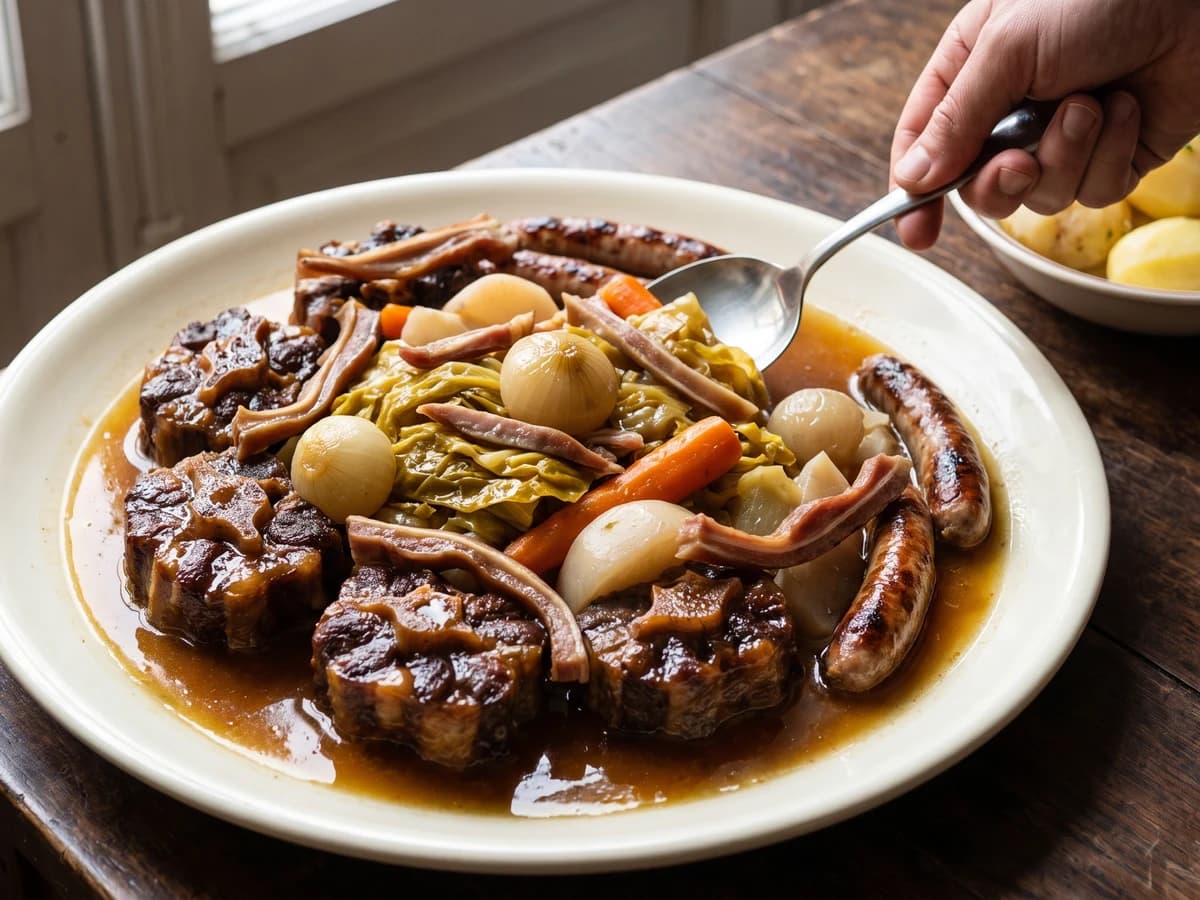
Queue de Bœuf en Hochepot gathers oxtail, pig's trotter and ear, cabbage, roots, and grilled chipolatas around a clear, gelatin-rich broth whose quiet simmer keeps every piece tender and distinct.

Chef Juliette
Beef shoulder larded with bacon, sharpened by red wine and vinegar, then sealed with garlic, vegetables, and dry lemon peel until the low oven turns it yielding and the gravy darkly glossy.