
Chef Juliette
Bouillabaisse à la Marseillaise
Marseille's great fish stew, saffron-gold and garlic-scented, proves that a hard boil can be the careful choice: it binds olive oil into broth before the whole pot meets bread.
A cooking platform built around craft, culture, and the stories behind what we eat.

Created by Chef Juliette
Based on No. 1172, Daube Chaude à la Provençale, from Le Guide Culinaire (1907) by Auguste Escoffier
Beef shoulder larded with bacon, sharpened by red wine and vinegar, then sealed with garlic, vegetables, and dry lemon peel until the low oven turns it yielding and the gravy darkly glossy.
Daube chaude à la Provençale (hot Provençal beef daube) teaches the discipline of a closed braise. Once the wine, bacon, fond, and aromatics are inside, the pot must lose almost nothing. That patient, enclosed cooking turns sturdy beef into yielding pieces surrounded by a wine-dark gravy with the gloss and body of melted rind. Before you touch a pan, know the one true thing: the seal is the dish.
The grand kitchen assumed four pounds of beef, a larding needle, a deep earthenware daubière, and enough hands to turn vegetables into perfect little olives. It needed neither a saucier nor a stockpot, because the bacon fat, wine, and tightly closed pot built their own sauce. At home, two pounds feeds four, a narrow paring knife replaces the larding needle, and a heavy cocotte with parchment beneath its lid does the work of the daubière. Finely chopped bacon replaces grated bacon, and five generous hours suit the smaller pot and the younger beef sold now. One cook, one stove, one evening's table.
The olive-shaped carrots were brigade polish and may become equal, olive-sized pieces; that is scaffolding. The larding, short wine marinade, careful drying, and low closed braise stay, because they are the daube. Dry the beef thoroughly before it reaches the bacon fat, then close the pot tightly and resist lifting the lid merely to admire your work.
Daube belongs to Provence, where households cooked sturdy cuts of beef in a daubière, a deep earthenware pot whose narrow neck and close lid returned condensation to the braise. It traveled from the family pot into the classical kitchen, which codified the larding, wine marinade, turned vegetables, and bouquet garni without changing the slow, enclosed cooking at its heart. Orange peel appears in many Provençal daubes, but this formula's dry lemon peel is deliberate, while chaude distinguishes its glossy hot service from daubes allowed to cool and set in their juices.
Quantity
8 pieces, 4 ounces each (2 pounds / 910 g total)
cut into large cubes
Quantity
8 strips, about 3 ounces / 85 g total
cut into strips about 2 inches by ½ inch and chilled firm
Quantity
1¼ teaspoons (6 ml / 7.5 g)
Quantity
½ teaspoon (2.5 ml / 1 g)
Quantity
1 small pinch (about 1/16 teaspoon / 0.3 ml / 0.1 g)
Quantity
Scant ½ cup (105 ml / 105 g) Cooked Marinade for Venison (No. 168)
cooled and prepared for this daube with ¼ cup (60 ml / 60 g) dry red wine and 3 tablespoons (45 ml / 45 g) red wine vinegar
Quantity
½ cup (120 ml / 120 g)
reserved for braising
Quantity
About ⅔ cup (160 ml / 85 g)
finely chopped
Quantity
6 (about 8 ounces / 225 g)
peeled and left whole
Quantity
2 (about 8 ounces / 225 g)
cut into 8 equal olive-sized pieces
Quantity
1 large rib (about 2 ounces / 55 g)
cut to match the carrots
Quantity
2 cloves (about ¼ ounce / 7 g)
peeled
Quantity
4 ounces (115 g), prepared through Blanchings (No. 273)
cut into ⅔-inch squares
Quantity
6
Quantity
2 sprigs
Quantity
1
Quantity
1 strip, about 2 inches by 1 inch
white pith pared away
| Ingredient | Quantity |
|---|---|
| beef shoulder or chuckcut into large cubes | 8 pieces, 4 ounces each (2 pounds / 910 g total) |
| unsmoked slab bacon for lardingcut into strips about 2 inches by ½ inch and chilled firm | 8 strips, about 3 ounces / 85 g total |
| fine sea salt | 1¼ teaspoons (6 ml / 7.5 g) |
| freshly ground black pepper | ½ teaspoon (2.5 ml / 1 g) |
| ground quatre-épices | 1 small pinch (about 1/16 teaspoon / 0.3 ml / 0.1 g) |
| Cooked Marinade for Venisoncooled and prepared for this daube with ¼ cup (60 ml / 60 g) dry red wine and 3 tablespoons (45 ml / 45 g) red wine vinegar | Scant ½ cup (105 ml / 105 g) Cooked Marinade for Venison (No. 168) |
| dry red winereserved for braising | ½ cup (120 ml / 120 g) |
| unsmoked baconfinely chopped | About ⅔ cup (160 ml / 85 g) |
| small onionspeeled and left whole | 6 (about 8 ounces / 225 g) |
| medium carrotscut into 8 equal olive-sized pieces | 2 (about 8 ounces / 225 g) |
| celerycut to match the carrots | 1 large rib (about 2 ounces / 55 g) |
| garlicpeeled | 2 cloves (about ¼ ounce / 7 g) |
| fresh bacon rindcut into ⅔-inch squares | 4 ounces (115 g), prepared through Blanchings (No. 273) |
| parsley stems | 6 |
| thyme | 2 sprigs |
| bay leaf | 1 |
| dry lemon peelwhite pith pared away | 1 strip, about 2 inches by 1 inch |
Chill the eight larding strips until firm enough to push through the beef without folding. Have the fresh bacon rind prepared through Blanchings (No. 273), then drain it thoroughly and cut it into ⅔-inch squares. Tie the parsley stems, thyme, bay leaf, and dry lemon peel into a compact bouquet garni, keeping the lemon peel in the centre.
Make a narrow channel through the centre of each beef cube, following the grain, with a slim paring or boning knife. Push one chilled bacon strip into each channel. Put the beef in a nonreactive bowl and season it with the salt, pepper, and quatre-épices, then pour over the cooled Cooked Marinade for Venison (No. 168). Cover and refrigerate for 2 to 3 hours, turning the cubes every 45 minutes so every surface meets the wine and vinegar.
Set a heavy 5½ to 6-quart cocotte over medium-low heat and add the finely chopped bacon while the pot is still cool. Cook for 7 to 10 minutes, stirring often, until the fat has rendered and the bacon is lightly golden. Do not take it to a brittle crisp; it still has hours of cooking ahead.
Add the whole onions, carrots, celery, and garlic to the rendered bacon. Raise the heat to medium and cook for 8 to 10 minutes, turning the vegetables until their edges take an honest golden colour. Equal-sized carrot pieces replace the classical olive tournage here. The shape was service polish; the size, which lets the vegetables cook evenly, is the part that matters.
Lift the beef from the marinade and reserve every drop of the Cooked Marinade for Venison (No. 168). Dry the cubes very thoroughly with towels, then add them to the cocotte among the vegetables. Fry for 7 to 8 minutes, turning the meat so its surfaces colour lightly and leave a brown fond on the pot. If the pot floods and the beef begins to boil, raise the heat and keep cooking until the moisture evaporates and the bacon fat sizzles again. Ça se rattrape. Do not discard that liquid, because it carries wine, seasoning, and beef juices.
Heat the oven to 275°F (135°C). Pour the reserved Cooked Marinade for Venison (No. 168) and the remaining red wine into the cocotte, scraping the floor until the fond dissolves into the liquid. Add the bacon rind prepared through Blanchings (No. 273) and nestle in the bouquet garni. Bring everything to a full boil for 2 minutes, then press a round of parchment over the surface and close the cocotte tightly with its lid. If the lid fits loosely, place a sheet of foil across the rim before setting the lid in place.
Transfer the sealed cocotte to the oven and braise for 5 to 5½ hours. Leave the lid closed for the first 4 hours. Check once after that: the liquid should barely tremble, the vegetables should be very soft, and a fork should slide into the beef without resistance. If the meat remains firm, it is not ruined; its connective tissue simply has not yielded. Reseal the pot and give it another 30 to 45 minutes. If the liquid has fallen below halfway up the meat, add 2 tablespoons of hot water and close the pot again.
Remove the bouquet garni and let the daube settle for 10 minutes. Skim the clear fat from the surface with a broad spoon, leaving the dark, gelatinous gravy beneath it. If the gravy is thinner than a light coating sauce, lift out the meat and vegetables and boil the liquid for 5 to 10 minutes until it turns glossy; return everything gently so the cubes stay whole. Taste for salt and pepper, then serve the daube in its cocotte or in a warmed deep serving bowl, the home equivalent of the hot timbale. À table!
1 serving (about 370g)
Culinary guides, cultural storytelling, and the editorial depth that makes cooking meaningful.
Discover Culinary ExplorerChef Juliette
Marseille's great fish stew, saffron-gold and garlic-scented, proves that a hard boil can be the careful choice: it binds olive oil into broth before the whole pot meets bread.

Chef Juliette
Waterzoi asks fresh, bone-in river fish to thicken its own buttery broth, with parsley root and pepper for company. No flour, no stockpot, just a brisk simmer watched closely.
Chef Juliette
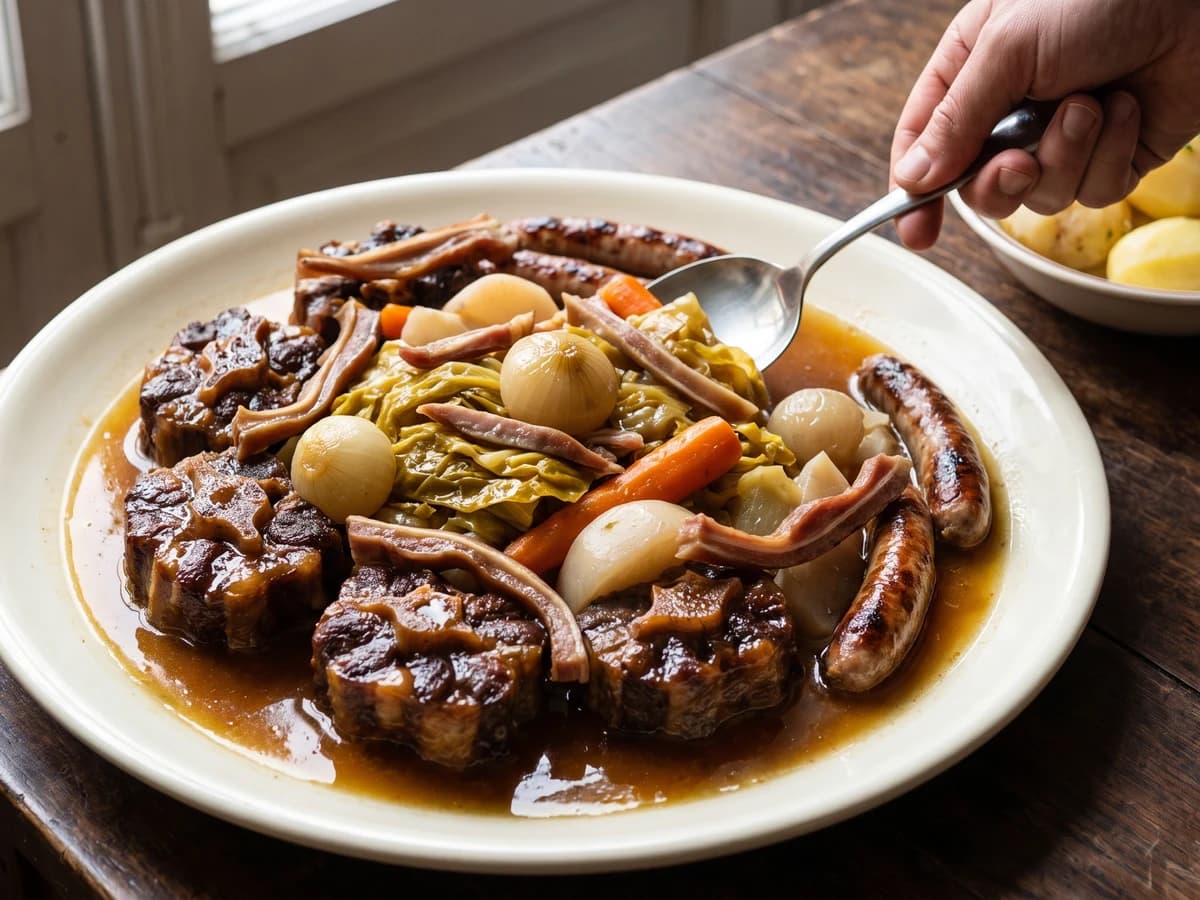
Queue de Bœuf en Hochepot gathers oxtail, pig's trotter and ear, cabbage, roots, and grilled chipolatas around a clear, gelatin-rich broth whose quiet simmer keeps every piece tender and distinct.
Chef Juliette
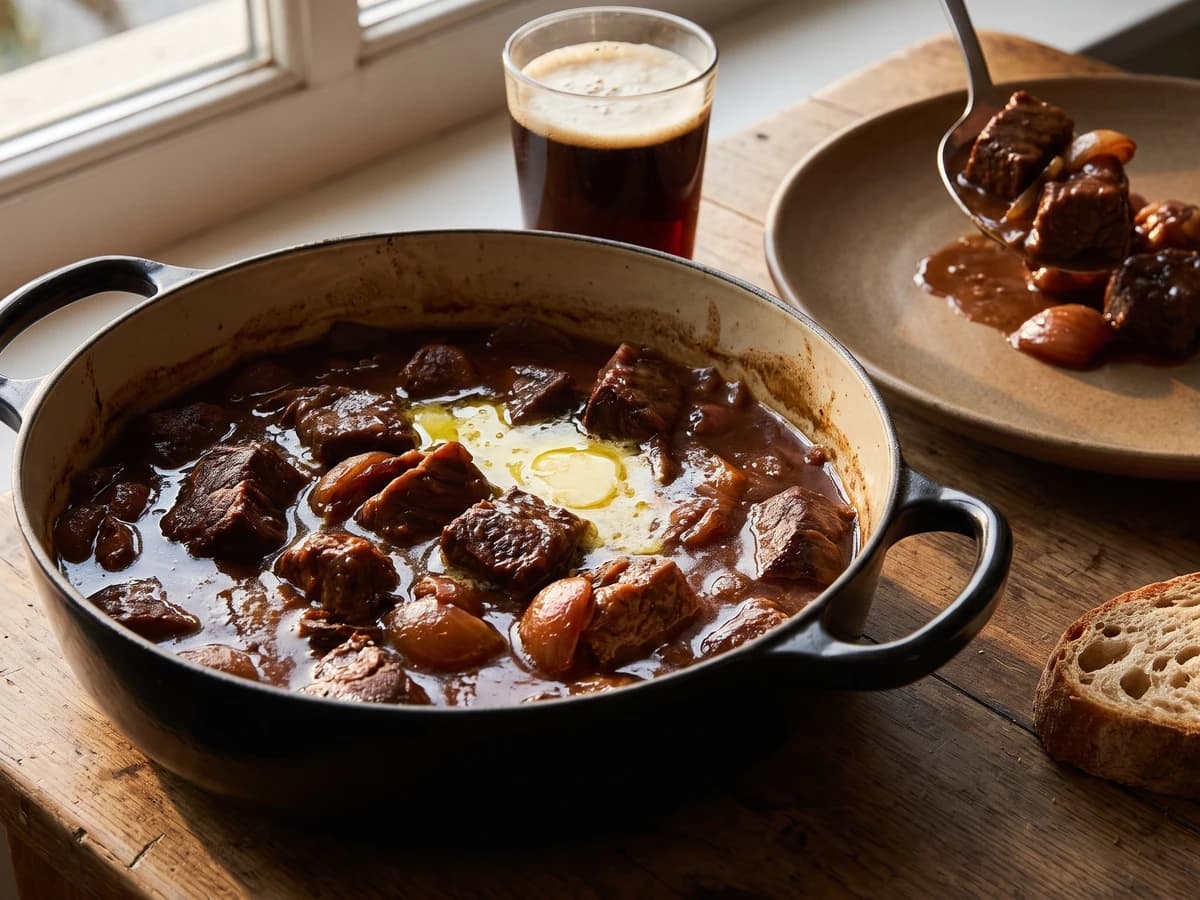
Beef shoulder and browned onions layered under old lambic, brown stock, and roux, then braised until the beer turns glossy and bittersweet: Flanders’ patient lesson in building a sauce.