
Chef Juliette
Bouillabaisse à la Marseillaise
Marseille's great fish stew, saffron-gold and garlic-scented, proves that a hard boil can be the careful choice: it binds olive oil into broth before the whole pot meets bread.
A cooking platform built around craft, culture, and the stories behind what we eat.
Created by Chef Juliette
Based on No. 1163, Queue de Bœuf en Hochepot, from Le Guide Culinaire (1907) by Auguste Escoffier
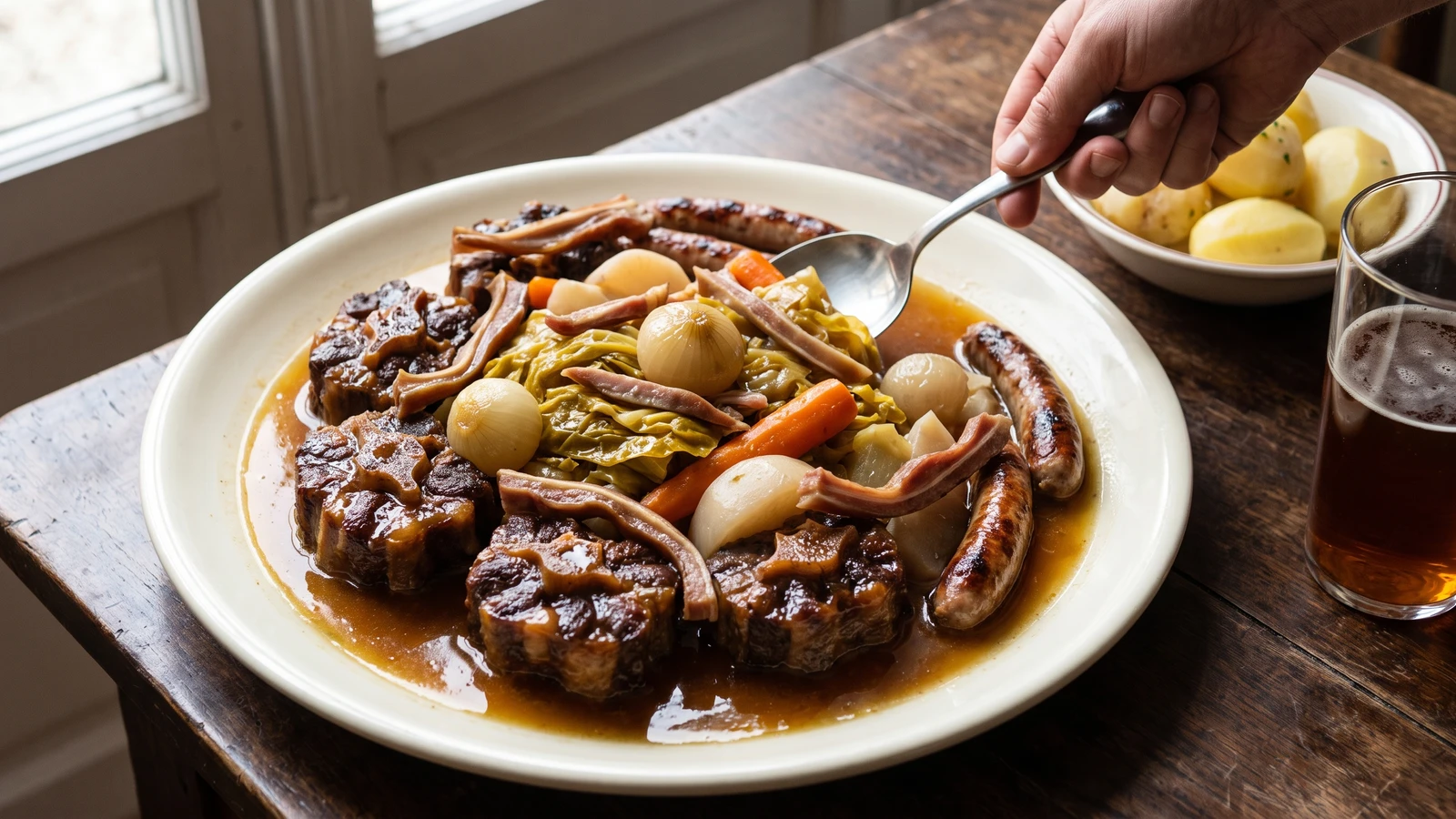
Queue de Bœuf en Hochepot gathers oxtail, pig's trotter and ear, cabbage, roots, and grilled chipolatas around a clear, gelatin-rich broth whose quiet simmer keeps every piece tender and distinct.
Queue de Bœuf en Hochepot (oxtail in a Flemish hotpot) teaches the discipline of the bare simmer. Tail, trotter, and ear give their gelatin to plain salted water while cabbage and roots keep their shapes; let the pot boil hard and the broth clouds, the meat tightens, and the vegetables collapse. The one true thing to know before touching the pan is simple: movement should be no more than an occasional bubble.
The professional kitchen surrounding the original could spare a saucier to skim, kept stock never off the fire, and had a salamander for grilling the sausages. This entry pointedly asks for cold water rather than stock, so the home version does too. A heavy lidded pot, a fine skimmer, and the household broiler are the honest equivalents. The dedicated hands and equipment are brigade scaffolding and can go; careful skimming and four hours at a tremble are the dish and must stay.
The book's service becomes four by using about half a large oxtail, one of its two trotters, half its ear, five of its ten onions, half the measured carrots and turnips, and five chipolatas (small fresh sausages). Nothing is enriched with fond, roux, or reduction because the source's clear, gelatin-rich liquor is the correct foundation. One cook, one stove, one evening. Guard the first rise to the boil and skim it clean before lowering the heat; get that right and the rest is patient assembly.
Hochepot belongs to Flanders, on both the northern French and Belgian tables, where household cooks simmer mixed meats with cabbage and storage roots in one generous pot. French classical kitchens carried that household preparation into formal service by arranging the oxtail and garnishes carefully, but the broth remained built from water and gelatinous cuts rather than prepared stock. It is often mistaken for a thick brown stew; this queue de bœuf version is closer to pot-au-feu, with a clear liquor and each component kept recognizable.
Quantity
½ large tail (about 2 lb / 900 g)
cut through the joints into 2-inch / 5-cm sections
Quantity
1 (about 1½ lb / 680 g)
scrubbed and cut through the bone into 4 pieces
Quantity
½ (about 4 oz / 120 g)
well scraped and cleaned
Quantity
10 cups (2.4 L / 2,400 g), or enough to cover the meats
Quantity
1 tablespoon plus 1½ teaspoons (22.5 ml / 24 g)
Quantity
½ cabbage (about 5 cups / 500 g)
cut through the core into 4 compact wedges
Quantity
5 (about 1⅔ cups / 250 g)
peeled and left whole
Quantity
½ cup (2½ oz / 70 g)
cut into pieces shaped like large garlic cloves
Quantity
½ cup (2½ oz / 70 g)
cut into pieces shaped like large garlic cloves
Quantity
5 small sausages (about 2 cups / 250 g)
Quantity
4 medium potatoes (about 4 cups / 700 g)
peeled
Quantity
12⅔ cups (3 L / 3,000 g)
divided
Quantity
2 tablespoons (30 ml / 30 g)
divided
| Ingredient | Quantity |
|---|---|
| oxtailcut through the joints into 2-inch / 5-cm sections | ½ large tail (about 2 lb / 900 g) |
| pig's trotterscrubbed and cut through the bone into 4 pieces | 1 (about 1½ lb / 680 g) |
| pig's earwell scraped and cleaned | ½ (about 4 oz / 120 g) |
| cold water for the hochepot | 10 cups (2.4 L / 2,400 g), or enough to cover the meats |
| fine sea salt for the hochepot | 1 tablespoon plus 1½ teaspoons (22.5 ml / 24 g) |
| small green cabbagecut through the core into 4 compact wedges | ½ cabbage (about 5 cups / 500 g) |
| small onionspeeled and left whole | 5 (about 1⅔ cups / 250 g) |
| carrotscut into pieces shaped like large garlic cloves | ½ cup (2½ oz / 70 g) |
| turnipscut into pieces shaped like large garlic cloves | ½ cup (2½ oz / 70 g) |
| Chipolata sausages | 5 small sausages (about 2 cups / 250 g) |
| waxy potatoespeeled | 4 medium potatoes (about 4 cups / 700 g) |
| cold water for the cabbage and potatoesdivided | 12⅔ cups (3 L / 3,000 g) |
| fine sea salt for the cabbage and potatoesdivided | 2 tablespoons (30 ml / 30 g) |
Fit the oxtail sections, trotter pieces, and half ear snugly into a 6½- to 7-quart heavy pot. Add the 10 cups of cold water and the 24 g salt, preserving the source's proportion of roughly one-third ounce of salt per quart. Bring the pot slowly toward a boil over medium heat, allowing 25 to 35 minutes. As grey froth rises, remove it patiently with a fine skimmer without taking away more liquid than necessary. Do not brown the meat first; this hochepot builds its foundation by extraction into water, and browning would turn it into another dish.
As soon as the first full bubbles appear, lower the heat until the liquid gives only an occasional lazy bubble. Set the lid slightly ajar and cook for 2 hours, turning the oxtail sections once with tongs but never stirring the pot. Skim away fresh froth or excess surface fat during the first half-hour. If the liquid boils hard, lift the pot completely from the heat for 2 minutes, skim the disturbed fat, then return it over a lower flame. Ça se rattrape: a clouded broth still tastes sound, and its serving liquor can be passed through a fine sieve after it settles.
Near the end of the first simmer, bring half the remaining water and half the remaining salt to a boil in a saucepan. Add the cabbage wedges and parboil for 5 minutes, just until the outer leaves become flexible. Lift them into cold water to stop the cooking, then drain thoroughly. Keep the core attached so each wedge survives its long finish. Prepare the whole onions and shape the carrots and turnips like large garlic cloves, broad enough to remain distinct after two hours.
After the meats have simmered for 2 hours, settle the drained cabbage, whole onions, carrots, and turnips among them. Return the liquid to its bare tremble, keep the lid slightly ajar, and cook for at least 2 hours more. Do not stir. Nudge the vegetables beneath the liquid with tongs and move the pot by its handles if anything needs settling. If a cabbage wedge or onion softens sooner than the rest, lift it carefully to a covered plate and return it for the last 10 minutes. Ça se rattrape, and the platter is better for one intact onion than six strands fished from the broth.
During the final 30 minutes, cook the potatoes à l'anglaise, plainly in water. Put them in a saucepan with the remaining cold water and salt, bring slowly to a boil, then simmer for 18 to 25 minutes until a small knife enters the centre without resistance. Drain them completely and return them to the empty warm pan for 2 minutes, turning gently so their surfaces dry. Keep them whole if they are modest in size; halve only a very large potato.
Heat the broiler with a rack about 6 inches / 15 cm from the element. Arrange the chipolatas on a rimmed broiler pan and grill for 8 to 12 minutes, turning several times, until evenly bronzed and cooked to 160°F / 71°C at the centre. This household broiler performs the salamander's work without changing the source's intention. Lift the pig's ear from the hochepot and cut it crosswise into small, narrow strips. Remove the trotter bones, keeping any tender meat and skin for the central garnish.
Warm a large deep platter. Arrange the oxtail sections in a circle, then mound the cabbage, onions, carrots, turnips, and any tender trotter meat in the centre. Surround the vegetables with the narrow strips of pig's ear and the grilled chipolatas, following the source's generous service. Skim the cooking liquor once more and spoon enough around the meat to glaze it and pool shallowly in the platter. Bring the potatoes à l'anglaise separately in a warm bowl or timbale. À table!
1 serving (about 1000g)
Culinary guides, cultural storytelling, and the editorial depth that makes cooking meaningful.
Discover Culinary ExplorerChef Juliette
Marseille's great fish stew, saffron-gold and garlic-scented, proves that a hard boil can be the careful choice: it binds olive oil into broth before the whole pot meets bread.

Chef Juliette
Waterzoi asks fresh, bone-in river fish to thicken its own buttery broth, with parsley root and pepper for company. No flour, no stockpot, just a brisk simmer watched closely.

Chef Juliette
Beef shoulder larded with bacon, sharpened by red wine and vinegar, then sealed with garlic, vegetables, and dry lemon peel until the low oven turns it yielding and the gravy darkly glossy.
Chef Juliette
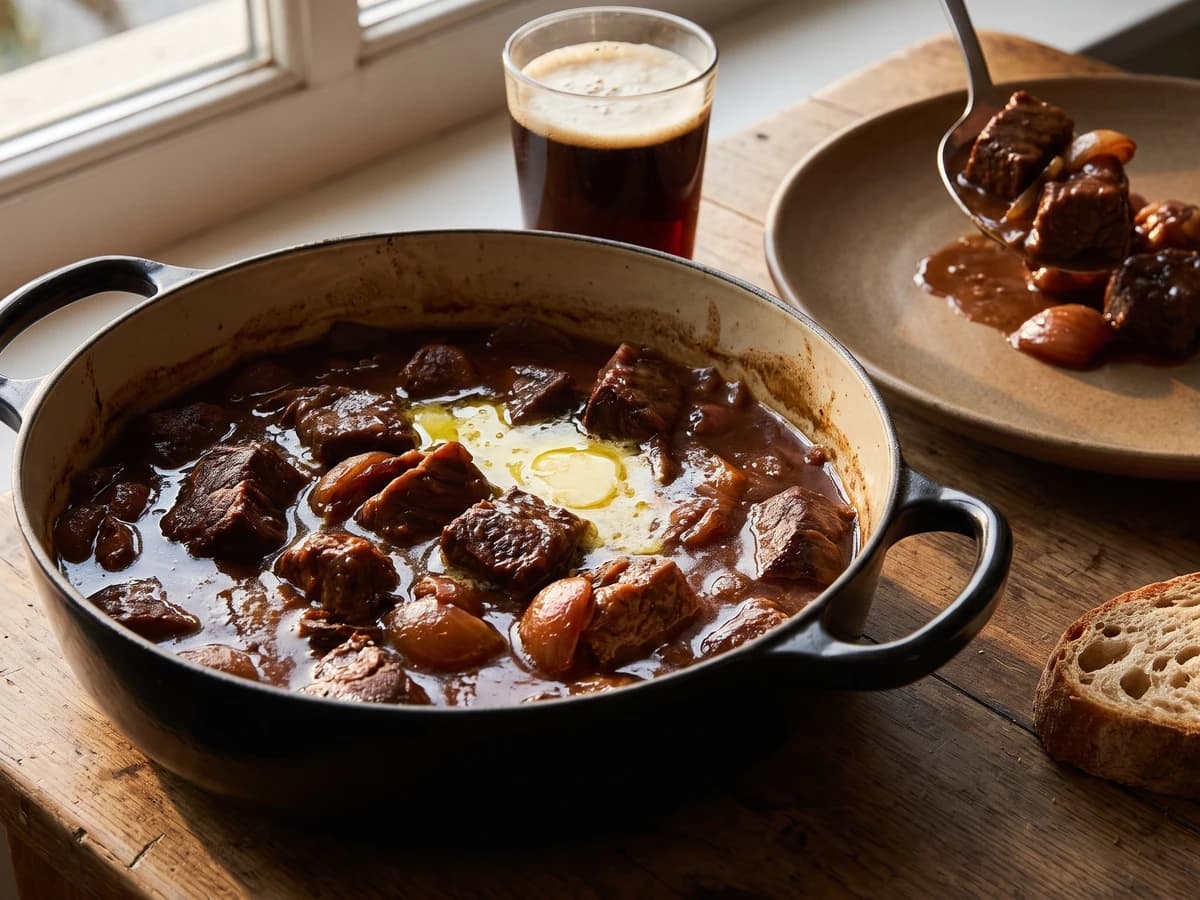
Beef shoulder and browned onions layered under old lambic, brown stock, and roux, then braised until the beer turns glossy and bittersweet: Flanders’ patient lesson in building a sauce.