Chef Juliette
Suet Dumpling
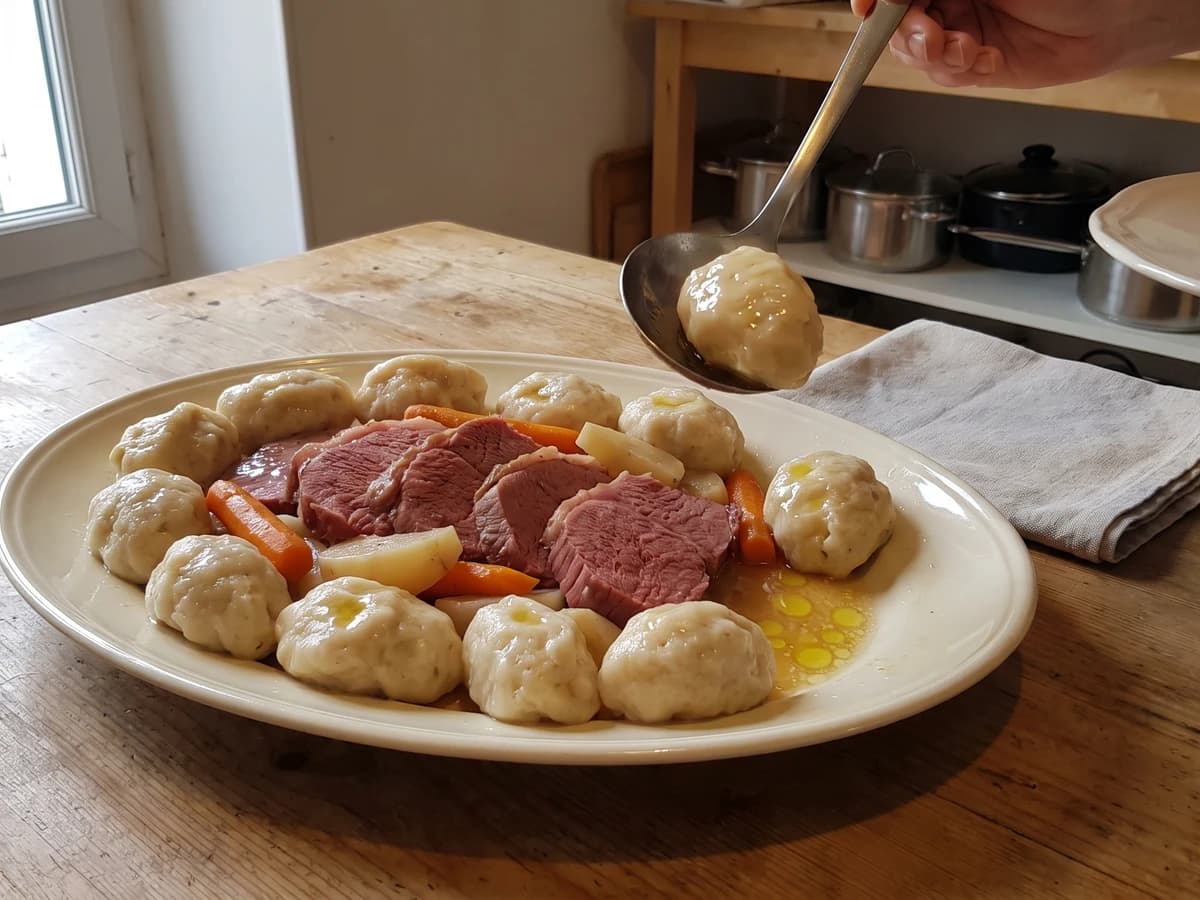
Boulettes au suif, poached beside salt beef, turn equal weights of flour and finely chopped suet into tender, rich dumplings. Keep the beef liquor at a bare tremble and the old garnish works beautifully at home.
A cooking platform built around craft, culture, and the stories behind what we eat.

Created by Chef Juliette
Based on No. 2163, Laitues Farcies pour Garniture, from Le Guide Culinaire (1907) by Auguste Escoffier
Small lettuce packets, tender but intact, carry either their own seasoned hearts or pilaff enriched with foie gras, then braise under butter and stock into a polished garnish for roast poultry or veal.
Laitues Farcies pour Garniture (stuffed lettuces for garnish) teach a small, exact lesson: a leaf becomes a proper casing only after it has been softened, cooled, and drained until no hidden water remains. Rush that draining and the packets slide open while their braising liquor turns thin. Get it right, and eight pale-green parcels hold their shape, drink in butter and stock, and arrive glossy enough to sit beside roast poultry or veal.
The original entry assumes a brigade could reach for Cabbages for Garnish.—A (No. 2104) or Cabbages for Garnish.—C (No. 2106) as readily as a pan, with stock never off the fire and a saucier ready to finish the liquor. At home, use one wide sauté pan, ¾ cup of good stock, and make eight parcels. Choose the chopped-lettuce filling, the foie-gras pilaff filling, or four of each. Separate service batches were brigade scaffolding and can go. The parboiling, thorough draining, tight folding, and gentle braise are the dish, so they stay. One cook, one stove, one evening.
A large kitchen could blanch whole heads in deep vats; on a home stove, the tender leaves and dense hearts cook more evenly in separate passes, so that is the only procedural change. Before you shape anything, press a leaf between two clean towels. If the towel stays dry, you are ready. That draining is the step that decides the dish.
Laitues farcies pour garniture belong to the Parisian classical-service repertoire, not to one provincial larder, though their method grows from household braises of cabbage and tender greens. Garniture here means a composed accompaniment, not a decorative flourish: the packets traveled from the kitchen-garden economy of using the whole head to formal platters beside poultry, veal, and other roasts. The common misconception is that lettuce belongs only raw to salad; French cooks have long parboiled and braised sturdy leaves, with foie gras and pilaff marking the richer table and chopped lettuce keeping the thrifty root visible.
Quantity
2 heads (about 1½ lb / 680 g)
Quantity
1 tablespoon (15 ml / 18 g)
Quantity
8 tablespoons (120 ml / 140 g), or 4 tablespoons (60 ml / 70 g) for a split batch, Cabbages for Garnish.—A (No. 2104)
Quantity
8 tablespoons (120 ml / 160 g), or 4 tablespoons (60 ml / 80 g) for a split batch, Cabbages for Garnish.—C (No. 2106)
Quantity
¾ cup (180 ml / 180 g)
Quantity
2 tablespoons (30 ml / 28 g)
divided
Quantity
to taste
| Ingredient | Quantity |
|---|---|
| large butter lettuces | 2 heads (about 1½ lb / 680 g) |
| fine sea salt for the blanching water | 1 tablespoon (15 ml / 18 g) |
| finished seasoned chopped-lettuce filling, option A (optional) | 8 tablespoons (120 ml / 140 g), or 4 tablespoons (60 ml / 70 g) for a split batch, Cabbages for Garnish.—A (No. 2104) |
| finished pilaff rice and foie-gras purée filling, option C (optional) | 8 tablespoons (120 ml / 160 g), or 4 tablespoons (60 ml / 80 g) for a split batch, Cabbages for Garnish.—C (No. 2106) |
| light unsalted chicken stock | ¾ cup (180 ml / 180 g) |
| unsalted butterdivided | 2 tablespoons (30 ml / 28 g) |
| fine sea salt and freshly ground white pepper | to taste |
Bring a large saucepan of water to a boil and season it with the measured salt. Separate 8 broad, unbroken outer leaves from the lettuces, plus 2 spare leaves for repairs, easing them away from the cores rather than pulling at their ribs. Wash them carefully. If making the chopped-lettuce version, quarter the remaining hearts through their stems; for the foie-gras pilaff version, keep the unused hearts raw for another meal.
Lower the large leaves into the boiling water in two batches and parboil them for 20 to 30 seconds, just until pliable and bright green. Lift them immediately into very cold water. If making the chopped-lettuce filling, parboil the quartered hearts separately for 45 to 60 seconds, until wilted but not collapsing, then cool them the same way. The separate passes are the home-kitchen translation: the leaves stay whole while the denser hearts receive the extra cooking they need.
Spread the cooled leaves in one layer on clean towels set over a rack, cover with another towel, and leave them for 10 minutes. Blot each leaf, then shave any thick rib nearly level with a small knife without cutting through the leaf. If using the hearts, squeeze them gently but firmly in a towel before chopping. Water trapped here dilutes the filling and braising liquor. Press one leaf between dry fingertips; it should feel supple, not slippery.
For the chopped-lettuce path, reach for the finished seasoned filling from Cabbages for Garnish.—A (No. 2104), prepared with the thoroughly drained chopped hearts. For the richer path, reach for the finished Cabbages for Garnish.—C (No. 2106), whose pilaff rice is already worked with foie-gras purée. Keep either filling cold until shaping. Each referenced preparation remains whole, with its own seasoning and proportions; this entry simply assigns 1 tablespoon to each lettuce packet.
Lay a leaf dull side up with its rib toward you. Place 1 level tablespoon of filling just below the center, fold the lower edge over it, bring in both sides, and roll into a compact packet. Cup it gently between your palms to round it. If a leaf is small or torn, overlap it with a spare leaf and roll both together, exactly as the source directs for an insufficient wrapper. Ça se rattrape. Set each packet seam side down while you shape the rest.
Rub a wide lidded sauté pan with 1 tablespoon of the butter. Arrange the packets seam side down in one snug layer, close enough to support one another but not crushed. Dot them with ½ tablespoon of the remaining butter, pour the stock around them, and season the liquid lightly with salt and white pepper. It should rise roughly one-third of the way up the packets. Cover the surface with a round of parchment, then put on the pan lid.
Bring the liquid just to a tremble over medium heat, then lower the heat and braise gently for 20 to 25 minutes. Do not turn the packets. If one begins to open, use two spoons to tuck its seam underneath and nestle it against its neighbors; if the pan approaches dryness, add stock a tablespoon at a time. Lift the tender packets to a warm platter. Boil the uncovered liquor until about ¼ cup remains and it lightly coats a spoon, then remove the pan from the heat and swirl in the final ½ tablespoon of cold butter. If the glaze looks oily, add 1 teaspoon of cold stock and swirl again until it reunites.
Nappez (coat) the packets with the butter-glossed braising liquor and bring them to the table at once, allowing 2 per person beside roast poultry, veal, or another simply sauced meat. Keep the platter generous and unadorned. The smooth green parcels and their glaze are the presentation. À table!
1 serving (about 200g)
Culinary guides, cultural storytelling, and the editorial depth that makes cooking meaningful.
Discover Culinary ExplorerChef Juliette
Boulettes au suif, poached beside salt beef, turn equal weights of flour and finely chopped suet into tender, rich dumplings. Keep the beef liquor at a bare tremble and the old garnish works beautifully at home.

Chef Juliette
Bread, flour, frangipane, and rice become four cool, supple panades for binding forcemeats, each changing body and flavor while preserving tenderness. The finest Mousselines need none, and knowing that distinction is the lesson.

Chef Juliette
Panade au pain is bread, milk, salt, heat, and attention: stir until the paste releases cleanly, butter it against a skin, and you have the quiet binder behind tender French farces.

Chef Juliette
Panade de farine teaches the drying stroke behind pâte à choux: flour meets boiling buttered water, then stays over the fire until the paste gathers, smooths, and quits the pan cleanly.