Chef Juliette
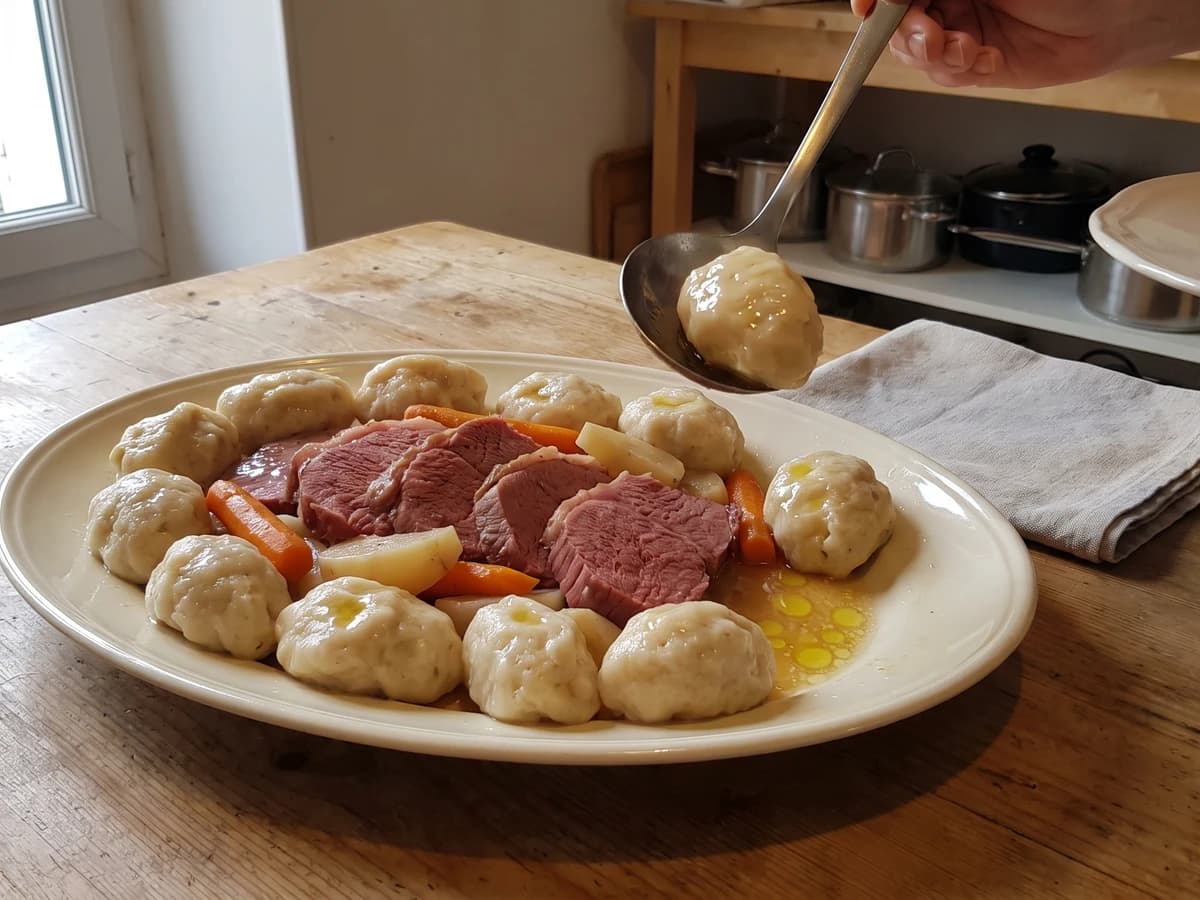
Suet Dumpling
Boulettes au suif, poached beside salt beef, turn equal weights of flour and finely chopped suet into tender, rich dumplings. Keep the beef liquor at a bare tremble and the old garnish works beautifully at home.
A cooking platform built around craft, culture, and the stories behind what we eat.

Created by Chef Juliette
Based on No. 2106, Cabbages for Garnish.—C, from Le Guide Culinaire (1907) by Auguste Escoffier
Supple cabbage leaves hide pilaff rice enriched with foie gras, then braise into glossy, tender packets, a precise little garnish that brings richness and order beside a handsome braised cut.
Choux Farcis pour Garniture C (small cabbage packets with pilaff rice and foie gras) teach the discipline of proportion: the leaf is a wrapper, not the bulk of the bite. Before you touch the pan, know this one thing. The leaves must be supple, cold, and thoroughly dry before filling. That keeps the seams closed and the rich center undiluted.
The original entry assumed a brigade with cooked pilaff rice and foie-gras purée waiting cold, a sautépan ready, and the braising method from Cabbages for Garnish.—A (No. 2104) already known. At home, use one wide lidded sauté pan and stop at twelve packets, three per person. The brigade quantity and service choreography are scaffolding, so they go. The parboiling, cooling, drying, tablespoon of pilaff rice in each leaf, foie-gras enrichment, and referenced braise are the dish, so they stay. One cook, one stove, one evening.
Done well, the Choux Farcis arrive as compact jade parcels, glossy from the braise, with separate grains of rice carrying the deep richness of foie gras. Guard the draining before you fill. It decides whether these are neat packets or wet bundles.
Choux pour garniture C belongs not to one province but to the formal service table of Paris, where small stuffed vegetables were arranged beside braised cuts rather than served as a separate course. It draws on the household chou farci known across France, then changes its scale and register: a single large cabbage becomes individual leaves filled with pilaff rice and foie gras. The letter C marks its place in a working series, not a regional claim; the shared braise links the garnitures while the filling distinguishes each one.
Quantity
12, plus 4 spare leaves if needed
Quantity
3/4 cup (180 ml / 120 g)
fully cooled
Quantity
1/4 cup (60 ml / 60 g)
cool but spreadable
Quantity
1 recipe Cabbages for Garnish.—A (No. 2104)
used for its braising method
| Ingredient | Quantity |
|---|---|
| large Savoy cabbage leaves | 12, plus 4 spare leaves if needed |
| cooked pilaff ricefully cooled | 3/4 cup (180 ml / 120 g) |
| foie-gras puréecool but spreadable | 1/4 cup (60 ml / 60 g) |
| referenced braising preparationused for its braising method | 1 recipe Cabbages for Garnish.—A (No. 2104) |
Ease twelve broad leaves from the cabbage without splitting them, beginning at the outside and cutting each one free at its base. Keep four smaller leaves nearby for repairs or double wrapping. Rinse away any grit, but leave the thick center ribs intact until the leaves have softened.
Lower the leaves in batches into a wide pot of gently boiling water. Parboil them for 2 to 3 minutes, just until the thick ribs bend without snapping and the green remains clear. Cool them immediately in very cold water, drain, and spread them flat between clean towels. Press until thoroughly dry, then shave the raised ribs level with a small knife without piercing the leaves. Wet cabbage makes loose packets and waters the filling, so don't hurry this drying.
Fold the fully cooled pilaff rice gently through the foie-gras purée until every grain carries a thin coating but remains distinct. Don't beat it into a paste. If warm rice melts the foie gras and the mixture turns greasy, spread it on a cold plate and refrigerate it for 10 minutes. Ça se rattrape. The finished pilaff and purée should already carry their seasoning, so taste before adding anything.
Lay each leaf inner side up. Place one-twelfth of the filling in the center, about 1 tablespoon plus 1 teaspoon (20 ml / 15 g), which gives every packet the prescribed tablespoon of pilaff rice plus its share of foie-gras purée. Fold the sides over the filling, bring up the base, and roll toward the tip to make a compact round packet. If one is too full to close without strain, remove a little filling. If a leaf is small or split, overlap a second leaf around it rather than forcing the seam.
Choose a shallow sauté pan just wide enough to hold the twelve packets in one close layer. Set them in one by one, seam-side down, so they support one another without being crushed. A second layer cooks unevenly and encourages the lower packets to open.
Braise the packets exactly as directed in Cabbages for Garnish.—A (No. 2104), keeping that preparation's braising medium, seasoning, cover, heat, and timing intact. They are ready when a knife slips through the folded cabbage without drag and each packet still holds its shape. If a seam lifts during cooking, tuck it beneath its neighbor and turn the packet seam-side down with two spoons.
Let the packets settle for 2 minutes, then lift them with a broad spoon or small flexible spatula so the softened leaves don't tear. Arrange three per person beside a braised piece, seams underneath, with their braising gloss intact. They need no decorative flourish. À table!
1 serving (about 145g)
Culinary guides, cultural storytelling, and the editorial depth that makes cooking meaningful.
Discover Culinary ExplorerChef Juliette
Boulettes au suif, poached beside salt beef, turn equal weights of flour and finely chopped suet into tender, rich dumplings. Keep the beef liquor at a bare tremble and the old garnish works beautifully at home.

Chef Juliette
Bread, flour, frangipane, and rice become four cool, supple panades for binding forcemeats, each changing body and flavor while preserving tenderness. The finest Mousselines need none, and knowing that distinction is the lesson.

Chef Juliette
Panade au pain is bread, milk, salt, heat, and attention: stir until the paste releases cleanly, butter it against a skin, and you have the quiet binder behind tender French farces.

Chef Juliette
Panade de farine teaches the drying stroke behind pâte à choux: flour meets boiling buttered water, then stays over the fire until the paste gathers, smooths, and quits the pan cleanly.