
Chef Juliette
John Dory (St. Pierre)
John Dory has the delicacy of sole and the firmness of turbot. A light flouring, a quick butter sauté, and nut-brown beurre noisette show exactly why looks never mattered.
A cooking platform built around craft, culture, and the stories behind what we eat.

Created by Chef Juliette
Based on No. 1931, Alouettes du Père Philippe, from Le Guide Culinaire (1907) by Auguste Escoffier
A tiny game bird, bacon, butter, and a hollow potato become one sealed parcel, baked until the potato drinks the juices and serves as both cooking pot and supper.
Alouettes du Père Philippe (Père Philippe’s larks baked inside potatoes) teaches cuisson à l’étouffée, cooking in a sealed enclosure. The potato is not a garnish here. It is the pot, and the one true thing to know before touching a pan is that its walls must be even and its lid must close tightly. Leave a thin place and the juices escape; seal it properly and bird, bacon, butter, and potato cook as one.
The old formula needed neither a saucier nor stock kept warm. Its brigade luxury was different: fine larks ready for the pan, a root-spoon, and a live hearth whose cinders could be renewed by another pair of hands. Wild larks are protected or unavailable in many markets, so four small farmed quail take their place honestly. Quail are larger, which requires extra-large potatoes and a longer cooking time. A hot home oven, oiled parchment, and a snug outer wrapping of foil replace the enclosing cinders. One cook, one stove, one evening.
The outer foil is scaffolding, a clean way to reproduce the pressure and surrounding heat of an ash bed. Hollowing the potato, raidir, or stiffening, the bird in butter, keeping the book’s one-third ounce of bacon per bird, and sealing each matching lid are the dish itself. Don't rush the hollowing. An even potato shell is the step that decides everything that follows.
Alouettes du Père Philippe belongs to the named game-bird preparations of the French classical grand-kitchen table, and its formula makes no claim to Lyon, Provence, or another regional larder. Its method traveled from hearth cookery into the codified repertoire: hot cinders surrounded an oiled-paper parcel while an ordinary potato became both casserole and edible casing. Père Philippe remains the dedicatee named in the title, but the enduring idea is structural, a tiny bird, salted pork, and butter sealed so none of their juices can escape.
Quantity
4, each 12 to 14 oz (340 to 400 g)
scrubbed
Quantity
4, each 4 to 5 oz (115 to 140 g)
oven-ready with heads and feet removed
Quantity
¼ cup (60 ml / 38 g) prepared by Blanchings (No. 273)
cut into ¼-inch dice
Quantity
3 tablespoons (45 ml / 42 g)
Quantity
1 tablespoon (15 ml / 14 g)
for the parchment
Quantity
½ teaspoon (2.5 ml / 3 g)
divided
| Ingredient | Quantity |
|---|---|
| extra-large russet or other floury baking potatoesscrubbed | 4, each 12 to 14 oz (340 to 400 g) |
| small farmed quailoven-ready with heads and feet removed | 4, each 4 to 5 oz (115 to 140 g) |
| unsmoked salted pork bellycut into ¼-inch dice | ¼ cup (60 ml / 38 g) prepared by Blanchings (No. 273) |
| unsalted butter | 3 tablespoons (45 ml / 42 g) |
| neutral oilfor the parchment | 1 tablespoon (15 ml / 14 g) |
| fine saltdivided | ½ teaspoon (2.5 ml / 3 g) |
Set a heavy rimmed baking sheet or cast-iron griddle in the lower third of the oven and heat to 425°F (220°C). Cut four 14-inch (35 cm) squares each of baking parchment and heavy foil. Brush one face of every parchment square lightly with the oil. The preheated metal gives strong heat beneath the parcels, while the oven surrounds them as the renewed cinders once did.
Keep each potato whole and unpeeled. From one long side, cut a matching lid about ⅙ inch (4 mm) thick, then use a melon baller or root-spoon to hollow the potato, leaving an even shell about ⅜ inch (1 cm) thick. Preserve each lid with its own potato. Season the cavities with half the salt. If the spoon breaks through a wall, ça se rattrape: press a thin shaving of the reserved potato firmly over the opening from inside, smear it with a little butter, and place that side against the parchment when wrapping.
Pat the quail dry and season them lightly with the remaining salt, remembering that the pork is already salted. Have the diced pork belly prepared by Blanchings (No. 273) and pat it dry. Melt the butter in a 12-inch (30 cm) skillet over medium heat until it foams. Raidir the quail in two batches, turning each for 60 to 90 seconds, only until the skin loses its raw shine and the flesh firms slightly. Do not brown or cook them through. Return all four birds to the skillet, add the bacon dice, and turn everything together for 30 seconds. Take the pan from the heat and retain every spoonful of its butter and pork fat. If the butter colors too quickly, lower the heat and add a small piece of fresh butter. Ça se rattrape, provided the fat has not turned bitter.
Divide a few bacon dice among the potato cavities. Fold each quail’s legs and wings close to its body, settle one bird into each potato, and distribute the remaining bacon and cooking fat around and over them. Return every lid in its original direction. If a lid rocks, shave potato from its underside rather than compressing the bird. Tie each potato crosswise with kitchen twine so the lid cannot lift. Set it oiled-parchment side down, wrap closely, then enclose it in foil with the seam uppermost. The tight lid is the dish; treat it with more attention than the parcel’s appearance.
Place the wrapped potatoes seam-side up on the preheated sheet. Bake for 55 to 65 minutes, turning each parcel carefully after 30 minutes so the potato cooks evenly. Test one after 50 minutes: a thin knife should pass through the potato shell without resistance, and a thermometer inserted through the lid seam into the thickest part of the quail should register 165°F (74°C). If either is short of its mark, rewrap the parcel and return all four for 8 to 10 minutes. The original larks needed about 40 minutes in cinders; larger farmed quail and their larger potato vessels need this added time.
Rest the parcels for 8 minutes, then remove the foil and parchment and set one potato on each plate. Cut the twine, lift the lid away from your hands, and spoon the pooled butter and bacon juices back over the quail. The tender potato flesh is eaten with the bird, scraped directly from its shell. Bring them to the table while the cut edges still gleam. À table!
1 serving (about 390g)
Culinary guides, cultural storytelling, and the editorial depth that makes cooking meaningful.
Discover Culinary ExplorerChef Juliette
John Dory has the delicacy of sole and the firmness of turbot. A light flouring, a quick butter sauté, and nut-brown beurre noisette show exactly why looks never mattered.

Chef Juliette
Fresh haddock proves its delicacy in the meunière pan: a fine flour crust, moist pearly flakes, and beurre noisette sharpened with lemon and parsley, ready from one skillet in half an hour.
Chef Juliette
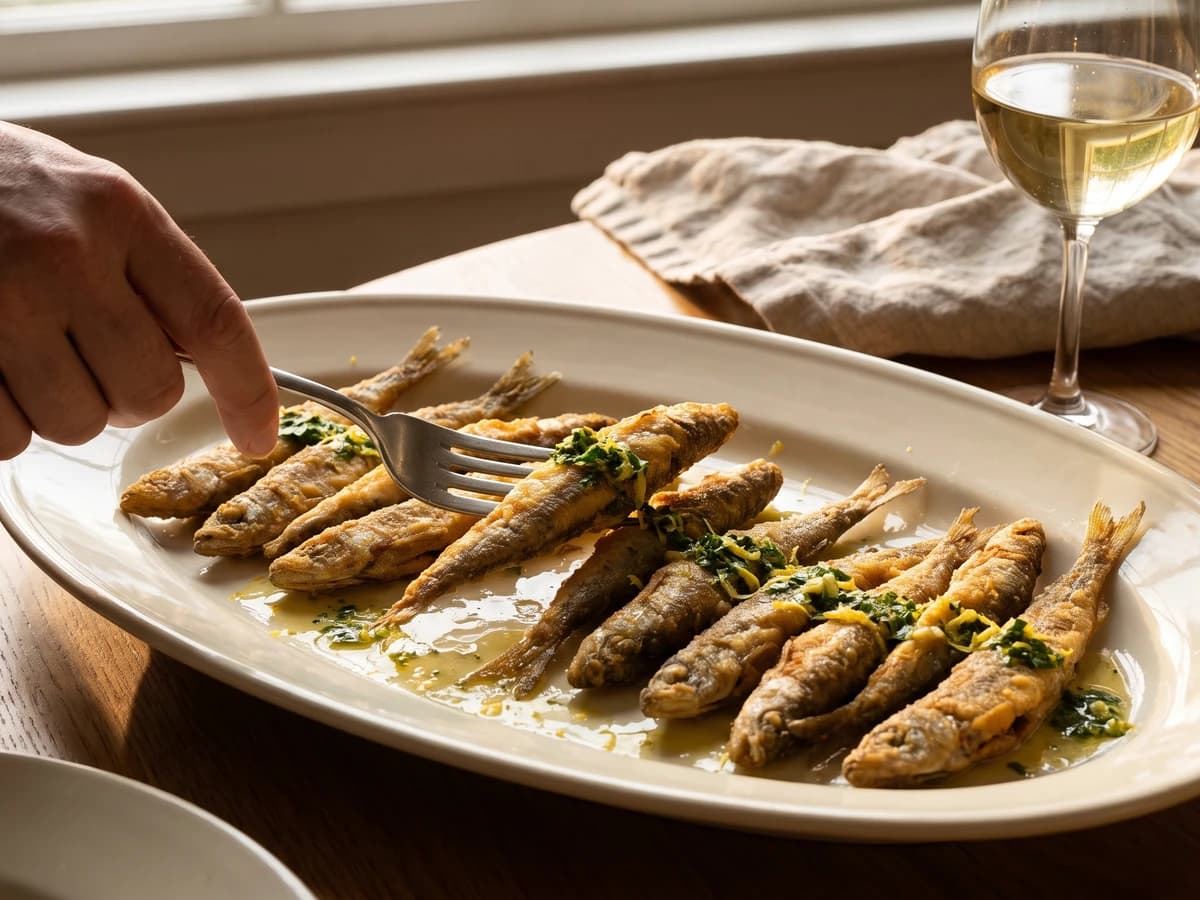
Éperlans à l’Anglaise turns small fish into a lesson in disciplined coating: boned smelts under a close, crisp crumb, pan-fried in clarified butter and finished with bright, half-melted maître d’hôtel butter.

Chef Juliette
Tiny smelts, shallot, mushrooms, white wine, gratin sauce, and fine bread raspings meet a fierce oven, where the fish must turn tender in the same breath the buttered crust bronzes.