
Chef Juliette
John Dory (St. Pierre)
John Dory has the delicacy of sole and the firmness of turbot. A light flouring, a quick butter sauté, and nut-brown beurre noisette show exactly why looks never mattered.
A cooking platform built around craft, culture, and the stories behind what we eat.

Created by Chef Juliette
Based on No. 1839, Faisan Grillé Diable, from Le Guide Culinaire (1907) by Auguste Escoffier
Faisan Grillé Diable turns a young pheasant into a burnished dinner of Dijon mustard, cayenne, fine crumbs, and butter, with gentle heat protecting the tender meat beneath the crisp crust.
Faisan Grillé Diable (young pheasant grilled with a mustard and breadcrumb crust) teaches command of the fire. The one true thing to know before touching a pan is that only a young, tender bird belongs here. Grilling can bronze pheasant beautifully, but it cannot soften an old bird before the breast dries.
The original kitchen assumed a saucier on staff, a stock never off the fire for the accompanying Devilled Sauce Escoffier, and a salamander whose fierce top heat could be moderated by distance. At home, the sauce remains a separate prepared component, while a wire rack, a rimmed sheet pan, and an ordinary broiler set well back from the element reproduce the intended finish. Two small birds feed four. One cook, one stove, one evening.
Formal entrée trussing and the butcher's beater were brigade scaffolding, so they can go; kitchen shears, a boning knife, and the flat base of a heavy skillet do the work more sensibly. The partial oven cooking, mustard sharpened with cayenne, firmly pressed crumbs, real butter, and patient final grilling are the dish itself, and every one stays. That final heat matters most: bronze the coating slowly enough that the pheasant finishes cooking before the crumbs scorch.
Faisan Grillé Diable belongs to the classical grand-kitchen repertoire centered in Paris, where à la diable signified mustard, peppery heat, breadcrumbs, and a sharp accompanying sauce rather than the larder of any particular French region. The pheasant preparation traveled directly from the established method for young chicken, with the more delicate game bird admitted only when tender enough to withstand grilling. A common misconception hides in the name: the bird does not begin raw over the grill, but is first partly cooked in the oven before receiving its mustard crust.
Quantity
2 birds, 1½ to 2 pounds each (680 to 900 g each), using Poulet de Grains Grillé Diable (No. 1636) as the preparation method
split down the back, flattened, and partially boned
Quantity
6 tablespoons (90 ml / 85 g)
melted and divided
Quantity
½ cup (120 ml / 125 g)
Quantity
½ teaspoon (2.5 ml / 1 g)
Quantity
1½ cups (360 ml / 150 g)
Quantity
2 teaspoons (10 ml / 12 g)
Quantity
1 teaspoon (5 ml / 2 g)
Quantity
2
sliced into thin rounds
Quantity
1 cup (240 ml / 240 g)
kept as the separate finished preparation specified by the source
| Ingredient | Quantity |
|---|---|
| young farmed pheasantssplit down the back, flattened, and partially boned | 2 birds, 1½ to 2 pounds each (680 to 900 g each), using Poulet de Grains Grillé Diable (No. 1636) as the preparation method |
| unsalted buttermelted and divided | 6 tablespoons (90 ml / 85 g) |
| smooth Dijon mustard | ½ cup (120 ml / 125 g) |
| cayenne pepper | ½ teaspoon (2.5 ml / 1 g) |
| fine unseasoned dry breadcrumbs | 1½ cups (360 ml / 150 g) |
| fine salt | 2 teaspoons (10 ml / 12 g) |
| freshly ground black pepper | 1 teaspoon (5 ml / 2 g) |
| small lemonssliced into thin rounds | 2 |
| prepared Devilled Sauce Escoffierkept as the separate finished preparation specified by the source | 1 cup (240 ml / 240 g) |
Heat the oven to 400°F (200°C). Cut each pheasant open lengthwise through the middle of the back with sturdy kitchen shears, then spread it breast-side up like a book. With a small boning knife, remove the narrow backbone, rib cages, wishbone, and any loose pelvic bones you can reach cleanly; leave the wing and drumstick bones so the bird retains its shape. Cover with parchment and press firmly with the flat base of a heavy skillet until the breast and legs lie at nearly the same height. This is the practical home translation of Poulet de Grains Grillé Diable (No. 1636). Do not hammer the breast thin, or it will cook before the legs.
Pat both sides thoroughly dry, then season with the salt and black pepper. Set the birds skin-side up on a wire rack fitted inside a rimmed sheet pan and brush them with 2 tablespoons (30 ml / 28 g) of the melted butter. Roast without turning for 10 to 14 minutes, until the surface has tightened, the flesh has lost its raw translucence, and the thickest part of the breast registers about 120 to 125°F (49 to 52°C). This is deliberately only a partial cooking, so move directly to the coating rather than letting the birds cool.
Stir the Dijon mustard and cayenne together, then coat both sides of each warm bird thoroughly, reaching into the joints and along the edges. Sprinkle the breadcrumbs copiously over the mustard and press them down with the flat of a broad knife or spatula so they adhere as one even jacket. Turn the birds carefully and repeat on the second side, then trickle the remaining 4 tablespoons (60 ml / 57 g) melted butter over the crumbs. If the coating slides away, stop. Ça se rattrape: scrape off the loose patch, blot away excess butter, apply a thin fresh layer of mustard, and press on more crumbs.
Change the oven to low broil and position the rack about 8 inches (20 cm) below the element. Broil the birds meat-side up for 4 to 5 minutes, then turn them with two broad spatulas and finish skin-side up for another 5 to 8 minutes, rotating the pan whenever one edge colours faster. The crust should become deep butter-gold and crisp while the mustard remains ochre beneath it. Check both breast and thigh away from the bone; each must reach 165°F (74°C). If the crumbs brown before the meat is ready, move the pan to the middle of a 350°F (180°C) oven until the temperature is reached. If the meat is ready but the coating is pale, bring it nearer the broiler for 20 seconds at a time. Patience, not a scorched crust.
Transfer the pheasants to a clean rack and rest them uncovered for 8 to 10 minutes; covering would trap moisture and soften the crust. Meanwhile, warm the prepared Devilled Sauce Escoffier gently in a small saucepan, without allowing it to boil, and pour it into a warmed sauce boat. The source treats this sauce as its own finished preparation, so keep it separate rather than turning the pheasant coating into an improvised pan sauce.
Divide each pheasant into two generous portions, keeping breast and leg together where the shape permits. Arrange the four portions on a warm round platter and border it with the thin lemon slices exactly as the preparation intends. Serve the Devilled Sauce Escoffier separately so each guest can spoon on as much heat and richness as desired. À table!
1 serving (about 310g)
Culinary guides, cultural storytelling, and the editorial depth that makes cooking meaningful.
Discover Culinary ExplorerChef Juliette
John Dory has the delicacy of sole and the firmness of turbot. A light flouring, a quick butter sauté, and nut-brown beurre noisette show exactly why looks never mattered.

Chef Juliette
Fresh haddock proves its delicacy in the meunière pan: a fine flour crust, moist pearly flakes, and beurre noisette sharpened with lemon and parsley, ready from one skillet in half an hour.
Chef Juliette
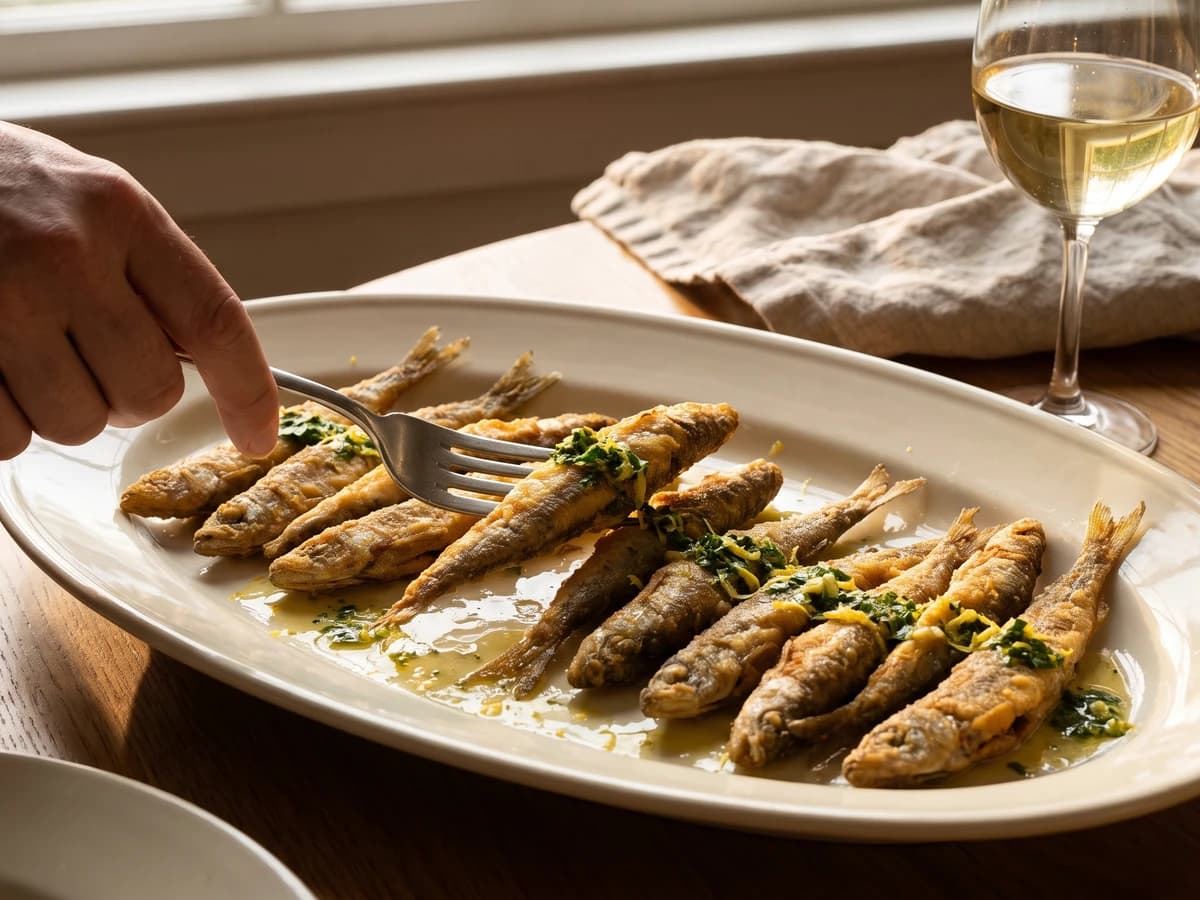
Éperlans à l’Anglaise turns small fish into a lesson in disciplined coating: boned smelts under a close, crisp crumb, pan-fried in clarified butter and finished with bright, half-melted maître d’hôtel butter.

Chef Juliette
Tiny smelts, shallot, mushrooms, white wine, gratin sauce, and fine bread raspings meet a fierce oven, where the fish must turn tender in the same breath the buttered crust bronzes.