
Chef Juliette
John Dory (St. Pierre)
John Dory has the delicacy of sole and the firmness of turbot. A light flouring, a quick butter sauté, and nut-brown beurre noisette show exactly why looks never mattered.
A cooking platform built around craft, culture, and the stories behind what we eat.

Created by Chef Juliette
Based on No. 1636, Poulet de Grains Grillé Diable, from Le Guide Culinaire (1907) by Auguste Escoffier
Poulet de Grains Grillé Diable turns one butter-basted chicken into a burnished weeknight main, with mustard, cayenne, and fine crumbs protecting tender meat while Devilled Sauce Escoffier waits alongside.
Poulet de Grains Grillé Diable (devilled grilled grain-fed chicken) teaches control of heat after coating. The one true thing to know before touching the bird is this: the crumbs must brown at the same pace the chicken finishes cooking. A fierce grill turns them bitter while the joints remain raw; gentle heat gives you a bronze crust, sharp mustard underneath, and properly juicy meat.
The original kitchen assumed a butcher's beater, a salamander whose distance from the fire could be judged by eye, and a saucier drawing from a stockpot that never went cold. Your equivalents are a heavy skillet for flattening, a low broiler with the bird set well beneath it, and prepared Devilled Sauce Escoffier warmed separately. Trussing before splitting was brigade scaffolding and buys the home cook nothing, so it goes. Partial boning, half-roasting in butter, the mustard and cayenne under the crumbs, and the gentle final grill are the dish itself, so every one stays. One cook, one stove, one evening.
The finished chicken should arrive whole on its round platter, deeply golden, edged with thin lemon slices, and glossy where melted butter has caught among the crumbs. Watch the coating during the final cooking. If it colors ahead of the meat, lower the bird and shield the darkest patches; ça se rattrape.
Poulet grillé à la diable belongs to the Parisian classical repertoire of grills, where à la diable signaled mustard and cayenne reinforced by a sharp sauce served separately, never poured over the crumb crust. Poulet de grain names a young, tender, grain-fed bird rather than a regional breed, and that tenderness made it suitable for quick dry cooking instead of a braise. The dish traveled readily from grand dining rooms to bourgeois home tables because its defining sequence, half-roast, coat, and grill gently, requires attention more than equipment.
Quantity
1 chicken (3½ to 4 lb / 1.6 to 1.8 kg)
backbone removed, opened flat, and partially boned
Quantity
2 teaspoons (10 ml / 12 g)
Quantity
1 teaspoon (5 ml / 2 g)
Quantity
6 tablespoons (90 ml / 85 g)
melted and divided
Quantity
⅓ cup (80 ml / 85 g)
Quantity
¼ teaspoon (1.25 ml / 0.5 g)
Quantity
1½ cups (360 ml / 90 g)
Quantity
1
cut into very thin slices
Quantity
¾ cup (180 ml / about 190 g)
for serving
| Ingredient | Quantity |
|---|---|
| small young chickenbackbone removed, opened flat, and partially boned | 1 chicken (3½ to 4 lb / 1.6 to 1.8 kg) |
| fine sea salt | 2 teaspoons (10 ml / 12 g) |
| freshly ground black pepper | 1 teaspoon (5 ml / 2 g) |
| unsalted buttermelted and divided | 6 tablespoons (90 ml / 85 g) |
| Dijon mustard | ⅓ cup (80 ml / 85 g) |
| cayenne pepper | ¼ teaspoon (1.25 ml / 0.5 g) |
| fine fresh white breadcrumbs | 1½ cups (360 ml / 90 g) |
| lemoncut into very thin slices | 1 |
| prepared Devilled Sauce Escoffierfor serving | ¾ cup (180 ml / about 190 g) |
Heat the oven to 400°F (200°C), with a rack in the middle. Set the chicken skin-side down on the cutting board. If the butcher hasn't done the partial boning, use poultry shears and a boning knife to remove the backbone, rib cage, wishbone, and breastbone while leaving the leg and wing bones attached. Cover the bird with parchment and press or tap it with a heavy skillet until the breast and thighs lie in one even plane. Don't pulverize the flesh; the purpose is even thickness, not punishment. Pat both sides dry, then season with the salt and black pepper.
Set a wire rack inside a rimmed sheet pan and place the chicken on it skin-side up, tucking the wing tips underneath. Brush both sides with half of the melted butter, using about 3 tablespoons (45 ml / 43 g). Roast for 22 to 28 minutes, rotating the pan once, until the skin is pale gold and beginning to tighten but the chicken is not yet cooked through. An instant-read thermometer should show roughly 120°F to 125°F (49°C to 52°C) in the breast. Continue directly to coating and grilling; don't leave a partially cooked bird standing.
Set the broiler to low and move its rack 8 to 10 inches (20 to 25 cm) beneath the element. Stir the Dijon mustard and cayenne together, then brush the mixture thoroughly over the skin and every exposed edge of the hot chicken. Scatter the breadcrumbs copiously over the mustard. Lay the flat of a broad knife or spatula gently against them so they adhere without becoming compacted, then trickle the remaining melted butter evenly over the coating. Mustard is the adhesive and the seasoning; butter helps the crumbs color and keeps them generous.
Return the chicken to the rack and broil gently for 12 to 20 minutes, rotating the pan every 4 to 5 minutes so the crumbs color evenly. The crust should deepen slowly from butter gold to an even Maillard bronze. Cook until the thickest part of the breast reaches 165°F (74°C) and the thigh reaches at least 175°F (79°C). If the crumbs darken before the meat is ready, lower the rack, cover only the darkest areas loosely with foil, and continue cooking. If one patch has blackened, lift away those crumbs, dab on a little mustard, and replace them with fresh crumbs. Ça se rattrape.
While the chicken finishes, warm the prepared Devilled Sauce Escoffier in a small saucepan over the gentlest heat, whisking occasionally. Keep it below a simmer so its finish remains smooth. If butter begins to bead on the surface during reheating, take the pan off the heat and whisk in a teaspoon of warm water until the sauce comes together again. Hold it warm for serving, still separate from the chicken so the crust stays crisp.
Rest the chicken for 8 to 10 minutes on a warm round platter. Border it with the thin lemon slices exactly as the dish intends, then bring the Devilled Sauce Escoffier to the table in a warm sauceboat. Carve the bird into breast and leg portions after everyone has seen the burnished whole. Spoon the sauce beside each portion, never over the crumbs. À table!
1 serving (about 330g)
Culinary guides, cultural storytelling, and the editorial depth that makes cooking meaningful.
Discover Culinary ExplorerChef Juliette
John Dory has the delicacy of sole and the firmness of turbot. A light flouring, a quick butter sauté, and nut-brown beurre noisette show exactly why looks never mattered.

Chef Juliette
Fresh haddock proves its delicacy in the meunière pan: a fine flour crust, moist pearly flakes, and beurre noisette sharpened with lemon and parsley, ready from one skillet in half an hour.
Chef Juliette
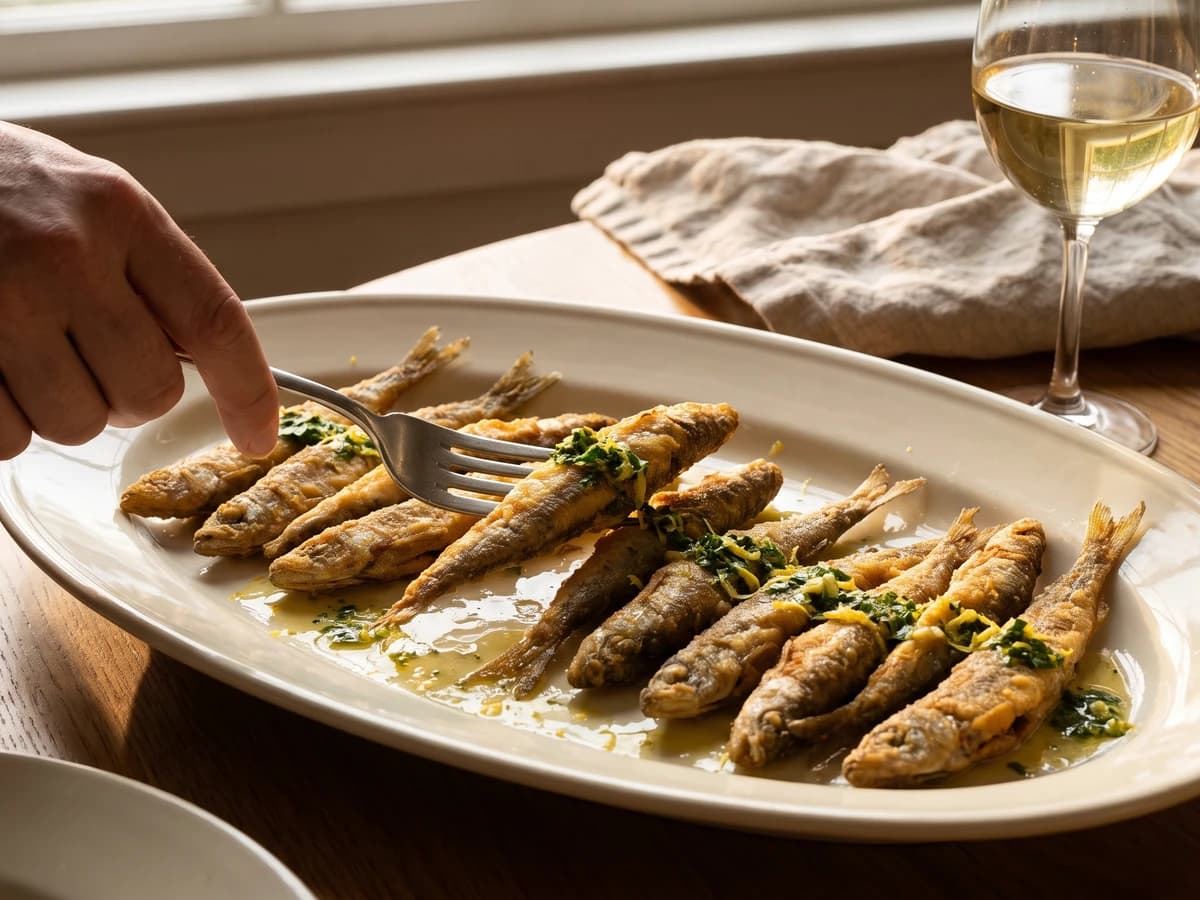
Éperlans à l’Anglaise turns small fish into a lesson in disciplined coating: boned smelts under a close, crisp crumb, pan-fried in clarified butter and finished with bright, half-melted maître d’hôtel butter.

Chef Juliette
Tiny smelts, shallot, mushrooms, white wine, gratin sauce, and fine bread raspings meet a fierce oven, where the fish must turn tender in the same breath the buttered crust bronzes.