
Chef Juliette
John Dory (St. Pierre)
John Dory has the delicacy of sole and the firmness of turbot. A light flouring, a quick butter sauté, and nut-brown beurre noisette show exactly why looks never mattered.
A cooking platform built around craft, culture, and the stories behind what we eat.
Created by Chef Juliette
Based on No. 1762, Caneton Farci à la Rouennaise, from Le Guide Culinaire (1907) by Auguste Escoffier
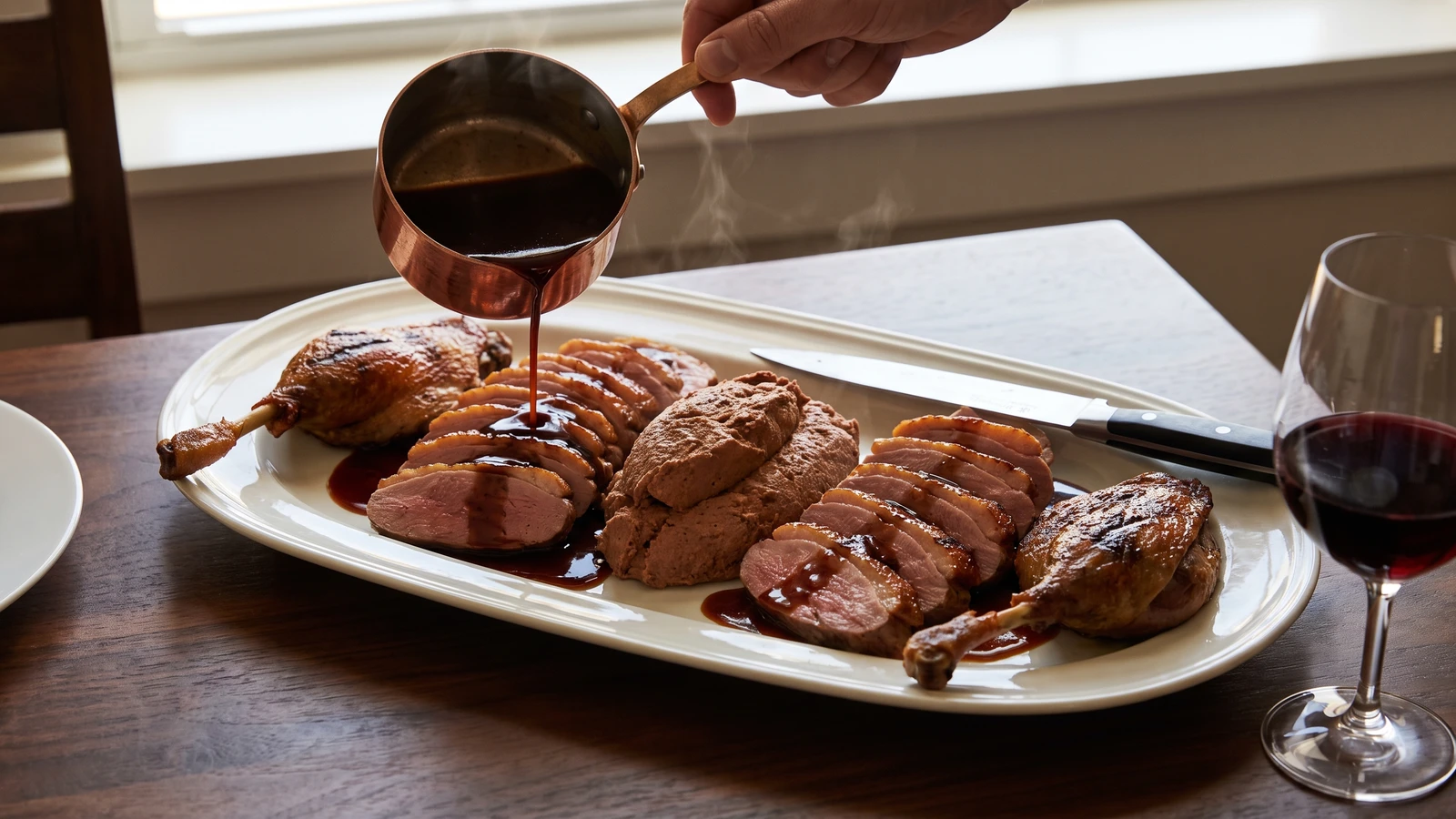
Caneton Farci à la Rouennaise turns one fiercely roasted duckling into a composed feast: rosy breast, grilled legs, liver forcemeat, and Sauce Rouennaise deepened with pressed carcass juices.
Caneton Farci à la Rouennaise teaches a hard, useful truth: a bird is not always cooked to one doneness. The breast must leave the fierce heat rosy and succulent, the legs need a second grilling, the liver forcemeat must be hot through, and the sauce waits for the last dark juices from the carcass. Try to finish all four in the roasting pan and you lose the dish before carving begins.
The original assumed a saucier with Sauce Rouennaise at hand, stock never off the fire, a fierce hearth, a salamander, a duck press, and extra hands to carve while everything stayed hot. Here, one young duckling feeds four. A fully heated oven replaces the hearth, the broiler replaces the salamander, and a sturdy colander, shears, and a heavy saucepan replace the press. The separate carver and tableside performance are brigade scaffolding and can go. The liver stuffing, brief roast, grilled legs, and pressed carcass juices must stay, because they are the dish. One cook, one stove, one evening.
When it lands correctly, you have burnished skin, rosy slices, crisp-edged legs, soft liver forcemeat, and a dark Sauce Rouennaise sharpened with Cognac and a few drops of lemon. Work by temperature rather than bravado, and remove the forcemeat to finish separately if it lags behind. The fierce, brief roast is the step that decides everything; read the thermometer early, then move briskly once the bird leaves the oven.
Caneton Farci à la Rouennaise belongs to Rouen and the lower Seine in Normandy, where young Rouen and Duclair ducks were prized for flesh that tolerated a fierce, brief roast. Birds intended for the regional sauce were traditionally kept unbled, and pressing the chopped carcass recovered their blood-rich juices and roasting liquor; the press was practical before it became ceremony. The dish traveled from Norman tables into grand service, where roasting, grilling, carving, pressing, and sauce work were divided among several hands, although its intent remains a generous platter made from every useful part of one bird.
Quantity
1, weighing 4 to 4½ pounds (1.8 to 2 kg)
giblets removed and skin dried
Quantity
1 full batch (No. 1754), about 1½ cups (360 ml / 370 g)
prepared through its own entry and half-cooled
Quantity
2 teaspoons (10 ml / 12 g)
divided
Quantity
1 teaspoon (5 ml / 2 g)
divided
Quantity
1¼ cups (300 ml / 315 g)
Quantity
¼ cup (60 ml / 57 g)
Quantity
½ teaspoon (2.5 ml / 3 g)
Quantity
1 tablespoon (15 ml / 15 g)
for rescuing the sauce if needed
| Ingredient | Quantity |
|---|---|
| young ducklinggiblets removed and skin dried | 1, weighing 4 to 4½ pounds (1.8 to 2 kg) |
| duck-liver forcemeat from Caneton Rouennaisprepared through its own entry and half-cooled | 1 full batch (No. 1754), about 1½ cups (360 ml / 370 g) |
| fine sea saltdivided | 2 teaspoons (10 ml / 12 g) |
| freshly ground black pepperdivided | 1 teaspoon (5 ml / 2 g) |
| prepared Sauce Rouennaise | 1¼ cups (300 ml / 315 g) |
| Cognac | ¼ cup (60 ml / 57 g) |
| freshly squeezed lemon juice | ½ teaspoon (2.5 ml / 3 g) |
| cold water (optional)for rescuing the sauce if needed | 1 tablespoon (15 ml / 15 g) |
Set a rack in the upper third of the oven and heat it to 500°F (260°C), or 475°F (245°C) with convection, for at least 30 minutes. Fit a metal roasting pan with a low rack, set a broiler-safe tray nearby, and have the Sauce Rouennaise measured into a small saucepan. The original fierce fire was fierce before the bird arrived; an oven still climbing toward temperature gives pale skin and slow, uneven cooking.
Pat the cavity and skin completely dry. Spoon the half-cooled duck-liver forcemeat from Caneton Rouennais (No. 1754) into the cavity without packing it hard; a dense plug heats too slowly. Close the opening with skewers or kitchen string, tie the legs loosely together, and season the bird with half the salt and pepper. Reserve the rest for the legs.
Set the duckling breast-side up on the rack and roast for 25 to 30 minutes, according to size, until the skin is burnished and taut. Begin checking at 23 minutes: the thickest breast should reach 145°F (63°C), away from bone, and the centre of the forcemeat must reach 165°F (74°C). Rest the duck untouched for at least 9 minutes. If the breast is ready before the forcemeat, remove the bird, spoon the forcemeat into a shallow ovenproof dish, and finish it separately to 165°F while the duck rests. Ça se rattrape. Do not sacrifice the breast by roasting the whole bird dry.
Switch the oven to its high broiler. Detach each leg cleanly through the joint, then cisel the inner flesh, meaning make close, shallow cuts almost to the bone at ½-inch intervals without cutting through the skin. Season the cuts well with the reserved salt and pepper, brush them with a little rendered duck fat from the roasting pan, and broil 4 to 6 inches from the heat. Give the inner side about 3 minutes, then turn the skin toward the heat until crisp and the thickest meat reaches 165°F (74°C). If the skin colours too quickly, lower the tray one level and finish with the cut side facing upward.
Run a sharp knife down either side of the breastbone and lift off each breast fillet with its skin intact. Slice the fillets thinly across the grain, keeping each side in order. Remove the forcemeat from the cavity in generous spoonfuls and keep it covered. Pour the resting and carving juices into a bowl, let the clear fat rise, and spoon off most of that fat without discarding the dark liquor beneath.
While the carcass is still warm, cut it roughly into 2-inch pieces with poultry shears. Set a sturdy metal colander over a bowl, add the pieces in batches, and sprinkle them gradually with the Cognac and lemon juice. Keep the Cognac away from the lit broiler and any open flame. Crush the bones and joints firmly with the base of a small heavy saucepan until no more dark gravy falls, then add the reserved carving juices and pass all the collected liquid through a fine-mesh sieve.
Warm the Sauce Rouennaise over the lowest heat, stirring steadily, then whisk in every drop of the strained carcass gravy. Bring it only to the point where it coats the back of a spoon in a thin, glossy layer. Do not let it boil. If the edge turns grainy, remove the pan from the heat immediately, whisk in cold water a teaspoon at a time, and strain into a clean warm pan. Ça se rattrape if you catch it early; a rolling boil cannot be taken back.
Warm a long platter with hot water and dry it thoroughly. Arrange the thin breast slices in two overlapping rows along its sides, place the hot forcemeat down the middle, and set one grilled leg at each end. Coat the breast lightly with Sauce Rouennaise so the rosy meat remains visible, then send the remaining sauce separately to the table. This is generous carving, not plating theatre. À table!
1 serving (about 360g)
Culinary guides, cultural storytelling, and the editorial depth that makes cooking meaningful.
Discover Culinary ExplorerChef Juliette
John Dory has the delicacy of sole and the firmness of turbot. A light flouring, a quick butter sauté, and nut-brown beurre noisette show exactly why looks never mattered.

Chef Juliette
Fresh haddock proves its delicacy in the meunière pan: a fine flour crust, moist pearly flakes, and beurre noisette sharpened with lemon and parsley, ready from one skillet in half an hour.

Chef Juliette
Éperlans à l’Anglaise turns small fish into a lesson in disciplined coating: boned smelts under a close, crisp crumb, pan-fried in clarified butter and finished with bright, half-melted maître d’hôtel butter.

Chef Juliette
Tiny smelts, shallot, mushrooms, white wine, gratin sauce, and fine bread raspings meet a fierce oven, where the fish must turn tender in the same breath the buttered crust bronzes.