
Chef Juliette
John Dory (St. Pierre)
John Dory has the delicacy of sole and the firmness of turbot. A light flouring, a quick butter sauté, and nut-brown beurre noisette show exactly why looks never mattered.
A cooking platform built around craft, culture, and the stories behind what we eat.

Created by Chef Juliette
Based on No. 1754, Caneton Rouennais, from Le Guide Culinaire (1907) by Auguste Escoffier
A Rouen duckling roasted pink, its burnished cavity filled with duck liver, unsmoked bacon, onion, parsley, and quatre-épices, the forcemeat barely stiffened before it is worked through a fine sieve.
Caneton Rouennais (Rouen-style roast duckling) teaches restraint with heat. The duck must remain rosy, and the liver inside it must be merely stiffened before it is pounded and sieved. The one true thing is this: cook either one too far and you lose the tenderness that defines the dish.
The original entry needs none of the canon's usual saucier, stockpot, or salamander. It assumes instead a young Rouen bird, a mortar, a fine tamis, and brigade hands free to pound eight ounces of liver into silk. At home, one duckling feeds four, a small food processor replaces the pounding, and a sturdy fine-mesh sieve does the work of the tamis. I have changed the labor and the portion, not the sequence or its proportions: four ounces of larding bacon, one ounce of onion, and eight ounces of duck liver remain intact. The mortar work was brigade scaffolding and can go. Barely stiffening the liver, sieving it fine, and roasting the bird without drying it are the dish itself, and they stay.
Done properly, the skin comes out deeply burnished, the breast remains rosy beneath it, and the forcemeat is smooth, rich, and faintly spiced rather than coarse or crumbly. Watch the liver first. The instant its surface firms while the center remains pink, take the pan from the heat; that is the step that decides everything afterward.
Caneton Rouennais belongs to Rouen and the lower Seine valley in Normandy, where young ducks raised near the waterways became prized for roasting while their flesh remained pink. Rouen duck is often confused with canard à la presse, but the regional bird supports several classical preparations; this entry specifies roasting rather than braising, apart from the exceptional cold service à la cuiller. When stuffed, its defining filling is a finely sieved mixture of duck liver, larding bacon, onion, parsley, and restrained spice.
Quantity
1 bird, 4½ to 5 pounds (2 to 2.3 kg)
giblets removed and liver reserved
Quantity
¾ cup (180 ml / 113 g)
diced
Quantity
3 tablespoons (45 ml / 28 g)
finely chopped
Quantity
1½ cups (350 ml / 227 g)
trimmed and sliced
Quantity
1 teaspoon (5 ml / 1 g)
finely chopped
Quantity
1½ teaspoons (7.5 ml / 9 g)
divided
Quantity
¾ teaspoon (3.75 ml / 1.5 g)
divided
Quantity
⅛ teaspoon (0.6 ml / 0.3 g)
| Ingredient | Quantity |
|---|---|
| young Rouen ducklinggiblets removed and liver reserved | 1 bird, 4½ to 5 pounds (2 to 2.3 kg) |
| larding bacon or unsmoked fatty bacondiced | ¾ cup (180 ml / 113 g) |
| yellow onionfinely chopped | 3 tablespoons (45 ml / 28 g) |
| duck livers, including the liver from the birdtrimmed and sliced | 1½ cups (350 ml / 227 g) |
| flat-leaf parsleyfinely chopped | 1 teaspoon (5 ml / 1 g) |
| fine sea saltdivided | 1½ teaspoons (7.5 ml / 9 g) |
| freshly ground black pepperdivided | ¾ teaspoon (3.75 ml / 1.5 g) |
| quatre-épices | ⅛ teaspoon (0.6 ml / 0.3 g) |
Set an oven rack in the lower-middle position and heat the oven to 450°F (230°C). Pat the duckling dry inside and out. Prick the fatty skin around the thighs, tail, and lower breast with the point of a skewer without piercing the meat beneath; these little openings let the fat escape while the skin bronzes. Season the cavity and skin with 1 teaspoon (5 ml / 6 g) of the salt and ½ teaspoon (2.5 ml / 1 g) of the pepper, then leave the bird at cool room temperature while you make the forcemeat.
Put the larding bacon in a heavy skillet over medium heat and cook for 4 to 5 minutes, stirring, until it releases its fat and the edges just begin to color. Add the onion and cook for another 3 minutes, until softened but not browned. Raise the heat to medium-high, add the sliced duck livers, parsley, remaining ½ teaspoon (2.5 ml / 3 g) salt, remaining ¼ teaspoon (1.25 ml / 0.5 g) pepper, and the quatre-épices. Toss for only 2 to 3 minutes, until the liver surfaces are firm and colored but the centers remain decidedly pink. Take the pan off the heat at once. If the livers have gone a little farther and the mixture looks dry, ça se rattrape: reserve a tablespoon of the rendered bacon fat and work it back into the paste in the next step.
Let the liver mixture half-cool for 10 to 15 minutes. It should be warm rather than hot, with the fat still supple. Transfer everything to a small food processor and pulse just until it becomes a cohesive paste; prolonged processing warms the fat and makes the forcemeat greasy. Press the paste through a fine-mesh sieve with a flexible spatula, scraping the smooth forcemeat from the underside. The food processor replaces the old mortar, but the sieve does not disappear. It removes sinew and gives the filling its proper fineness. If the paste smears oil across the sieve, chill it for 10 minutes and continue once the fat firms.
Spoon the forcemeat loosely into the duck's cavity, leaving room for heat to circulate. Do not compress it into a solid plug. Fold the neck skin underneath, tie the legs together with kitchen twine, and tuck the wing tips behind the shoulders. Set the duck breast-side up on a rack in a roasting pan. Stuff only immediately before roasting; a filled bird should not wait about the kitchen.
Roast at 450°F (230°C) for 15 minutes, then reduce the oven to 375°F (190°C). Carefully spoon accumulated fat from the pan and continue roasting for 30 to 40 minutes, rotating the pan once. The skin should be deep bronze, the thickest part of the breast should reach 150°F (66°C) and remain at or above that temperature for at least 5 minutes through resting, and the center of the forcemeat must reach 165°F (74°C). If the breast reaches its mark while the forcemeat still lags, do not sacrifice the duck. Ça se rattrape: spoon the forcemeat into a shallow ovenproof dish and return it to the oven until it reaches 165°F (74°C) while the bird rests. If the skin darkens too quickly, shield the breast loosely with foil and leave the legs exposed.
Transfer the duckling to a warm platter and rest it for 15 minutes. Spoon the forcemeat into a warmed serving bowl, remove the twine, and carve off the legs before slicing each breast thickly across the grain. Pour away the clear rendered fat from the roasting pan for another use, then spoon the remaining concentrated duck juices lightly over the carved meat. Serve the forcemeat beside each portion, generous rather than decorative. À table!
1 serving (about 320g)
Culinary guides, cultural storytelling, and the editorial depth that makes cooking meaningful.
Discover Culinary ExplorerChef Juliette
John Dory has the delicacy of sole and the firmness of turbot. A light flouring, a quick butter sauté, and nut-brown beurre noisette show exactly why looks never mattered.

Chef Juliette
Fresh haddock proves its delicacy in the meunière pan: a fine flour crust, moist pearly flakes, and beurre noisette sharpened with lemon and parsley, ready from one skillet in half an hour.
Chef Juliette
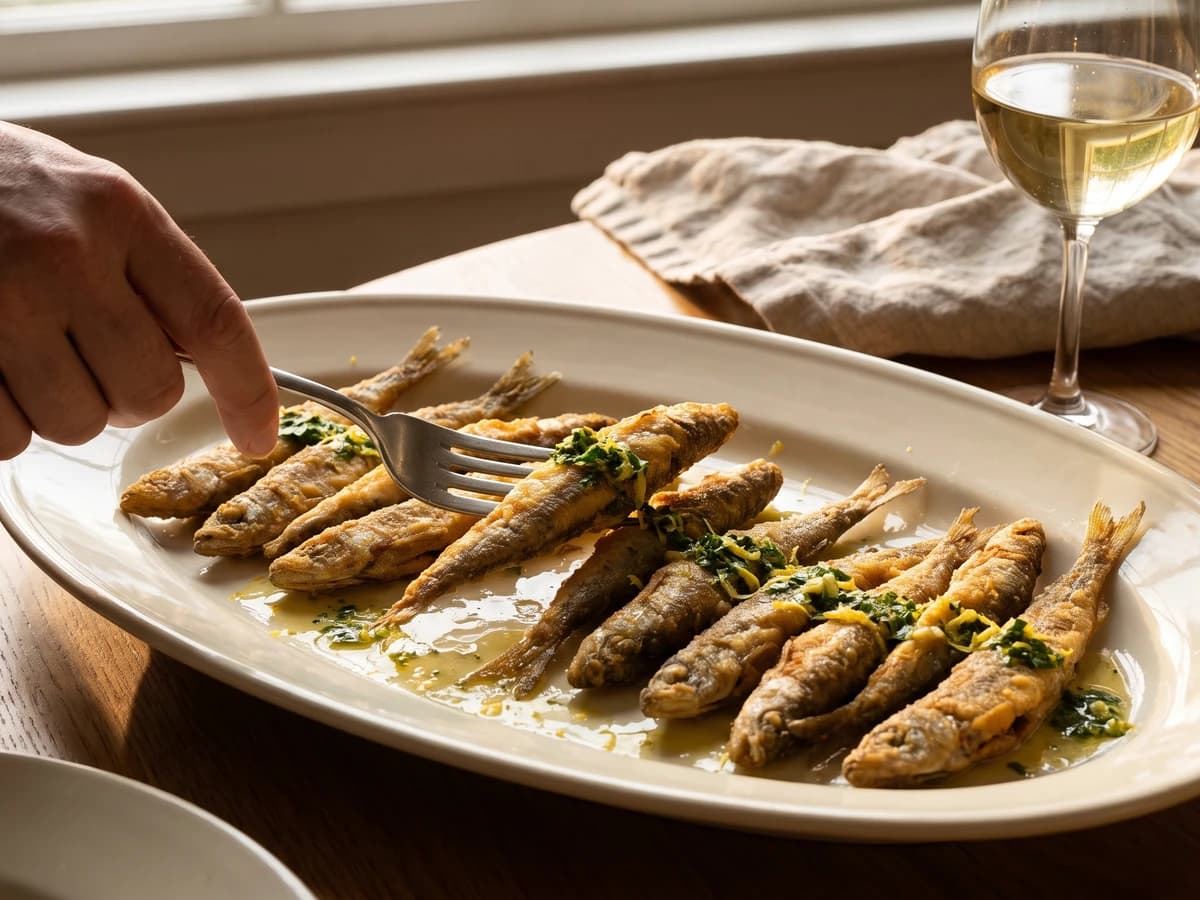
Éperlans à l’Anglaise turns small fish into a lesson in disciplined coating: boned smelts under a close, crisp crumb, pan-fried in clarified butter and finished with bright, half-melted maître d’hôtel butter.

Chef Juliette
Tiny smelts, shallot, mushrooms, white wine, gratin sauce, and fine bread raspings meet a fierce oven, where the fish must turn tender in the same breath the buttered crust bronzes.