
Chef Juliette
John Dory (St. Pierre)
John Dory has the delicacy of sole and the firmness of turbot. A light flouring, a quick butter sauté, and nut-brown beurre noisette show exactly why looks never mattered.
A cooking platform built around craft, culture, and the stories behind what we eat.
Created by Chef Juliette
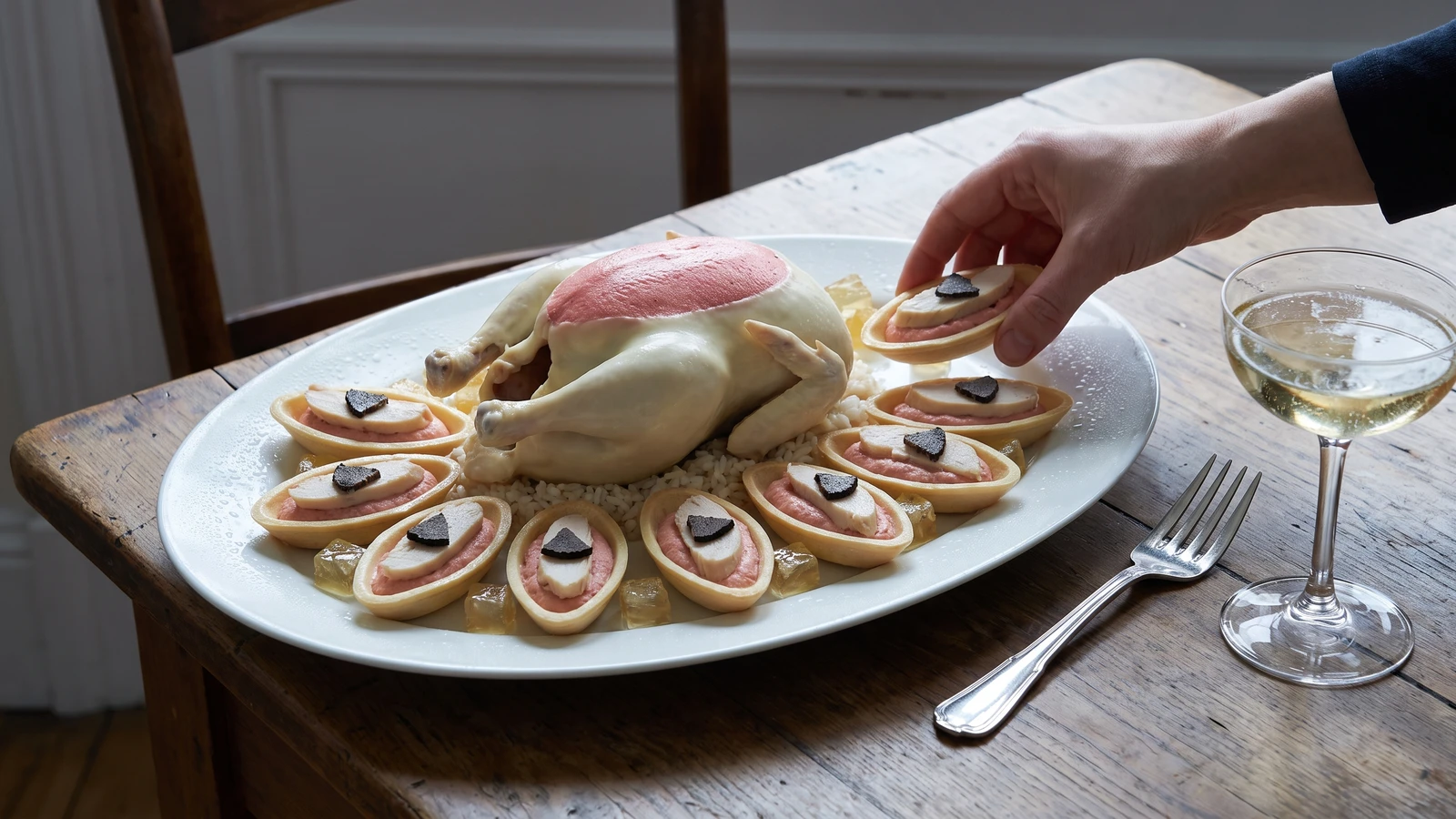
Based on No. 1698, Poularde Rose de Mai, from Le Guide Culinaire (1907) by Auguste Escoffier
A cold grand-kitchen pullet brought home: tender suprêmes, ivory chaud-froid, rose-pink tomato mousse, truffle, crisp barquettes, and clear jelly, assembled by one cook with timing instead of a brigade.
Poularde Rose de Mai (cold poached pullet with tomato mousse) teaches the architecture of cold classical cookery. Sauce chaud-froid blanche, a white velouté glaze that sets cold, must meet a thoroughly chilled bird at precisely the consistency of heavy cream. Temperature is an ingredient here. If the bird is damp or the sauce too warm, the coating slides; if the sauce is too cold, it clumps. Ça se rattrape, and the method tells you how.
The kitchen surrounding the original recipe assumed a saucier on staff, stock never off the fire, a garde-manger with ranks of boat-shaped molds, and a salamander waiting for neighboring dishes, though it has no work on this cold platter. At home, the pullet's own poaching liquid becomes both sauce and jelly, the refrigerator replaces the cold larder, and eight small barquettes replace a banquet procession. The elaborate piping and several pairs of hands were brigade scaffolding, so they go. The poaching, mousse, chaud-froid, truffle, jelly glaze, rice cushion, and reconstruction are the dish, so they stay.
This is one cook, one stove, and one evening of assembly, provided the bird and referenced preparations are chilled in advance. Barely whipped cream is essential in the tomato mousse: stiff cream makes a cold mousse dry and woolly, while half-whipped cream leaves it fresh and unctuous. Before you touch the pan, remember the step that decides everything: cool the chaud-froid until it falls in a slow, continuous ribbon before coating the cold, dry bird.
Poularde Rose de Mai belongs to the Parisian cold-buffet repertoire, where the garde-manger combined poached poultry, chaud-froid, mousse, aspic, and pastry forms into composed centerpieces for formal tables. Its rosy name comes from the tomato mousse used to rebuild the breast and fill the barquettes, not from a Provençal seasoning or a Lyonnais tradition. The presentation traveled to bourgeois special-occasion tables because its scale could shrink, although the essential sequence of chilling, coating, setting, and glazing could not.
Quantity
1 bird (4 to 4½ lb / 1.8 to 2 kg)
Quantity
10 cups (2.4 L / 2.4 kg), or enough to cover the bird
Quantity
1 (about 4 oz / 115 g)
cut into chunks
Quantity
1 (about 5 oz / 140 g)
white and pale green parts rinsed and cut into chunks
Quantity
1 (about 6 oz / 170 g)
quartered
Quantity
1 (about 2 oz / 55 g)
cut into chunks
Quantity
1
1 bay leaf, 4 parsley stems, and 2 thyme sprigs
Quantity
2 tablespoons (30 ml / 36 g)
divided
Quantity
1 teaspoon (5 ml / 2 g)
Quantity
4 tablespoons (60 ml / 57 g)
divided
Quantity
¼ cup (60 ml / 30 g)
Quantity
½ cup (120 ml / 120 g)
Quantity
2 teaspoons (10 ml / 6 g)
Quantity
1 tablespoon (15 ml / 15 g)
Quantity
¼ teaspoon (1.25 ml / 0.5 g)
Quantity
1 tablespoon (15 ml / 9 g)
Quantity
¾ cup (180 ml / 150 g)
Quantity
3 cups (710 ml / 650 g) Préparation de la Mousse de Tomates (No. 814)
chilled until spoonable
Quantity
1 (about 1 oz / 28 g)
cut into thin diamonds
| Ingredient | Quantity |
|---|---|
| small pullet or compact roasting chicken | 1 bird (4 to 4½ lb / 1.8 to 2 kg) |
| cold water | 10 cups (2.4 L / 2.4 kg), or enough to cover the bird |
| large carrotcut into chunks | 1 (about 4 oz / 115 g) |
| large leekwhite and pale green parts rinsed and cut into chunks | 1 (about 5 oz / 140 g) |
| medium yellow onionquartered | 1 (about 6 oz / 170 g) |
| celery stalkcut into chunks | 1 (about 2 oz / 55 g) |
| bouquet garni1 bay leaf, 4 parsley stems, and 2 thyme sprigs | 1 |
| fine sea saltdivided | 2 tablespoons (30 ml / 36 g) |
| black peppercorns | 1 teaspoon (5 ml / 2 g) |
| unsalted butterdivided | 4 tablespoons (60 ml / 57 g) |
| plain flour | ¼ cup (60 ml / 30 g) |
| heavy cream | ½ cup (120 ml / 120 g) |
| unflavored powdered gelatin for the chaud-froid | 2 teaspoons (10 ml / 6 g) |
| fresh lemon juice | 1 tablespoon (15 ml / 15 g) |
| ground white pepper | ¼ teaspoon (1.25 ml / 0.5 g) |
| unflavored powdered gelatin for the chicken jelly | 1 tablespoon (15 ml / 9 g) |
| medium-grain white rice | ¾ cup (180 ml / 150 g) |
| Préparation de la Mousse de Tomateschilled until spoonable | 3 cups (710 ml / 650 g) Préparation de la Mousse de Tomates (No. 814) |
| Barquettesprepared in boat-shaped molds | 8 small Barquettes (No. 314) |
| small black trufflecut into thin diamonds | 1 (about 1 oz / 28 g) |
Set the pullet breast-up in a stockpot that holds it snugly. Add the carrot, leek, onion, celery, bouquet garni, 1 tablespoon of the salt, the peppercorns, and enough cold water to cover. Bring the liquid up slowly, skimming away the grey foam before it reaches a simmer. Hold it at the faintest tremble, partly covered, for 50 to 65 minutes, turning the bird once, until the thickest part of the thigh reaches 165°F (74°C). Never let it boil: boiling tightens the breast before the legs are ready.
Lift the pullet onto a rack over a tray and let it lose its surface heat for 20 minutes. Refrigerate it uncovered until completely cold, about 3 hours, then cover it. Strain the poaching liquid through a fine sieve, discarding the vegetables and bouquet garni. Cool the broth rapidly over an ice bath and refrigerate it; once cold, lift away every trace of surface fat. Reserve 2 cups for the chaud-froid, 2 cups for the jelly, and 1¼ cups for the rice. Get both bird and broth into the refrigerator within 2 hours of leaving the heat.
Put ½ cup of the cold reserved broth in a small bowl and sprinkle the 1 tablespoon of gelatin evenly over it. Leave it for 5 minutes to swell. Heat the remaining 1½ cups of broth until hot but not boiling, stir in the softened gelatin until completely dissolved, and season assertively with salt because cold dulls flavor. Strain again. Reserve ¾ cup in a covered bowl for binding and glazing, then pour the rest into a shallow tray in a layer about ⅜ inch thick. Chill until firm enough to cut, at least 2 hours.
Sprinkle the 2 teaspoons of gelatin over 3 tablespoons of the cold broth measured for the sauce and leave it to swell. Melt 3 tablespoons of the butter in a saucepan, stir in the flour, and cook gently for 2 minutes without letting the roux color. Whisk in the remaining broth a little at a time, then simmer gently for 12 to 15 minutes until the velouté coats the back of a spoon. Add the cream and simmer for 3 minutes. Off the heat, stir in the softened gelatin, lemon juice, white pepper, and enough salt to taste complete when cool. Pass the sauce through a fine sieve, then stir it over an ice bath until it falls from the spoon in a slow, unbroken ribbon.
Rinse the rice until the water runs nearly clear. Put it in a small saucepan with the reserved 1¼ cups of broth, the remaining tablespoon of butter, and a pinch of salt. Cover and cook at the barest simmer until tender and dry, about 16 minutes, then rest it off the heat for 10 minutes. Stir in ¼ cup of the reserved liquid chicken jelly while both are still warm. Pack the rice into a low oval, about 1 inch high, at the center of a long chilled platter. Smooth it firmly, cover, and refrigerate until set.
Arrange the 8 prepared Barquettes (No. 314) on a tray, keeping them in their molds if the molds support their shape. Spoon the Préparation de la Mousse de Tomates (No. 814) into them, using about half the mousse and leveling each filling just above the rim. The mousse must remain airy and spoonable; don't beat it again. Chill the filled barquettes until the mousse is set, about 1 hour.
Set the thoroughly chilled pullet breast-up on a board. Cut down each side of the breastbone and follow the ribs with the knife to lift both suprêmes, the breast fillets, in clean whole pieces. Remove the skin from the suprêmes and trim them evenly. With poultry shears, carefully clip away the exposed breastbone and sharp rib ends while leaving the legs, wings, and remaining carcass intact. Pat every surface dry, then return the suprêmes and carcass to the refrigerator for 20 minutes.
Place the cold, dry carcass on a rack over a clean tray. Ladle the ribboning chaud-froid over it from the center outward, letting the sauce cover the skin, legs, wings, and cut surfaces in an even ivory coat. Refrigerate for 15 minutes, then add a second thin coat wherever the first looks translucent. If the sauce slides off, the bird is damp or the sauce is too warm. Scrape the sauce from the tray, dry and rechill the bird, cool the sauce to a heavier ribbon, and coat again.
Transfer the coated carcass onto the chilled rice cushion. Spoon the remaining Préparation de la Mousse de Tomates (No. 814) into the hollow left by the breastbone, building it into a smooth, rounded breast shape. Keep the contours generous rather than fussy; the pale rose mousse should read as part of the bird, not as piping decoration. Chill until firm, about 45 minutes.
Slice the two cold suprêmes diagonally into 8 even pieces. Arrange them on a rack and coat each completely with the remaining chaud-froid. While the surface is still tacky, center a thin truffle diamond on every slice. Chill for 20 minutes, until the white coating is firm and matte.
Warm the remaining ½ cup of reserved chicken jelly only until fluid, then cool it until barely cool to the touch. Brush a thin layer over every coated suprême so the truffle and sauce take on a clear gloss. If the chaud-froid softens or streaks, the jelly is too warm; chill the slices again, cool the jelly further, and reglaze. Turn the set jelly from its tray and cut it into croûtons, small diamonds and triangles about ¾ inch across.
At the last moment, release the filled Barquettes (No. 314) from their molds and arrange them evenly around the rice cushion. Place one glazed suprême slice on each barquette, truffle facing upward. Distribute the croûtons of jelly between them and around the base of the reconstructed pullet. Keep the platter chilled until 15 minutes before serving so the mousse stays set but the chicken loses its refrigerator chill. Serve two barquettes per person, then carve the coated legs from the centerpiece if wanted. À table!
1 serving (about 700g)
Culinary guides, cultural storytelling, and the editorial depth that makes cooking meaningful.
Discover Culinary ExplorerChef Juliette
John Dory has the delicacy of sole and the firmness of turbot. A light flouring, a quick butter sauté, and nut-brown beurre noisette show exactly why looks never mattered.

Chef Juliette
Fresh haddock proves its delicacy in the meunière pan: a fine flour crust, moist pearly flakes, and beurre noisette sharpened with lemon and parsley, ready from one skillet in half an hour.
Chef Juliette
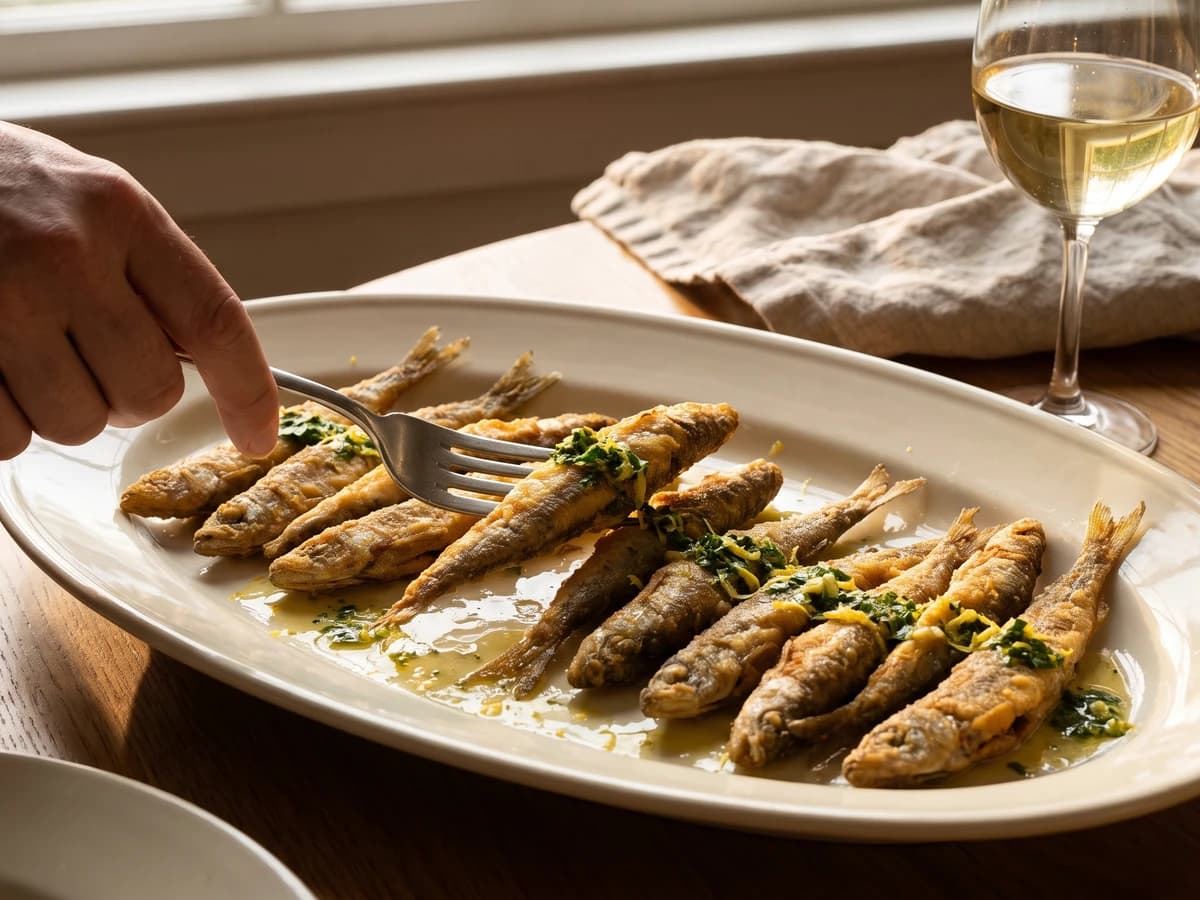
Éperlans à l’Anglaise turns small fish into a lesson in disciplined coating: boned smelts under a close, crisp crumb, pan-fried in clarified butter and finished with bright, half-melted maître d’hôtel butter.

Chef Juliette
Tiny smelts, shallot, mushrooms, white wine, gratin sauce, and fine bread raspings meet a fierce oven, where the fish must turn tender in the same breath the buttered crust bronzes.