
Chef Juliette
John Dory (St. Pierre)
John Dory has the delicacy of sole and the firmness of turbot. A light flouring, a quick butter sauté, and nut-brown beurre noisette show exactly why looks never mattered.
A cooking platform built around craft, culture, and the stories behind what we eat.

Created by Chef Juliette
Based on No. 1684, Soufflé de Volaille with Raw Meat, from Le Guide Culinaire (1907) by Auguste Escoffier
Soufflé de Volaille teaches the delicate rule of mousseline work: fold stiff whites into cold raw chicken forcemeat without beating, then bake at once for four tender, ivory timbales.
Soufflé de Volaille (raw chicken mousseline soufflé) teaches a ruthless little truth: its height is borrowed air, and once the stiff whites meet the raw mousseline, you fold, never beat. The finished timbales should rise pale and tender, with faintly butter-gold crowns and centers as delicate as quenelles.
The book assumed two pounds of Fine Chicken Forcemeat or “Mousseline” (No. 195) already cold in a brigade pantry, four whites waiting at the pastry bench, and rows of identical metal timbales filled by many hands. No saucier, stockpot, or salamander stands behind this particular entry; its brigade advantage was prepared forcemeat, cold working conditions, and scale. For one cook, one stove, one evening, the ratio is simply halved: one pound of the finished referenced mousseline, two whites, and four straight-sided ramekins. The large batch and specialized molds are scaffolding and can go. The cold mousseline, stiff whites, careful fold, and moderate oven are the dish and must stay.
Have the oven and molds ready before you begin whipping. This mixture will not wait while you clear a shelf, and the fold is the one step that decides everything: broad turns, a light hand, then straight into the oven.
Soufflé de volaille belongs to the classical Parisian dining room rather than to a single province, where cooks carried poultry mousseline from quenelles and garnishes into an individual molded course. In the book's vocabulary, mousselines are portions molded one diner at a time, not a separate cream sauce or a flour-bound batter. The lift comes from egg white folded into raw forcemeat, a grand-kitchen technique that passes cleanly to the home ramekin.
Quantity
1 pound (454 g) Fine Chicken Forcemeat or “Mousseline” (No. 195)
refrigerator-cold
Quantity
2 large whites (about 1/4 cup / 60 ml / 60 g)
at cool room temperature
Quantity
1 tablespoon (15 ml / 14 g)
softened, for the timbales
| Ingredient | Quantity |
|---|---|
| Fine Chicken Forcemeat or “Mousseline”refrigerator-cold | 1 pound (454 g) Fine Chicken Forcemeat or “Mousseline” (No. 195) |
| large egg whitesat cool room temperature | 2 large whites (about 1/4 cup / 60 ml / 60 g) |
| unsalted buttersoftened, for the timbales | 1 tablespoon (15 ml / 14 g) |
Heat the oven to 350°F (175°C), the moderate oven specified by the book, with a rack in the middle. Brush four 6-ounce (180 ml) straight-sided ramekins or metal timbale molds generously with the softened butter, using upward strokes along the sides. Set them on a rimmed baking sheet. Do not flour or crumb the molds; butter alone belongs here.
Put the refrigerator-cold Fine Chicken Forcemeat or “Mousseline” (No. 195) into a wide chilled bowl. Work it briefly with a flexible spatula, just until pliable enough to accept the whites. Keep it cold. If the bowl loses its chill or the surface grows glossy and loose, nest it over ice for five minutes before continuing; warmth weakens the mousseline before it ever reaches the oven.
Beat the egg whites in a perfectly clean, dry bowl until they stand in stiff but glossy peaks. The tip should hold upright while the foam remains smooth and cohesive. Stop there. Dry, grainy whites will not fold cleanly; if they have gone that far, beat two fresh whites rather than forcing them into the mousseline. Ça se rattrape before folding, not afterward.
Add one quarter of the whipped whites to the cold mousseline. Cut the spatula down through the center, sweep across the bottom, lift the mixture over itself, and turn the bowl. Add the remaining whites in two additions and continue with the same broad folding motion until no large white pockets remain. Fold, do not beat. If the mixture begins to slacken while a few fine streaks remain, stop and portion it; those streaks disappear as the molds are filled, while further stirring would drive out the air. That restraint is the dish.
Divide the mixture among the buttered timbales, about 4 1/2 ounces (128 g) in each, filling them roughly three quarters full. Smooth the tops gently and wipe the rims clean without tapping the molds. Bake directly on the sheet pan, without a water bath, for 20 to 25 minutes. Do not open the oven during the first 18 minutes. They are ready when the crowns have risen, the tops are faintly butter-gold, the centers spring lightly, and a representative timbale reaches 165°F (74°C) at its center. If the tops color before the centers are safe, lay a loose sheet of foil over them for the final minutes.
Carry the timbales directly to the table in their molds. The interiors should be ivory, moist, and finely aerated, delicate as quenelles but substantial enough for a first course or light main dish. Their crowns will begin to settle as they wait; that is the nature of a soufflé, not a failure. Never apologize at your own table. À table!
1 serving (about 110g)
Culinary guides, cultural storytelling, and the editorial depth that makes cooking meaningful.
Discover Culinary ExplorerChef Juliette
John Dory has the delicacy of sole and the firmness of turbot. A light flouring, a quick butter sauté, and nut-brown beurre noisette show exactly why looks never mattered.

Chef Juliette
Fresh haddock proves its delicacy in the meunière pan: a fine flour crust, moist pearly flakes, and beurre noisette sharpened with lemon and parsley, ready from one skillet in half an hour.
Chef Juliette
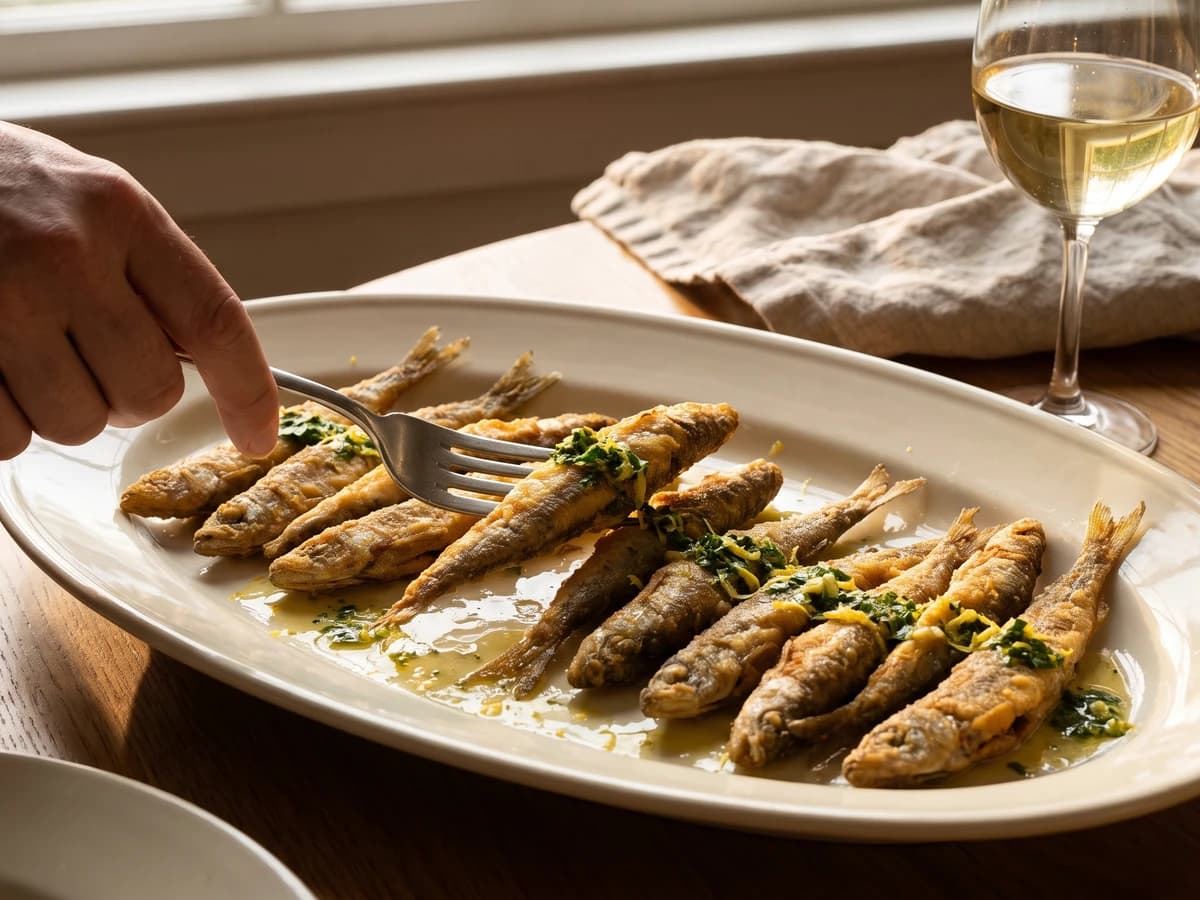
Éperlans à l’Anglaise turns small fish into a lesson in disciplined coating: boned smelts under a close, crisp crumb, pan-fried in clarified butter and finished with bright, half-melted maître d’hôtel butter.

Chef Juliette
Tiny smelts, shallot, mushrooms, white wine, gratin sauce, and fine bread raspings meet a fierce oven, where the fish must turn tender in the same breath the buttered crust bronzes.