
Chef Juliette
John Dory (St. Pierre)
John Dory has the delicacy of sole and the firmness of turbot. A light flouring, a quick butter sauté, and nut-brown beurre noisette show exactly why looks never mattered.
A cooking platform built around craft, culture, and the stories behind what we eat.
Created by Chef Juliette
Based on No. 1641, Poulet de Grains à la Limousine, from Le Guide Culinaire (1907) by Auguste Escoffier
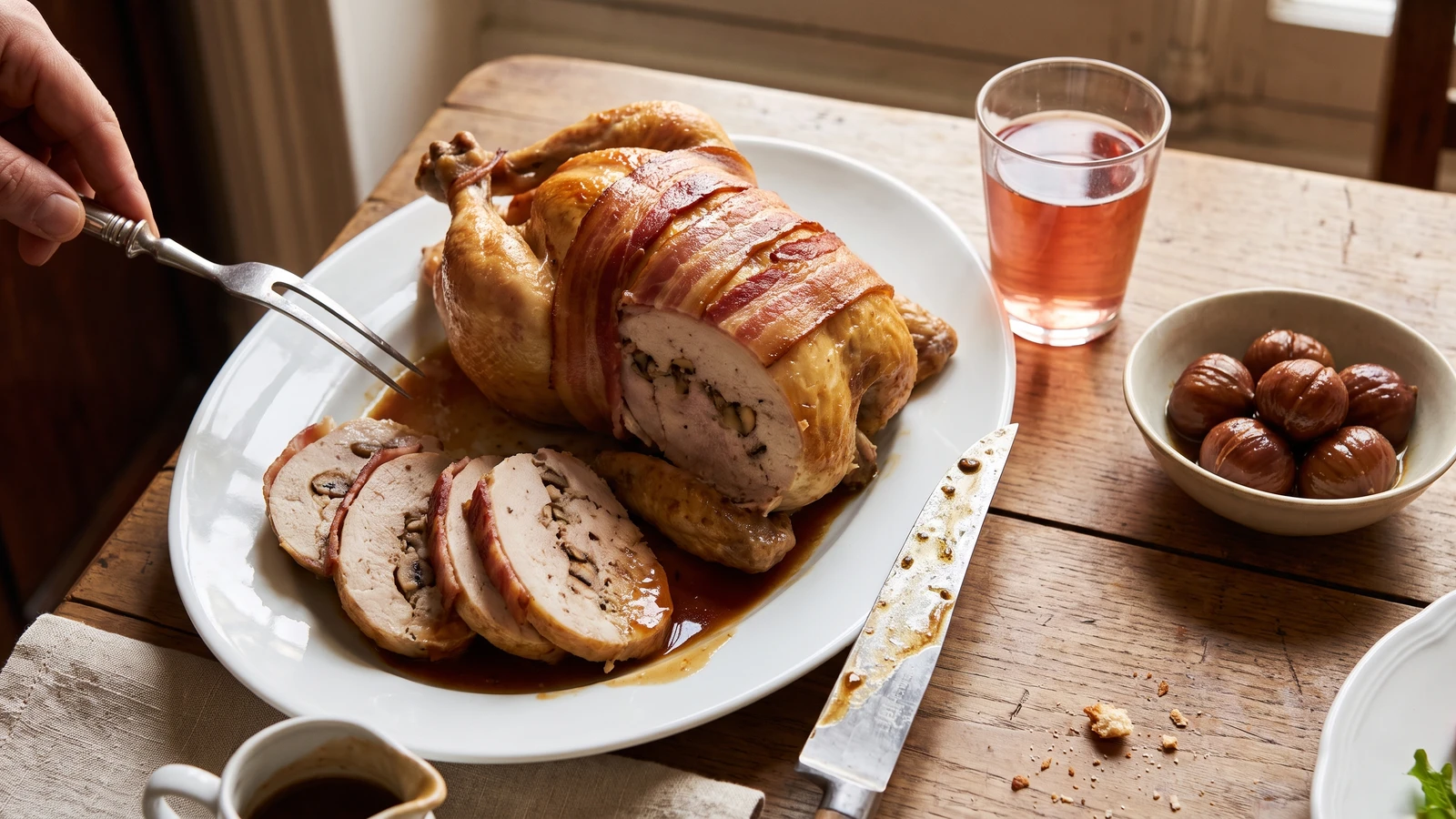
Gently roasted young chicken, sausage and mushrooms held moist at its center, bacon guarding the breast, with glossy veal jus and six consommé-tender chestnuts served proudly apart.
Poulet de Grains à la Limousine (Limousin-style grain-fed chicken) teaches the quiet discipline of roasting a stuffed bird gently enough for its center to cook without sacrificing the breast. The stuffing is not a side note. It is the clock for the whole dish, and it must reach a safe, moist set before the chicken leaves the cocotte.
The original kitchen assumed a saucier with veal gravy ready, a stockpot of consommé never off the fire, and another pair of hands tending six chestnuts. The brigade scaffolding can go. One cup of good prepared consommé, a few spoonfuls of prepared veal gravy, an ordinary oven, and an instant-read thermometer give one cook the same result. The book gives one bird without fixing its modern weight, so this version specifies a 3½ to 4-pound chicken, keeping the half-pound of sausage and two ounces of mushrooms in their proper proportion. No salamander belongs here because nothing is gratinéed.
What stays is the dish itself: mushrooms fried in butter and folded into sausage meat, bacon protecting the bird as it cooks, veal gravy added only at the finish, and exactly six chestnuts simmered in consommé and sent separately. Fill the cavity loosely, never ram it tight. That one gesture decides whether the stuffing sets tender or becomes a heavy plug.
Poulet de Grains à la Limousine belongs to the classical reading of Limousin through its chestnut groves: the phrase à la Limousine tells the table to expect chestnuts, not a vague country garnish. Household pairings of poultry, pork, mushrooms, and chestnuts passed into grand-kitchen service, where the bird was stuffed but the consommé-cooked chestnuts were presented separately. That separation is the revealing detail, because the chestnuts remain a distinct accompaniment rather than disappearing into the forcemeat.
Quantity
1 (3½ to 4 lb / 1.6 to 1.8 kg)
Quantity
1 cup (240 ml / 225 g)
Quantity
¾ cup (180 ml / 57 g)
finely chopped
Quantity
1 tablespoon (15 ml / 14 g)
Quantity
6 rectangles (about 3 oz / 85 g), prepared by Blanchings (No. 273)
Quantity
2 tablespoons (30 ml / 28 g)
Quantity
6 (about 4 oz / 115 g)
peeled, raw or vacuum-packed
Quantity
1 cup (240 ml / 240 g)
Quantity
2 to 3 tablespoons (30 to 45 ml / 30 to 45 g)
warmed
Quantity
¾ teaspoon (3.75 ml / 4.5 g)
Quantity
¼ teaspoon (1.25 ml / 0.6 g)
| Ingredient | Quantity |
|---|---|
| whole young roasting chicken, grain-fed if available | 1 (3½ to 4 lb / 1.6 to 1.8 kg) |
| good plain pork sausage meat | 1 cup (240 ml / 225 g) |
| button or cremini mushroomsfinely chopped | ¾ cup (180 ml / 57 g) |
| unsalted butter for the mushrooms | 1 tablespoon (15 ml / 14 g) |
| breast bacon | 6 rectangles (about 3 oz / 85 g), prepared by Blanchings (No. 273) |
| unsalted butter for the cocotte | 2 tablespoons (30 ml / 28 g) |
| large chestnutspeeled, raw or vacuum-packed | 6 (about 4 oz / 115 g) |
| prepared chicken or veal consommé | 1 cup (240 ml / 240 g) |
| prepared veal gravywarmed | 2 to 3 tablespoons (30 to 45 ml / 30 to 45 g) |
| fine salt | ¾ teaspoon (3.75 ml / 4.5 g) |
| freshly ground black pepper | ¼ teaspoon (1.25 ml / 0.6 g) |
Melt the 1 tablespoon butter in a frying pan over medium heat. Add the chopped mushrooms and cook until they release their water, the liquid evaporates, and the pieces become glossy and lightly golden, about 6 minutes. Spread them on a plate and let them cool completely, then fold them lightly into the sausage meat without kneading. Warm mushrooms soften the sausage fat and make the stuffing greasy; if that happens, ça se rattrape. Chill the mixture for 10 minutes until firm again.
Heat the oven to 325°F (160°C). Pat the chicken dry inside and out, then season the cavity and exposed skin with the salt and pepper. Spoon the stuffing loosely into the cavity, leaving room for heat to move through it; if the final spoonful will not fit without force, bake it separately in a buttered ramekin. Tie the legs together without cinching them shut. Smear the 2 tablespoons butter across the bottom of a heavy cocotte, set the bird breast-side up inside, and lay the six rectangles of breast bacon prepared by Blanchings (No. 273) across and around the breast.
Cover the cocotte and roast for 50 minutes. Remove the lid, baste the chicken with the buttery juices, and continue roasting uncovered for 35 to 55 minutes, basting twice more. The heat should remain gentle; this dish wants moist flesh and settled stuffing, not an aggressively crisp skin. If the bacon or breast colors too quickly, put the lid back on loosely. Ça se rattrape, and the bird will continue cooking without scorching.
While the chicken roasts, put the six chestnuts and consommé in the smallest saucepan that holds them snugly. Bring the liquid just to a simmer, then lower the heat and cook raw chestnuts for 25 to 35 minutes, or vacuum-packed chestnuts for 8 to 10 minutes, until a fine skewer enters without resistance. Never boil them hard or they will crumble. If the consommé reduces before raw chestnuts soften, add hot water a tablespoon at a time. Hold the chestnuts in their liquid so they stay moist.
Begin checking the chicken after about 1 hour 20 minutes. Insert an instant-read thermometer through the cavity opening into the center of the stuffing, then test the thickest part of the thigh without touching bone. Both must reach at least 165°F (74°C). If the bacon is bronzed but the stuffing remains below temperature, cover the breast, lower the oven to 300°F (150°C), and continue in 10-minute intervals. Transfer the chicken to a board and rest it loosely covered for 15 minutes.
Tilt the cocotte and spoon away only any large pool of clear fat, leaving the buttery roasting juices and browned glaze behind. Set the cocotte over medium-low heat, add the warmed veal gravy, and scrape the bottom gently as it bubbles for 1 to 2 minutes, just until the jus is glossy and lightly coats a spoon. If it tightens too far or tastes too salty, loosen it with a tablespoon of hot water. If it is thin, simmer it for another minute. No flour and no cream belong here; the veal gravy and the bird's own juices are enough.
Remove the stuffing in generous spoonfuls, then carve the chicken and arrange both on a warm platter with the bacon rectangles. Spoon the veal jus over the meat without drowning the stuffing. Lift the six chestnuts into a separate warm serving dish and moisten them with a little of their consommé, exactly as the original service requires. One cook, one stove, one evening. À table!
1 serving (about 350g)
Culinary guides, cultural storytelling, and the editorial depth that makes cooking meaningful.
Discover Culinary ExplorerChef Juliette
John Dory has the delicacy of sole and the firmness of turbot. A light flouring, a quick butter sauté, and nut-brown beurre noisette show exactly why looks never mattered.

Chef Juliette
Fresh haddock proves its delicacy in the meunière pan: a fine flour crust, moist pearly flakes, and beurre noisette sharpened with lemon and parsley, ready from one skillet in half an hour.

Chef Juliette
Éperlans à l’Anglaise turns small fish into a lesson in disciplined coating: boned smelts under a close, crisp crumb, pan-fried in clarified butter and finished with bright, half-melted maître d’hôtel butter.

Chef Juliette
Tiny smelts, shallot, mushrooms, white wine, gratin sauce, and fine bread raspings meet a fierce oven, where the fish must turn tender in the same breath the buttered crust bronzes.