
Chef Juliette
John Dory (St. Pierre)
John Dory has the delicacy of sole and the firmness of turbot. A light flouring, a quick butter sauté, and nut-brown beurre noisette show exactly why looks never mattered.
A cooking platform built around craft, culture, and the stories behind what we eat.
Created by Chef Juliette
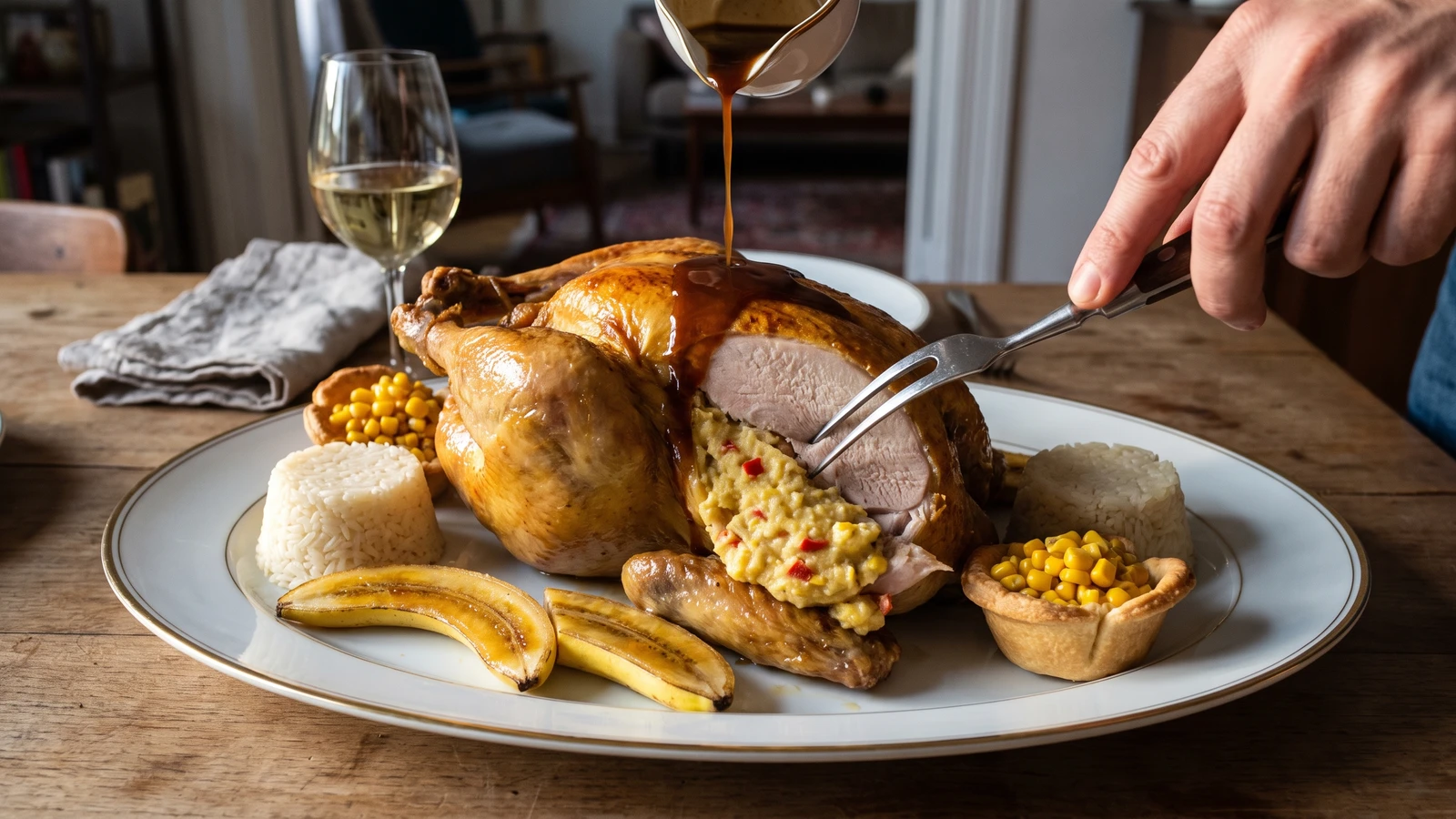
Based on No. 1488, Poularde à la Louisiane, from Le Guide Culinaire (1907) by Auguste Escoffier
Poularde à la Louisiane pairs a savoury, butter-poêled bird with creamed maize, sweet capsicum, neat rice timbales, fried bananas, and crisp croustades, a grand garnish made workable for one home table.
Poularde à la Louisiane (pullet stuffed with creamed maize and capsicum, butter-poêled and served with rice, fried bananas, and pastry croustades) teaches a severe little lesson in balance: a sweet garnish wants a savoury bird. Before you touch a pan, know this one true thing. The maize must be seasoned past polite, because cream, corn, banana, and rice will soften every edge by the time the platter reaches the table.
The original service assumed a saucier on staff, a stock never off the fire, croustades already drying, and enough hands to mold rice while the bird rested. At home, one heavy lidded casserole carries Poëlings (No. 250), the broiler replaces a salamander if the skin needs a last minute of colour, four small rice molds replace the brigade border, and two Croustades (No. 2393) preserve the formal ends of the platter. I changed the scale and equipment, not the architecture. One cook, one stove, one evening.
The drying-box and the line of waiting hands were scaffolding, so they go. The stuffing, the butter-rich poêling, the alternating rice and banana, and the maize-filled croustades are the dish, so they stay. Keep the maize thick enough to sit in the cavity, then cook the poularde until both thigh and stuffing are safely done without surrendering the breast. That is the step that matters most.
Despite its name, Poularde à la Louisiane belongs to the Parisian grand-kitchen repertoire, where à la Louisiane signaled a composed garnish of maize, capsicum, rice, and banana. It is not a transcription of a Louisiana household chicken dish; it is a French menu-name shaped by the produce metropolitan cooks associated with the Gulf South, then arranged into timbales and croustades for formal service. The home translation keeps its revealing contrast, a deeply savoury poêled bird against sweet maize and fruit, while shrinking the architecture to one platter.
Quantity
1 bird, 4½ to 5 lb (2 to 2.3 kg)
giblets removed and skin dried
Quantity
3½ cups (840 ml / 570 g)
divided
Quantity
⅓ cup (80 ml / 42 g)
seeded and cut into small dice
Quantity
1 cup (240 ml / 240 g)
divided
Quantity
2 tablespoons (30 ml / 28 g)
divided
Quantity
4 teaspoons (20 ml / 24 g)
divided
Quantity
¾ teaspoon (3.75 ml / 1.7 g)
divided
Quantity
1 quantity Poëlings (No. 250), scaled for one 4½ to 5 lb (2 to 2.3 kg) poularde
Quantity
1 cup (240 ml / 185 g)
Quantity
1¾ cups (420 ml / 420 g)
Quantity
1 tablespoon (15 ml / 14 g)
Quantity
2
Quantity
2 tablespoons (30 ml / 28 g)
| Ingredient | Quantity |
|---|---|
| poularde or plump roasting chickengiblets removed and skin dried | 1 bird, 4½ to 5 lb (2 to 2.3 kg) |
| fresh or frozen maize kernelsdivided | 3½ cups (840 ml / 570 g) |
| sweet red capsicumseeded and cut into small dice | ⅓ cup (80 ml / 42 g) |
| heavy creamdivided | 1 cup (240 ml / 240 g) |
| unsalted butter for the maizedivided | 2 tablespoons (30 ml / 28 g) |
| fine sea saltdivided | 4 teaspoons (20 ml / 24 g) |
| ground white pepperdivided | ¾ teaspoon (3.75 ml / 1.7 g) |
| Poëlings | 1 quantity Poëlings (No. 250), scaled for one 4½ to 5 lb (2 to 2.3 kg) poularde |
| long-grain white rice | 1 cup (240 ml / 185 g) |
| water | 1¾ cups (420 ml / 420 g) |
| unsalted butter for the rice | 1 tablespoon (15 ml / 14 g) |
| firm, just-ripe bananas | 2 |
| unsalted butter for frying the bananas | 2 tablespoons (30 ml / 28 g) |
| Croustadesbaked and thoroughly dried | 2 Croustades (No. 2393), each 3 inches (7.5 cm) |
Set aside ¾ cup (180 ml / 116 g) of the maize for the croustades. Melt ½ tablespoon of the maize butter in a saucepan, add the reserved maize and ¼ cup (60 ml / 60 g) of the cream, then season with a pinch each of salt and white pepper. Cook gently until the cream clings closely to the kernels, then scrape it into a bowl and reserve. In the same pan, melt the remaining 1½ tablespoons of maize butter and soften the diced capsicum for 2 minutes without browning. Add the remaining 2¾ cups (660 ml / 454 g) maize and ¾ cup (180 ml / 180 g) cream. Season with 1½ teaspoons salt and ½ teaspoon white pepper, then simmer gently until a spoon drawn across the pan leaves a clean trail. The stuffing must be distinctly savoury and thick enough to mound. If it remains loose, keep reducing; if it tightens too far, loosen it with one spoonful of cream. Ça se rattrape. Spread it on a tray and cool to room temperature.
Season the poularde inside and out with 2 teaspoons salt and the remaining white pepper. Spoon the capsicum-flecked maize into the body and neck cavities without packing it hard; heat must be able to reach the centre. Close the openings with small skewers or kitchen string and truss the legs neatly. Stuff the bird only when you are ready to cook it, never hours beforehand.
Cook the stuffed poularde using Poëlings (No. 250), with that preparation scaled to this one bird and its heavy lidded casserole. Begin checking after 1 hour 15 minutes. The centre of the maize stuffing must reach 165°F (74°C), and the thickest part of the thigh should register at least 165°F (74°C), preferably near 170°F (77°C), without the probe touching bone. If the breast colours before the stuffing is safe, shield only the breast with foil and continue cooking. If the temperatures are reached but the skin remains pale, brush it with butter and place it briefly under the broiler, watching every second. Rest the poularde for 20 minutes and complete the poëling stock as directed in Poëlings (No. 250).
While the poularde cooks, rinse the rice until the water runs nearly clear. Bring the measured water and ½ teaspoon salt to a boil, stir in the rice once, cover, and cook over the lowest heat for about 15 minutes. Remove it from the heat and leave it covered for 10 minutes, then fold in the rice butter. Butter four 4-ounce (120 ml) ramekins lightly, pack in the rice, and hold them covered in a warm place. If a timbale refuses to unmold, wrap its base in a hot damp towel for 20 seconds and try again; don't attack it with a knife.
During the poularde's rest, peel the bananas and split each lengthwise to make four curved halves. Melt the frying butter in a broad skillet over medium heat and add the bananas cut-side down. Fry until golden at the edges, about 1 to 2 minutes per side, turning once with a thin spatula. The bananas must be ripe enough to sweeten but firm enough to remain whole. If they begin to soften, stop turning them and slide them directly onto a warm plate.
Warm the reserved maize gently, adding a teaspoon of cream only if it has become stiff. Place the baked Croustades (No. 2393) in the turned-off oven for a few minutes to restore their crispness, then fill each with half the hot maize à la crème just before assembling the platter. Filling them early softens the pastry, and crisp pastry is part of the contrast.
Set the rested poularde breast-side up in the centre of a warm oval platter. Unmold two rice timbales along each long side and alternate them with the four fried banana halves. Place one maize-filled croustade at each short end. Strain and degrease the finished poëling stock from Poëlings (No. 250), taste it for salt, and serve it in a warmed sauceboat rather than flooding the crisp skin. Bring the whole bird to the table and carve there. À table!
1 serving (about 720g)
Culinary guides, cultural storytelling, and the editorial depth that makes cooking meaningful.
Discover Culinary ExplorerChef Juliette
John Dory has the delicacy of sole and the firmness of turbot. A light flouring, a quick butter sauté, and nut-brown beurre noisette show exactly why looks never mattered.

Chef Juliette
Fresh haddock proves its delicacy in the meunière pan: a fine flour crust, moist pearly flakes, and beurre noisette sharpened with lemon and parsley, ready from one skillet in half an hour.
Chef Juliette
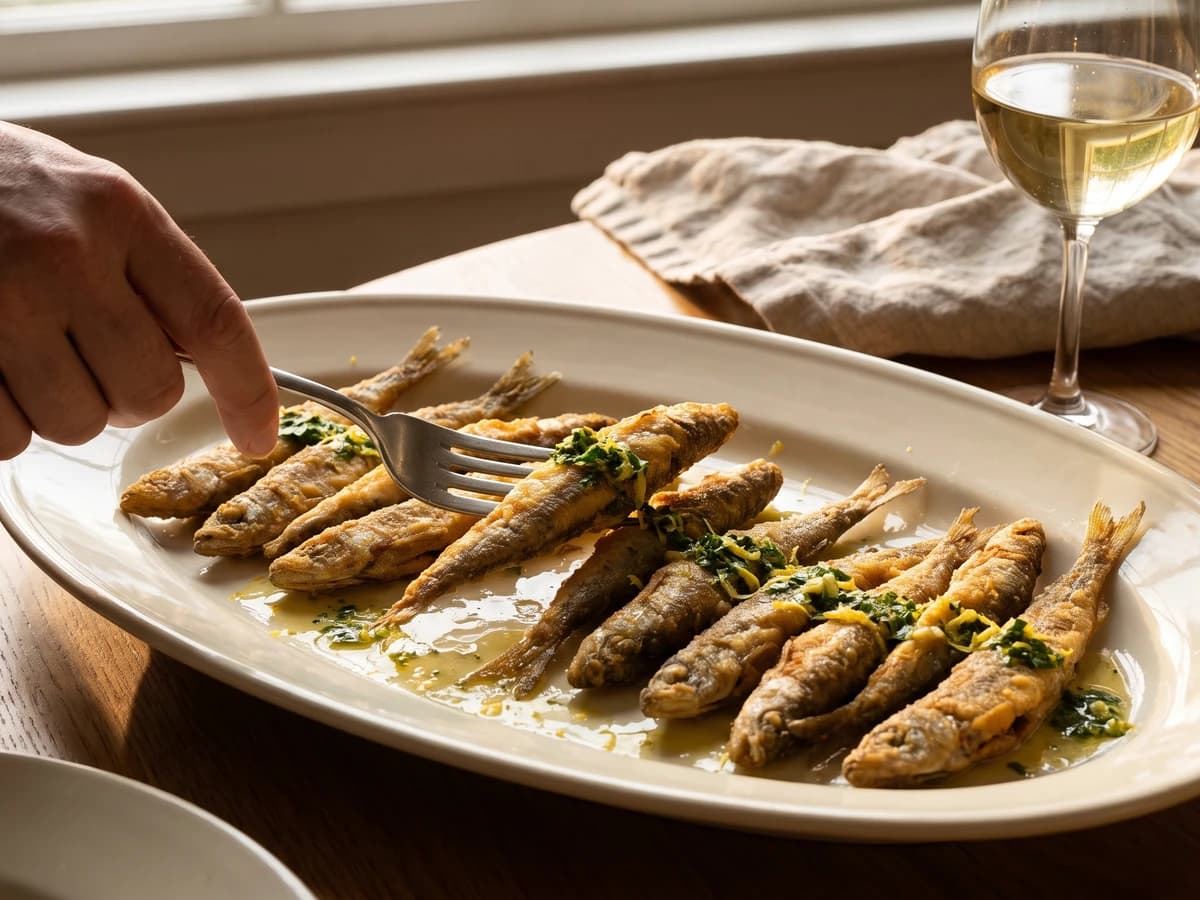
Éperlans à l’Anglaise turns small fish into a lesson in disciplined coating: boned smelts under a close, crisp crumb, pan-fried in clarified butter and finished with bright, half-melted maître d’hôtel butter.

Chef Juliette
Tiny smelts, shallot, mushrooms, white wine, gratin sauce, and fine bread raspings meet a fierce oven, where the fish must turn tender in the same breath the buttered crust bronzes.