
Chef Juliette
John Dory (St. Pierre)
John Dory has the delicacy of sole and the firmness of turbot. A light flouring, a quick butter sauté, and nut-brown beurre noisette show exactly why looks never mattered.
A cooking platform built around craft, culture, and the stories behind what we eat.

Created by Chef Juliette
Based on No. 1430, Mousses et Mousselines Chaudes de Jambon, from Le Guide Culinaire (1907) by Auguste Escoffier
One chilled ham farce becomes either a generous moulded mousse or eight egg-shaped mousselines, poached gently to a tender satin set. The entire dish turns on testing the ham's salt before cooking.
Mousses et Mousselines Chaudes de Jambon (hot ham mousse and individual ham mousselines) teach the discipline of farce mousseline, a silken cream-bound forcemeat whose lightness depends on cold ingredients and gentle cooking. The one true thing to know before touching a pan is simpler: the ham has already been salted. Cook and taste a teaspoon of farce before adding so much as a grain.
The grand kitchen surrounding the original formula had a saucier on staff, stock never off the fire, a salamander for finishing, mortar, sieve, ice, and enough hands to shape a dining room's service. The saucier, stockpot, and salamander are scaffolding here, not the dish, so they go. What stays is the cold emulsion from Fine Chicken Forcemeat or “Mousseline” (No. 195), prepared with ham, then a small home mould or two tablespoons and a quiet poach. I scale the formula to a half batch for four. One cook, one stove, one evening.
A mousse is the large form, unmoulded and sliced for the table; mousselines are the same farce shaped like eggs for individual servings. The original permitted vegetable red when the ham looked pale, but I leave it out because it changes appearance, not flavour. A natural blush is honest. Keep the farce cold, keep the water below a boil, and above all, cook one teaspoon and taste it before shaping the rest.
These hot ham preparations belong to the Parisian grand-kitchen table rather than a single provincial larder, where mousseline forcemeat gave cooks a common grammar for meat, poultry, game, fish, and shellfish. Their passage into bourgeois dining rooms changed scale rather than technique: a mousse filled one mould for several guests, while mousselines were shaped one portion at a time. The two names do not indicate different mixtures or degrees of lightness; they distinguish form and service.
Quantity
1 half batch, about 2¼ cups (540 ml / 540 g), Fine Chicken Forcemeat or “Mousseline” (No. 195)
prepared with cooked ham replacing the chicken, no added salt until tested, and kept very cold
Quantity
1 tablespoon (15 ml / 14 g)
softened, for the large mousse mould
Quantity
up to ¼ cup (60 ml / 60 g)
for correcting excessive salt only
Quantity
up to ¼ teaspoon (1.25 ml / 1.5 g)
for adjusting after the cooked seasoning test only
| Ingredient | Quantity |
|---|---|
| Fine Chicken Forcemeat or “Mousseline”prepared with cooked ham replacing the chicken, no added salt until tested, and kept very cold | 1 half batch, about 2¼ cups (540 ml / 540 g), Fine Chicken Forcemeat or “Mousseline” (No. 195) |
| unsalted butter (optional)softened, for the large mousse mould | 1 tablespoon (15 ml / 14 g) |
| cold heavy cream, at least 35% fat (optional)for correcting excessive salt only | up to ¼ cup (60 ml / 60 g) |
| fine salt (optional)for adjusting after the cooked seasoning test only | up to ¼ teaspoon (1.25 ml / 1.5 g) |
Choose one small moulded mousse for slicing or eight individual mousselines, two per person. The preparation is identical; only the shaping and poaching method change. Keep the ham farce over a bowl of ice while you prepare the mould or poaching pan. Cold is not brigade ceremony here. It keeps the cream held inside the meat proteins instead of separating into fat and liquid.
Bring a small saucepan of unsalted water to the barest tremble. Poach one teaspoon of Fine Chicken Forcemeat or “Mousseline” (No. 195), prepared with ham, for two minutes, then taste it warm. Add fine salt only if the sample genuinely needs it. If it tastes briny, fold cold heavy cream into the farce one tablespoon at a time, using no more than ¼ cup, chill for ten minutes, and test again. Ça se rattrape now; after the whole batch is cooked, it does not.
For the large mousse, heat the oven to 325°F (160°C). Butter a 700 to 750 ml mould or small soufflé dish thoroughly, then line its base with a round of parchment and butter the parchment. Spoon in the cold farce in three additions, pressing each gently against the sides to exclude air pockets without beating out its lightness. Smooth the top and cover it with buttered parchment, buttered side down.
Set the mould in a deep roasting pan and pour hot water around it to come halfway up the sides. Bake in this bain-marie, a water bath, for 25 to 35 minutes, until the centre feels softly resilient and reaches 160°F (71°C). The surrounding water should quiver, never boil. If it begins bubbling hard, lower the oven and add a little cold water to the roasting pan. If a rim of fat appears, remove the mousse as soon as its centre is safely set and rest it for five minutes; the texture will be less fine, but it remains entirely worth serving.
For individual mousselines, bring a wide pan of unsalted water to 180 to 185°F (82 to 85°C), with only an occasional bubble at the edge. Dip two matching tablespoons in the hot water. Scoop a rounded spoonful of cold farce with one, then pass it between the spoons three or four times to form a smooth egg shape. Shape eight, working in two batches if the pan is not wide enough to hold them without touching.
Slip the mousselines into the hot water and poach for 8 to 10 minutes, turning them once, until plump, softly springy, and 160°F (71°C) at the centre. Never let the water boil. If the first mousseline feathers, cracks, or slumps, lift the pan from the heat and remove it; lower the water temperature, chill the remaining farce for fifteen minutes, then shape and test another. Ça se rattrape. One failed quenelle is tuition, not dinner lost.
For the mousse, rest the mould for five minutes, loosen the edge with a thin knife, and invert it onto a warmed oval platter. Remove the parchment and slice at the table. For mousselines, lift them with a slotted spoon, drain them on a folded clean towel, and arrange two on each warmed plate. Serve immediately while the texture is tender and satin-soft. Never apologize at your own table. À table!
1 serving (about 145g)
Culinary guides, cultural storytelling, and the editorial depth that makes cooking meaningful.
Discover Culinary ExplorerChef Juliette
John Dory has the delicacy of sole and the firmness of turbot. A light flouring, a quick butter sauté, and nut-brown beurre noisette show exactly why looks never mattered.

Chef Juliette
Fresh haddock proves its delicacy in the meunière pan: a fine flour crust, moist pearly flakes, and beurre noisette sharpened with lemon and parsley, ready from one skillet in half an hour.
Chef Juliette
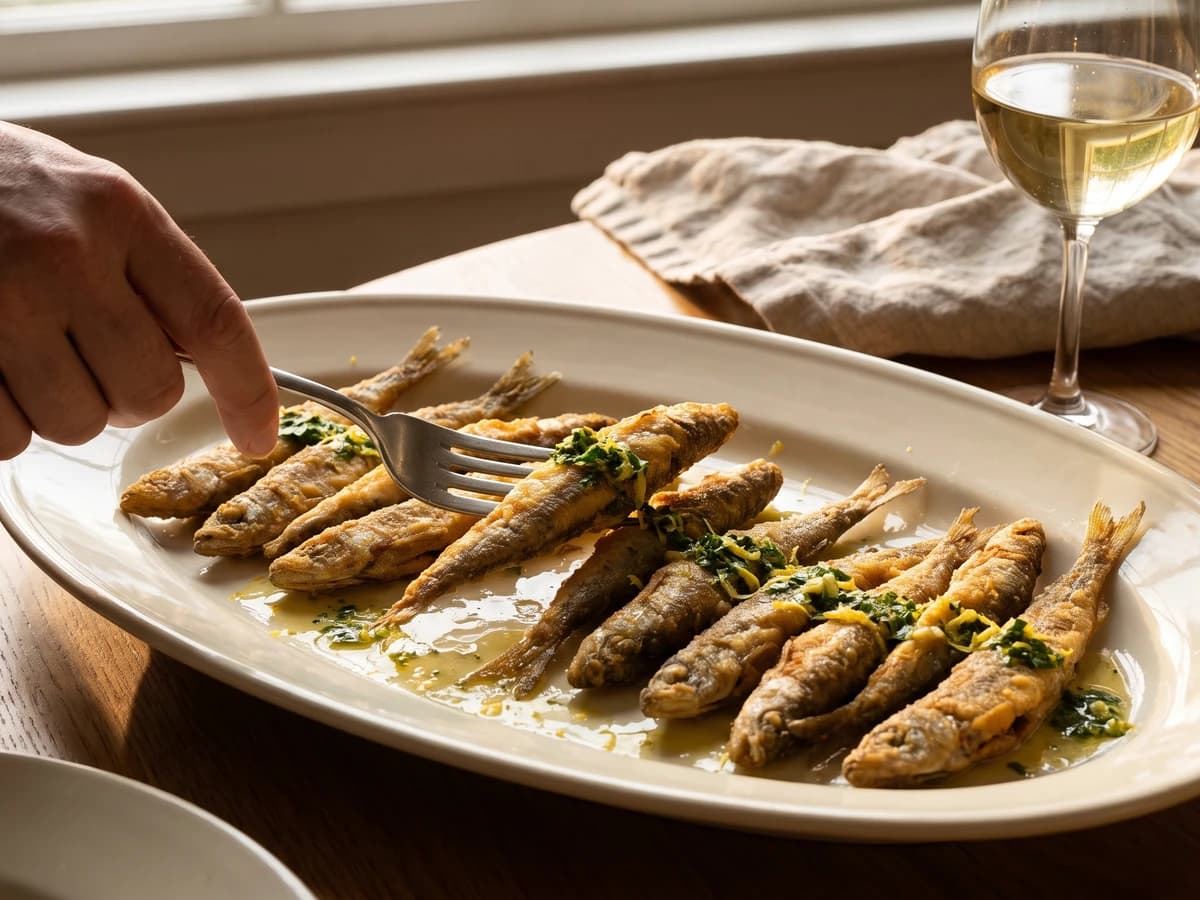
Éperlans à l’Anglaise turns small fish into a lesson in disciplined coating: boned smelts under a close, crisp crumb, pan-fried in clarified butter and finished with bright, half-melted maître d’hôtel butter.

Chef Juliette
Tiny smelts, shallot, mushrooms, white wine, gratin sauce, and fine bread raspings meet a fierce oven, where the fish must turn tender in the same breath the buttered crust bronzes.