
Chef Juliette
John Dory (St. Pierre)
John Dory has the delicacy of sole and the firmness of turbot. A light flouring, a quick butter sauté, and nut-brown beurre noisette show exactly why looks never mattered.
A cooking platform built around craft, culture, and the stories behind what we eat.

Created by Chef Juliette
Based on No. 1373, Côtelettes d’Agneau de Lait Milanaise, from Le Guide Culinaire (1907) by Auguste Escoffier
Parmesan-laced crumbs turn milk-fed lamb cutlets butter-gold while a rich macaroni garnish waits inside the ring, a lesson in setting a crust fast and serving it before tenderness slips away.
Côtelettes d’Agneau de Lait Milanaise (milk-fed lamb cutlets Milanese-style) teach one truth: a panure à l’anglaise, a coating of flour, egg preparation, and crumbs, must set the instant it meets the butter. The fat must be hot enough to seize the coating before it sheds, but controlled enough that the Parmesan bronzes without burning while the delicate lamb cooks beneath it.
The original didn't need a stockpot or salamander; its hidden luxury was simultaneous hands. A garde-manger kept Anglaise (for Egg-and-bread-crumbing) (No. 174) ready, while a saucier or entremetier handed over the macaroni garnish specified through Côte de Veau Milanaise (No. 1258), already hot for service. At home, you prepare those two linked recipes as finished components, flatten eight cutlets with the smooth face of a meat mallet, and work in two quick batches. The extra hands were brigade scaffolding and can go. The four-to-one breadcrumb and Parmesan ratio, clarified butter, and circular service are the dish, so they stay. One cook, one stove, one evening.
The platter should arrive generous and unmistakable: butter-gold cutlets overlapping around tomato-red macaroni, with cheese, Madeira, mushrooms, ham, tongue, and truffle giving the centre its grand character. Before the first cutlet touches the pan, bring the clarified butter to 350°F (175°C). That moment decides the crust.
Côtelettes d’Agneau de Lait Milanaise belongs to the French grand-kitchen canon’s à la milanaise family, a French reading of Milan in Lombardy rather than a regional French preparation. Its Parmesan breading nods toward the Milanese cutlet, while the central macaroni bound with cheese and tomato, enriched with ham, tongue, mushrooms, truffle, and Madeira, is a composed French garnish. The name is sometimes mistaken for a direct Italian household recipe, but the ringed presentation and elaborate centre place this version firmly at the French formal table.
Quantity
8 cutlets, about 2½ oz (70 g) each
Quantity
1 teaspoon (5 ml / 6 g)
Quantity
½ teaspoon (2.5 ml / 1 g)
Quantity
½ cup (120 ml / 60 g)
Quantity
¾ cup (180 ml / 180 g) Anglaise (for Egg-and-bread-crumbing) (No. 174)
finished and chilled
Quantity
1 cup (240 ml / 100 g)
Quantity
¼ cup (60 ml / 25 g)
finely grated
Quantity
⅔ cup (160 ml / 145 g)
Quantity
3 cups (720 ml / about 700 g) finished garnish à la milanaise from Côte de Veau Milanaise (No. 1258)
prepared as a finished component and kept warm
| Ingredient | Quantity |
|---|---|
| milk-fed lamb rib cutlets | 8 cutlets, about 2½ oz (70 g) each |
| fine sea salt | 1 teaspoon (5 ml / 6 g) |
| freshly ground black pepper | ½ teaspoon (2.5 ml / 1 g) |
| plain flour | ½ cup (120 ml / 60 g) |
| Anglaise (for Egg-and-bread-crumbing)finished and chilled | ¾ cup (180 ml / 180 g) Anglaise (for Egg-and-bread-crumbing) (No. 174) |
| fine dry breadcrumbs | 1 cup (240 ml / 100 g) |
| Parmesanfinely grated | ¼ cup (60 ml / 25 g) |
| clarified butter | ⅔ cup (160 ml / 145 g) |
| Côte de Veau Milanaiseprepared as a finished component and kept warm | 3 cups (720 ml / about 700 g) finished garnish à la milanaise from Côte de Veau Milanaise (No. 1258) |
Measure the finished Anglaise (for Egg-and-bread-crumbing) (No. 174) into a shallow dish and keep it cold until the cutlets are ready. Put the finished garnish à la milanaise specified through Côte de Veau Milanaise (No. 1258) into a covered saucepan, ready for gentle reheating. These are finished preparations the original kitchen reached for, not components to rebuild inside this recipe.
Lay each cutlet between two sheets of parchment. Moisten the smooth face of a meat mallet and strike from the thicker centre toward the edge until the meaty eye is about ⅜ inch (1 cm) thick, roughly half its original thickness. Keep the bone intact and avoid pounding the edge into holes. Pat the meat thoroughly dry, then season both sides with the salt and pepper. A wet surface loosens the flour, and every later layer depends upon that first one holding.
Mix the breadcrumbs and Parmesan thoroughly, preserving the entry’s exact ratio of four parts crumbs to one part cheese by weight. Pass each cutlet lightly through the flour and shake off every loose patch. Coat it completely in the Anglaise (for Egg-and-bread-crumbing) (No. 174), let the excess drain, then press it into the Parmesan crumbs on both sides. Set the breaded cutlets on a rack for 10 minutes so the layers settle together. If a bare patch appears, dab it with a little Anglaise and press on fresh crumbs. If a whole section slides, scrape that section clean, flour it again, and rebuild it. Ça se rattrape.
Set the finished garnish from Côte de Veau Milanaise (No. 1258) over the gentlest heat and stir from the bottom until the macaroni is hot, glossy, and cohered by its butter and cheeses. Do not boil it. If the cheese begins to tighten or release fat, take the pan off the heat and stir steadily until it comes together; if necessary, add only a small splash of hot water. Hold it covered off the heat while the cutlets cook.
Heat the clarified butter in a 12-inch (30 cm) heavy skillet to 350°F (175°C). Without a thermometer, a pinch of breadcrumb should sizzle vigorously at once and turn gold, not black. Fry the cutlets in two uncrowded batches, about 2 to 3 minutes on the first side and 1½ to 2 minutes on the second, until the crust is deep butter-gold and the lamb reaches 145°F (63°C) after resting for at least 3 minutes. Transfer each batch to a rack, never paper, which traps moisture beneath the crust. If the breading begins to shed, stop nudging the cutlet and let the first side set before turning. If the Parmesan darkens too quickly, lift the pan from the heat, lower the flame, and continue once the butter calms. The crust is browned, not sacrificed.
Mound the hot macaroni garnish in the centre of a warmed oval platter. Arrange the rested cutlets around it in an overlapping circle, meaty ends turned inward and bones pointing toward the rim. Serve at once, while the crumb still answers the knife and the macaroni remains glossy. Cooking well is not cooking fancy. À table!
1 serving (about 320g)
Culinary guides, cultural storytelling, and the editorial depth that makes cooking meaningful.
Discover Culinary ExplorerChef Juliette
John Dory has the delicacy of sole and the firmness of turbot. A light flouring, a quick butter sauté, and nut-brown beurre noisette show exactly why looks never mattered.

Chef Juliette
Fresh haddock proves its delicacy in the meunière pan: a fine flour crust, moist pearly flakes, and beurre noisette sharpened with lemon and parsley, ready from one skillet in half an hour.
Chef Juliette
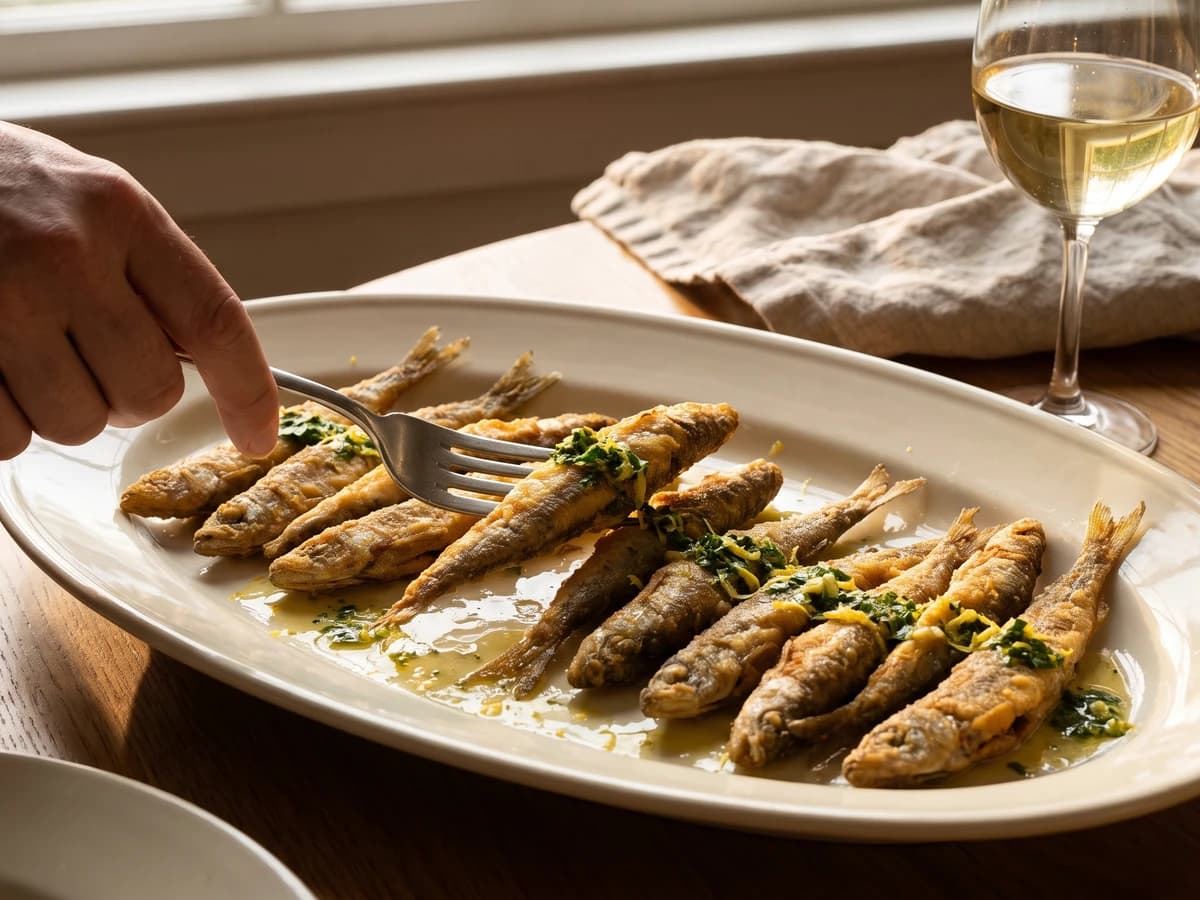
Éperlans à l’Anglaise turns small fish into a lesson in disciplined coating: boned smelts under a close, crisp crumb, pan-fried in clarified butter and finished with bright, half-melted maître d’hôtel butter.

Chef Juliette
Tiny smelts, shallot, mushrooms, white wine, gratin sauce, and fine bread raspings meet a fierce oven, where the fish must turn tender in the same breath the buttered crust bronzes.