
Chef Juliette
John Dory (St. Pierre)
John Dory has the delicacy of sole and the firmness of turbot. A light flouring, a quick butter sauté, and nut-brown beurre noisette show exactly why looks never mattered.
A cooking platform built around craft, culture, and the stories behind what we eat.
Created by Chef Juliette
Based on No. 1258, Côte de Veau Milanaise, from Le Guide Culinaire (1907) by Auguste Escoffier
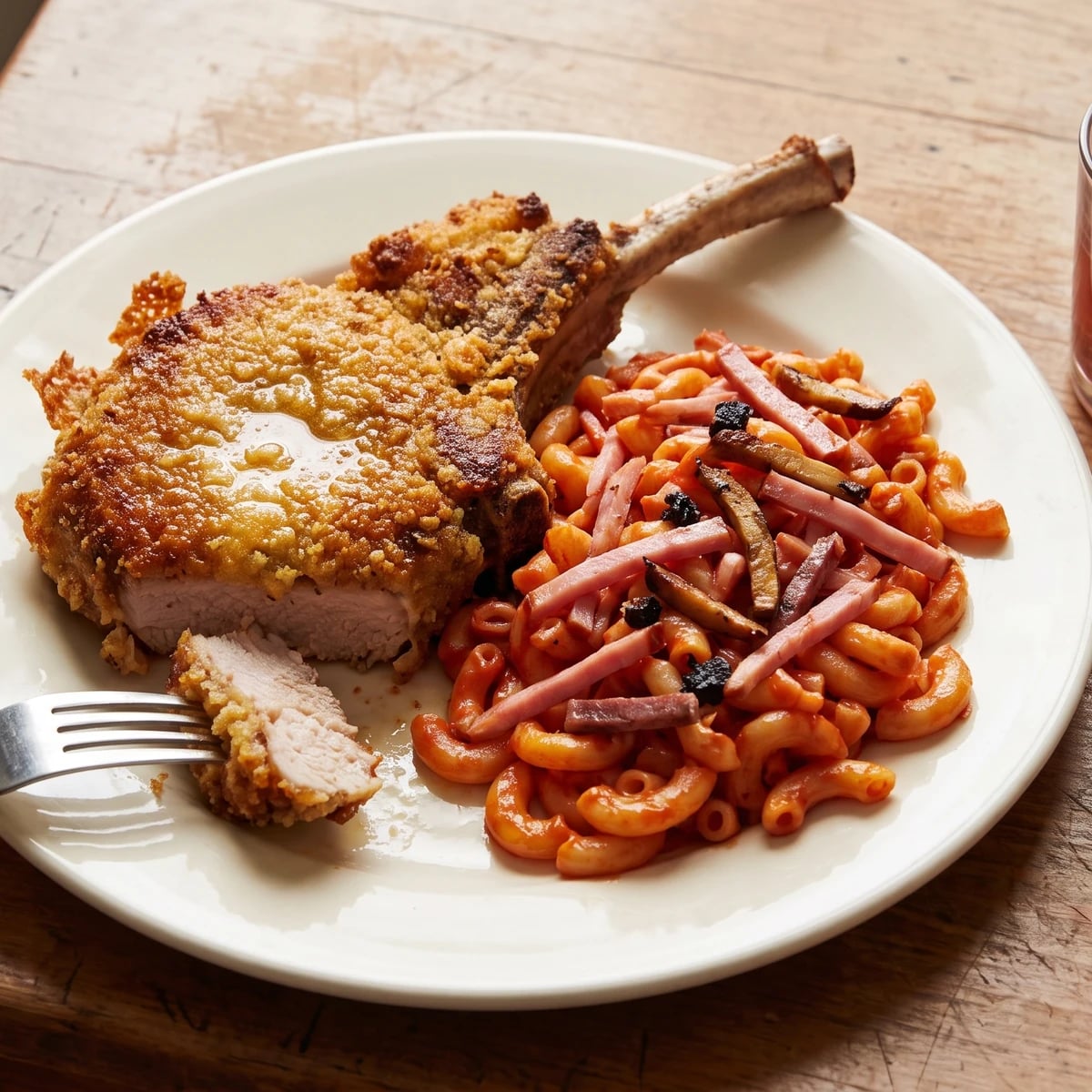
Parmesan in the crumb is the mark: a thin veal chop fried bronze in clarified butter, with tomato-cheese macaroni carrying Madeira-warmed ham, tongue, mushroom, and truffle beside it.
Côte de veau milanaise (a thin veal chop in Parmesan crumb with milanaise macaroni) teaches timing disguised as generosity. The cheese crumb is the mark. Because Parmesan colors faster than bread alone, the veal must be beaten evenly to half its thickness so the meat reaches tenderness in the same breath that the crust turns deep butter-gold.
The source entry assumes a cold larder already stocked with cooked ham, salted tongue, mushrooms, and truffle, plus another pair of hands to tend the macaroni while the chop fries. It asks for neither a saucier nor stock kept on the fire, and no salamander belongs over this crumb. At home, prepared cured tongue and preserved whole truffle answer the larder, one saucepan handles the garnish and macaroni, and a rack in a low oven replaces the hot pass. The paper frill around the bone is service scaffolding, so it goes. The Parmesan crumb, clarified-butter frying, Madeira-warmed julienne, and tomato-cheese macaroni are the dish, so every one stays. One cook, one stove, one evening.
The finished plate is generous: crisp bronze veal, a clean pale interior, and glossy red macaroni tangled with savory matchsticks from the larder. Before you touch the pan, flatten every part of the meat to the same thickness and let the breading sit for ten minutes. That evenness decides the dish.
Côte de veau milanaise belongs to the French classical family of preparations à la milanaise, a grand-kitchen reading of northern Italian breaded veal rather than a transcript of a Milan household recipe. French service broadened the identity into Parmesan crumb and tomato-red macaroni bound with Gruyère and Parmesan, then enriched it with ham, salted tongue, mushrooms, truffle, and Madeira. That elaborate garnish is the distinction: reduce the dish to a plain breaded chop and the meaning of milanaise in this entry disappears.
Quantity
4 chops, about 8 ounces (225 g) each and 3/4 inch (2 cm) thick
Quantity
1 tablespoon plus 1 teaspoon (20 ml / 24 g)
divided
Quantity
1 teaspoon (5 ml / 2 g)
divided
Quantity
2
Quantity
1 1/2 cups (350 ml / 150 g)
Quantity
3/4 cup (175 ml / 75 g)
Quantity
3/4 cup (175 ml / 160 g)
for frying
Quantity
2 cups (475 ml / 225 g)
Quantity
4 tablespoons (60 ml / 57 g)
divided
Quantity
1/2 cup (120 ml / 50 g)
Quantity
1/4 cup (60 ml / 25 g)
Quantity
1/2 cup (120 ml / 125 g)
Quantity
1/8 teaspoon (0.6 ml / 0.25 g)
Quantity
1/2 cup (120 ml / 75 g)
cut julienne-fashion
Quantity
1/2 cup (120 ml / 75 g)
cut julienne-fashion
Quantity
1 1/2 cups (350 ml / 120 g)
cut julienne-fashion
Quantity
2 tablespoons (30 ml / 20 g)
cut julienne-fashion
Quantity
1/3 cup (80 ml / 78 g)
| Ingredient | Quantity |
|---|---|
| bone-in veal rib chops | 4 chops, about 8 ounces (225 g) each and 3/4 inch (2 cm) thick |
| fine sea saltdivided | 1 tablespoon plus 1 teaspoon (20 ml / 24 g) |
| freshly ground black pepperdivided | 1 teaspoon (5 ml / 2 g) |
| large eggs | 2 |
| fine dry breadcrumbs | 1 1/2 cups (350 ml / 150 g) |
| finely grated Parmesan for the crumb | 3/4 cup (175 ml / 75 g) |
| clarified butterfor frying | 3/4 cup (175 ml / 160 g) |
| dry macaroni | 2 cups (475 ml / 225 g) |
| unsalted butterdivided | 4 tablespoons (60 ml / 57 g) |
| finely grated Gruyère | 1/2 cup (120 ml / 50 g) |
| finely grated Parmesan for the macaroni | 1/4 cup (60 ml / 25 g) |
| bright-red canned tomato purée | 1/2 cup (120 ml / 125 g) |
| freshly grated nutmeg | 1/8 teaspoon (0.6 ml / 0.25 g) |
| very lean cooked hamcut julienne-fashion | 1/2 cup (120 ml / 75 g) |
| cooked salted beef or veal tonguecut julienne-fashion | 1/2 cup (120 ml / 75 g) |
| firm mushroomscut julienne-fashion | 1 1/2 cups (350 ml / 120 g) |
| preserved black trufflecut julienne-fashion | 2 tablespoons (30 ml / 20 g) |
| dry Madeira | 1/3 cup (80 ml / 78 g) |
Heat the oven to 200°F (95°C) and set a wire rack over a sheet pan inside. Cut the ham, salted tongue, mushrooms, and truffle julienne-fashion, into fine matchstick rods, keeping the mushrooms separate. Grate both cheeses before beginning; once the veal meets the butter, there is no useful pause.
Lay each chop between sheets of parchment. Dampen the smooth face of a meat mallet and strike the flesh evenly, working around the bone without hitting it, until the meat is reduced to half its original thickness, about 3/8 inch (1 cm). Season the chops with 1 teaspoon (5 ml / 6 g) of the salt and half the pepper. Beat the eggs in a shallow dish. Mix the breadcrumbs with the Parmesan in another, keeping the source ratio of two parts crumbs to one part cheese. Dip each chop directly into egg, let the excess fall away, then press it firmly into the crumb mixture on both sides. There is no flour layer in this formula. Rest the breaded chops on a rack for 10 minutes so the coating adheres.
Bring a large saucepan of water to a boil and add 1 tablespoon (15 ml / 18 g) of the salt. Cook the macaroni until tender with a faint resistance at the centre. Reserve 1 cup (240 ml) of its cooking water, then drain without rinsing. Toss the macaroni with 1 tablespoon (15 ml / 14 g) of the butter and keep it covered nearby.
Return the saucepan to medium-high heat and melt 1 tablespoon (15 ml / 14 g) of the butter. Add the mushroom julienne and cook until its moisture evaporates and the edges begin to brown. Add the ham, salted tongue, truffle, and Madeira. Bubble for 2 to 3 minutes, tossing gently, until everything is hot and the Madeira has reduced to a glossy spoonful rather than disappearing. Transfer the mixture to a bowl.
Put the tomato purée and remaining 2 tablespoons (30 ml / 29 g) butter into the saucepan. Cook for 2 minutes over medium heat, just until glossy, keeping the purée vividly red rather than browning it. Add the macaroni, nutmeg, and remaining pepper. Take the pan off the heat and fold in the Gruyère, Parmesan, and Madeira-warmed julienne. Add reserved pasta water a spoonful at a time until the cheeses and tomato cohere around the macaroni in a glossy coating. Taste before adding any extra salt because the tongue and cheeses carry plenty. If the cheese clumps or the macaroni tightens, stop heating and work in warm pasta water one spoonful at a time. Ça se rattrape. Cover and hold over the lowest possible heat.
Heat enough clarified butter to cover the bottom of your largest heavy skillet generously, about 1/4 inch (6 mm) deep, over medium heat. It should shimmer at about 340°F (170°C), never smoke. Lower in one or two chops without crowding and fry without shifting them for 2 to 3 minutes, until the underside is deep butter-gold. Turn once and cook the second side for another 2 to 3 minutes, until the crust is crisp and the thickest meat beside the bone reaches 145°F (63°C). Transfer to the warm rack and repeat, replenishing the clarified butter as needed. Parmesan darkens quickly, so if loose crumbs begin turning mahogany, lift out the chop, take the pan off the heat, remove the dark crumbs, add fresh clarified butter, and lower the flame before continuing. Ça se rattrape; scorched crumbs left in the pan do not.
Rest the final chops for 3 minutes. If the macaroni has tightened while the veal cooked, loosen it over gentle heat with another spoonful of reserved pasta water. Set each chop on a warm plate with its bare bone pointing outward and spoon a generous mound of milanaise macaroni beside it, never beneath the crust. Serve at once. À table!
1 serving (about 490g)
Culinary guides, cultural storytelling, and the editorial depth that makes cooking meaningful.
Discover Culinary Explorer
Chef Juliette
John Dory has the delicacy of sole and the firmness of turbot. A light flouring, a quick butter sauté, and nut-brown beurre noisette show exactly why looks never mattered.

Chef Juliette
Fresh haddock proves its delicacy in the meunière pan: a fine flour crust, moist pearly flakes, and beurre noisette sharpened with lemon and parsley, ready from one skillet in half an hour.

Chef Juliette
Éperlans à l’Anglaise turns small fish into a lesson in disciplined coating: boned smelts under a close, crisp crumb, pan-fried in clarified butter and finished with bright, half-melted maître d’hôtel butter.

Chef Juliette
Tiny smelts, shallot, mushrooms, white wine, gratin sauce, and fine bread raspings meet a fierce oven, where the fish must turn tender in the same breath the buttered crust bronzes.