
Chef Juliette
Bouillabaisse à la Marseillaise
Marseille's great fish stew, saffron-gold and garlic-scented, proves that a hard boil can be the careful choice: it binds olive oil into broth before the whole pot meets bread.
A cooking platform built around craft, culture, and the stories behind what we eat.

Created by Chef Juliette
Based on No. 1346, Daube à l’Avignonnaise, from Le Guide Culinaire (1907) by Auguste Escoffier
Red-wine mutton, larded with bacon and sealed beneath more bacon, onion, rind, and orange peel, cooks five quiet hours until the daube turns spoon-tender and its sauce shines deep garnet.
Daube à l’Avignonnaise (Avignon-style mutton braise) teaches the discipline of enclosed braising: no hard browning, no impatient boiling, just seasoned meat, wine, pork, aromatics, and five hours held in a sealed pot. The one true thing to know before touching a pan is that the seal is not theater. It keeps the wine and rendered fat circulating around the mutton until a firm leg becomes yielding and the onions nearly disappear into the sauce.
The original assumed a whole leg of mature mutton, a larding needle, an earthenware daubière, a baker’s steady oven, and brown stock never off the fire. At home, a butcher-boned mutton leg, a narrow knife for threading the bacon, a heavy lidded pot sealed with soft flour paste, a low domestic oven, and a small measure of good prepared brown stock do the same work. The transfer onto a napkin was service scaffolding, so it goes. The two-hour marinade, bacon larding, orange peel, layered pot, and five-hour cooking are the dish, so they stay. One cook, one stove, one evening, provided the marinade begins in the afternoon.
Do not add a fashionable browning step. This daube builds its character inside the closed pot, where wine, pork rind, onions, and time make the sauce. Listen when the pot first comes to a simmer: it should murmur gently, never pound, before it enters the oven. That quiet heat decides everything.
Daube à l’Avignonnaise belongs to Avignon in Provence and the surrounding kitchens of the Comtat Venaissin, where mutton, olive oil, wine, and dried orange peel meet in a deep earthenware daubière. Household cooks layered and sealed the pot before sending it into steady communal or baker’s heat, and the classical kitchen kept that method while making its larding and service more formal. This is not a generic beef daube under a southern name: mutton, bacon rind, and orange peel give the Avignon preparation its particular character.
Quantity
2 lb 10 oz (1.2 kg)
cut into roughly 3 oz (85 g) pieces
Quantity
3 oz (85 g)
chilled and cut into long thick strips for larding
Quantity
2 teaspoons (10 ml / 12 g)
divided
Quantity
1 teaspoon (5 ml / 2 g)
divided
Quantity
1⅔ cups (400 ml / 400 g) Cooked Marinade for Venison (No. 168)
fully cooled
Quantity
2 tablespoons (30 ml / 27 g)
Quantity
½ small, about ⅓ cup (80 ml / 50 g)
thinly sliced
Quantity
½ medium, about ¾ cup (180 ml / 75 g)
thinly sliced
Quantity
3 cloves
lightly crushed
Quantity
4 sprigs
Quantity
1
Quantity
¼ cup loosely packed (60 ml / 10 g)
Quantity
2 medium, about 2 cups (475 ml / 300 g)
finely chopped
Quantity
2 cloves
crushed
Quantity
¾ cup (180 ml / 115 g), prepared through Blanchings (No. 273)
diced and thoroughly dried
Quantity
4 oz (115 g), prepared through Blanchings (No. 273)
cut into 1-inch squares and thoroughly dried
Quantity
10 slices (6 oz / 170 g)
for lining and covering the pot
Quantity
1 packed cup (240 ml / 30 g)
tied into a compact bouquet
Quantity
1 strip, about 3 by 1 inches
Quantity
1 teaspoon (5 ml / 1 g)
Quantity
⅛ teaspoon (0.6 ml / 0.15 g)
Quantity
¼ cup (60 ml / 60 g)
Quantity
¾ cup (180 ml / 90 g)
for sealing paste
Quantity
¼ cup (60 ml / 60 g), plus a few drops if needed
for sealing paste
| Ingredient | Quantity |
|---|---|
| boneless leg of muttoncut into roughly 3 oz (85 g) pieces | 2 lb 10 oz (1.2 kg) |
| unsmoked slab baconchilled and cut into long thick strips for larding | 3 oz (85 g) |
| fine sea saltdivided | 2 teaspoons (10 ml / 12 g) |
| freshly ground black pepperdivided | 1 teaspoon (5 ml / 2 g) |
| red-wine Cooked Marinade for Venisonfully cooled | 1⅔ cups (400 ml / 400 g) Cooked Marinade for Venison (No. 168) |
| mild olive oil | 2 tablespoons (30 ml / 27 g) |
| carrotthinly sliced | ½ small, about ⅓ cup (80 ml / 50 g) |
| onion for the marinadethinly sliced | ½ medium, about ¾ cup (180 ml / 75 g) |
| garlic for the marinadelightly crushed | 3 cloves |
| fresh thyme | 4 sprigs |
| bay leaf | 1 |
| parsley stalks | ¼ cup loosely packed (60 ml / 10 g) |
| onions for layeringfinely chopped | 2 medium, about 2 cups (475 ml / 300 g) |
| garlic for layeringcrushed | 2 cloves |
| lean unsmoked bacondiced and thoroughly dried | ¾ cup (180 ml / 115 g), prepared through Blanchings (No. 273) |
| fresh unsmoked pork rindcut into 1-inch squares and thoroughly dried | 4 oz (115 g), prepared through Blanchings (No. 273) |
| thinly sliced unsmoked streaky baconfor lining and covering the pot | 10 slices (6 oz / 170 g) |
| flat-leaf parsleytied into a compact bouquet | 1 packed cup (240 ml / 30 g) |
| dried untreated orange peel | 1 strip, about 3 by 1 inches |
| dried thyme | 1 teaspoon (5 ml / 1 g) |
| finely crumbled dried bay leaf | ⅛ teaspoon (0.6 ml / 0.15 g) |
| good brown stock | ¼ cup (60 ml / 60 g) |
| plain flourfor sealing paste | ¾ cup (180 ml / 90 g) |
| cool waterfor sealing paste | ¼ cup (60 ml / 60 g), plus a few drops if needed |
Season the chilled bacon strips with ½ teaspoon of the salt and ¼ teaspoon of the pepper. Dry the mutton, then use a narrow knife to cut a tunnel through each piece in the same direction as the meat’s grain. Push one seasoned bacon strip through each tunnel, leaving it buried inside rather than hanging from the ends. Larding with the grain lets the bacon baste the meat without splitting the pieces apart. If a strip buckles, chill it for ten minutes and widen the tunnel slightly. Ça se rattrape.
Place the larded mutton in a nonreactive bowl with the sliced carrot, sliced onion, three crushed garlic cloves, fresh thyme, bay leaf, and parsley stalks. Pour over the fully cooled red-wine Cooked Marinade for Venison (No. 168) and the olive oil, turning the pieces until every surface is coated. Cover and refrigerate for two hours, turning once halfway through. Keep the marinade cold. Warm liquid dulls the meat’s texture, while an overnight soak would push this particular entry beyond its intended seasoning.
While the mutton marinates, have the diced lean bacon and pork rind ready through Blanchings (No. 273), then dry both very well. Mix the chopped onions with the two crushed garlic cloves. Tie the parsley around the dried orange peel to make a compact bouquet that will be easy to retrieve. Combine the dried thyme and crumbled bay in a small dish.
Line the bottom and sides of a 4-quart daubière or heavy Dutch oven with about two-thirds of the thin bacon slices, allowing their edges to overlap. Lift the mutton from its marinade and season it with the remaining salt and pepper. Arrange one layer of meat over the bacon, then scatter over some onion mixture, diced bacon, pork rind, and a pinch of the thyme and bay. Repeat until everything is used, setting the parsley and orange bouquet in the middle. Do not brown the meat or onions. In this daube, enclosed layering is the technique, and browning would turn it into a different braise.
Strain the marinade through a fine sieve directly over the layered meat, pressing lightly on the vegetables before discarding them. Add the brown stock, then cover the contents with the remaining bacon slices. Mix the flour and water into a soft, pliable paste and roll it into a rope. Set on the lid and press the paste around its seam. This is the home equivalent of sealing a daubière: snug enough to hold moisture, but never a locking or pressure-tight closure. Patch any crack with a damp finger and another pinch of paste.
Set the sealed pot over low heat for about fifteen minutes, until you hear the liquid begin a quiet murmur inside. Transfer it to a 285°F (140°C) oven and cook for five hours without opening it. The original baker’s oven supplied steady, surrounding heat; your low domestic oven does the same work. A hard boil tightens the mutton, so if the pot rattles or bubbles violently around the seal, lower the oven by 15°F (10°C). If you smell scorching, break the seal, add ¼ cup of hot stock, reseal, and continue. Ça se rattrape.
Break away the paste and lift the lid carefully. Remove and discard the bacon slices from the top and retrieve the parsley and orange bouquet. Skim the clear fat patiently with a shallow spoon, leaving the dark, glossy braising juices behind. If the sauce seems thin, lift out the meat and reduce the liquid in the uncovered pot for five to ten minutes, then return the meat. If it becomes too concentrated, loosen it with a spoonful of hot stock. Never apologize for the sauce. Adjust it.
Let the daube settle for fifteen minutes so the meat can drink back some of its juices. Bring it to the table in the daubière or Dutch oven, which preserves the household character better than transferring it to formal serving ware. Spoon mutton, onions, softened rind, and plenty of sauce into warm shallow bowls. À table!
1 serving (about 490g)
Culinary guides, cultural storytelling, and the editorial depth that makes cooking meaningful.
Discover Culinary ExplorerChef Juliette
Marseille's great fish stew, saffron-gold and garlic-scented, proves that a hard boil can be the careful choice: it binds olive oil into broth before the whole pot meets bread.

Chef Juliette
Waterzoi asks fresh, bone-in river fish to thicken its own buttery broth, with parsley root and pepper for company. No flour, no stockpot, just a brisk simmer watched closely.
Chef Juliette
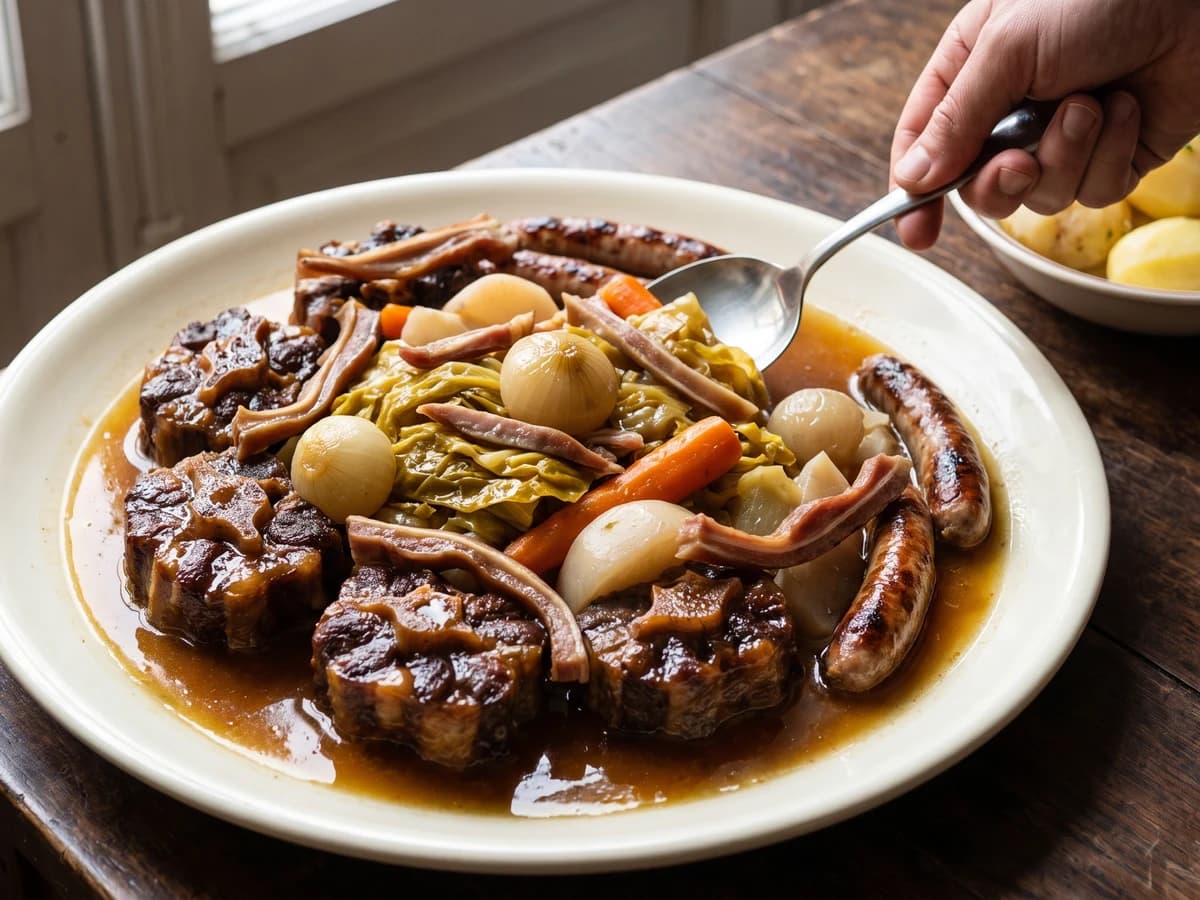
Queue de Bœuf en Hochepot gathers oxtail, pig's trotter and ear, cabbage, roots, and grilled chipolatas around a clear, gelatin-rich broth whose quiet simmer keeps every piece tender and distinct.

Chef Juliette
Beef shoulder larded with bacon, sharpened by red wine and vinegar, then sealed with garlic, vegetables, and dry lemon peel until the low oven turns it yielding and the gravy darkly glossy.