
Chef Juliette
John Dory (St. Pierre)
John Dory has the delicacy of sole and the firmness of turbot. A light flouring, a quick butter sauté, and nut-brown beurre noisette show exactly why looks never mattered.
A cooking platform built around craft, culture, and the stories behind what we eat.
Created by Chef Juliette
Based on No. 1342, Rognons Brochette au Vert Pré, from Le Guide Culinaire (1907) by Auguste Escoffier
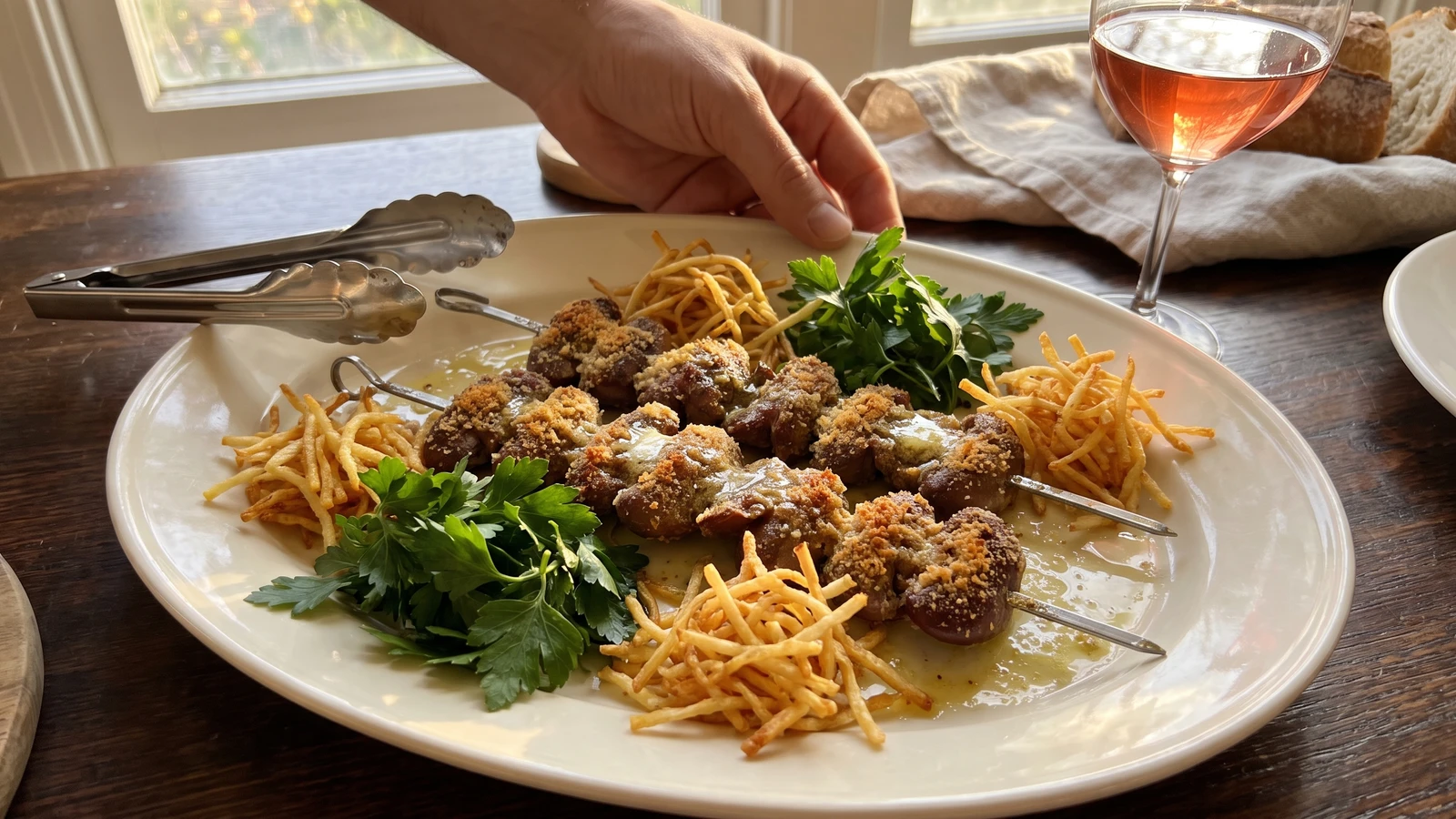
Butterflied kidneys, pinned open on skewers and grilled over fierce heat, with pommes paille and vivid parsley: a classical grill lesson in exact trimming, dry surfaces, and stopping at the right second.
Rognons brochette au vert pré (skewered kidneys with straw potatoes and green parsley) teaches the discipline of the grill. Trim exactly, dry completely, cook quickly, and stop. Kidneys gain a fine bronze crust in minutes, but tenderness can be lost in seconds.
The original kitchen assumed mature mutton kidneys, a grill already hot, and a fryer kept ready beside it. It needed neither a saucier nor a stockpot. At home, small lamb kidneys are the honest equivalent when mutton isn't available, while a cast-iron griddle, close broiler, or covered barbecue supplies the heat and a deep saucepan handles the potatoes. The smaller kidneys cook faster and taste milder, so the quantity increases while the total weight stays right for four. One cook, one stove, one evening.
The separate grill and frying stations were brigade scaffolding, so they can go. Fry the pommes paille first and hold them briefly while the kidneys cook. The butterflied shape, fine breadcrumb coat, fierce last-minute grilling, crisp potatoes, and bunches of green parsley are the dish itself, and they stay.
The trimming decides everything. Remove the membrane and firm white core without carving away the tender flesh, then dry each kidney until no moisture remains before butter and crumbs touch it. Do that carefully, and the fire can do its work.
Rognons brochette au vert pré belongs to the classical Parisian grill-room and bistro repertoire, where economical mutton kidneys became a composed dish through exact trimming and fast cooking. The name describes the arrangement rather than an herb sauce: bronzed kidneys at the center, golden pommes paille around them, and distinctly green bunches of parsley suggesting a meadow. Generations of dining-room cooks kept the presentation simple because the contrast of crisp potato, mineral-rich kidney, and fresh parsley was already complete.
Quantity
8 mutton kidneys or 12 small lamb kidneys (about 1 lb 8 oz / 680 g total)
membranes and firm white cores removed
Quantity
4 tablespoons (60 ml / 56 g)
clarified during cooking
Quantity
1 cup (240 ml / 90 g)
Quantity
4 medium potatoes (about 1 lb 12 oz / 800 g)
peeled
Quantity
6 cups (1.5 L / about 1.4 kg)
Quantity
1 large bunch (about 4 cups loosely packed / 100 g)
washed and thoroughly dried
Quantity
1 1/2 teaspoons (7.5 ml / 9 g)
divided
Quantity
3/4 teaspoon (3.75 ml / 2 g)
| Ingredient | Quantity |
|---|---|
| mutton kidneys or small lamb kidneysmembranes and firm white cores removed | 8 mutton kidneys or 12 small lamb kidneys (about 1 lb 8 oz / 680 g total) |
| unsalted butterclarified during cooking | 4 tablespoons (60 ml / 56 g) |
| fine fresh white breadcrumbs | 1 cup (240 ml / 90 g) |
| floury potatoes, such as russetpeeled | 4 medium potatoes (about 1 lb 12 oz / 800 g) |
| neutral frying oil | 6 cups (1.5 L / about 1.4 kg) |
| flat-leaf parsleywashed and thoroughly dried | 1 large bunch (about 4 cups loosely packed / 100 g) |
| fine saltdivided | 1 1/2 teaspoons (7.5 ml / 9 g) |
| freshly ground black pepper | 3/4 teaspoon (3.75 ml / 2 g) |
Pull away the thin outer membrane from each kidney. Split it lengthwise almost through, leaving the two lobes attached like an open book, then cut out the firm white core and any tubes with the tip of a small knife. Remove the hard tissue, not half the kidney. Pat every surface thoroughly dry and push a short skewer crosswise through the lobes to hold each kidney open.
Cut the potatoes into pommes paille, matchsticks about 1/16 inch or 2 mm thick. A mandoline with its guard makes quick work of this, though a sharp knife is perfectly respectable. Rinse the cut potatoes under cold water until the water runs clear, soak them for 10 minutes, then drain and dry them between clean towels. They must be impeccably dry because surface water makes the oil spit and prevents a crisp finish.
Divide the parsley into small, loose bunches, keeping the tender stems attached, and dry it once more if necessary. Melt the butter gently, skim away the foam, and spoon the clear golden fat into a bowl, leaving the milky sediment behind. This clarified butter gives the kidneys real butter flavor without scorching under the grill. Heat the oven to 250°F or 120°C for the brief potato hold.
Heat the frying oil in a deep, heavy saucepan to 355°F or 180°C. Fry the potatoes in small handfuls for 2 to 3 minutes, stirring carefully so the strands separate, until crisp and evenly golden. Drain on a rack or absorbent paper, season with half the salt, and hold them in the oven for no longer than 15 minutes. If a batch comes out limp, the oil cooled too far. Ça se rattrape: bring it to 375°F or 190°C and refry that batch for 30 to 45 seconds.
Season the kidneys on both sides with the remaining salt and the pepper. Brush them lightly with clarified butter, then press them into the breadcrumbs, shaking off every loose excess. You want a fine, even veil that will bronze against the heat, not a heavy cutlet crust. Coat them only when the grill is ready so the crumbs remain dry.
Heat a cast-iron griddle, close broiler, or covered barbecue until a crumb of bread browns almost at once. Grill the kidneys rounded side down for 2 to 3 minutes, then turn and cook the cut side for about 2 minutes, brushing sparingly with the remaining clarified butter. Work in two batches if crowding would cool the surface. If juices begin pooling instead of sizzling, lift the kidneys out, reheat the grill, and return them; trapped moisture is the problem, not the meat. They are ready when the crumb is deep gold and the centers reach 145°F or 63°C with a faint rosy blush. Rest for 3 minutes. If one is still cool and raw at its center, return it cut side down for 30 seconds.
Arrange the skewered kidneys closely down the center of a warmed oval platter. Surround them with alternating small heaps of pommes paille and loose bunches of very green parsley, keeping the potatoes airy rather than pressing them into a solid border. Bring the platter straight to the table. This dish waits for nobody, and nobody should have to wait for it. À table!
1 serving (about 305g)
Culinary guides, cultural storytelling, and the editorial depth that makes cooking meaningful.
Discover Culinary ExplorerChef Juliette
John Dory has the delicacy of sole and the firmness of turbot. A light flouring, a quick butter sauté, and nut-brown beurre noisette show exactly why looks never mattered.

Chef Juliette
Fresh haddock proves its delicacy in the meunière pan: a fine flour crust, moist pearly flakes, and beurre noisette sharpened with lemon and parsley, ready from one skillet in half an hour.

Chef Juliette
Éperlans à l’Anglaise turns small fish into a lesson in disciplined coating: boned smelts under a close, crisp crumb, pan-fried in clarified butter and finished with bright, half-melted maître d’hôtel butter.

Chef Juliette
Tiny smelts, shallot, mushrooms, white wine, gratin sauce, and fine bread raspings meet a fierce oven, where the fish must turn tender in the same breath the buttered crust bronzes.