
Chef Juliette
John Dory (St. Pierre)
John Dory has the delicacy of sole and the firmness of turbot. A light flouring, a quick butter sauté, and nut-brown beurre noisette show exactly why looks never mattered.
A cooking platform built around craft, culture, and the stories behind what we eat.

Created by Chef Juliette
Based on No. 1302, Neck of Mutton, from Le Guide Culinaire (1907) by Auguste Escoffier
Carré de mouton turns an economical neck rack into a burnished centerpiece: trim with care, protect the cushion with bacon, roast on the bone, and let a short rest keep every slice rosy.
Carré de mouton rôti (neck of mutton trimmed and roasted as a rack) teaches that the shape of a joint governs its cooking. The ribs lift the meat, the bacon protects the cushion, and careful trimming lets heat reach the roast evenly. Get the cut right before touching the pan. A chopped stewing neck cannot become this dish, however bravely you tie it.
The original formula assumed a butcher at the block, enough mutton for a grand relevé, several hands preparing compound garnishes, a saucier on staff, and stock never off the fire. Your butcher removes the chine and exposes the final ⅔ inch of each rib; your shallow roasting pan supplies the fond, the browned glaze that becomes a small clear jus. A salamander contributes nothing here. One cook, one stove, one evening.
The compound garnishes and paper frills are service scaffolding. Keep the frills if the occasion delights you, but the dish itself is the correct rack, the bardage (barding with bacon), honest roasting, and a full rest before carving. Tie the bacon snugly without strangling the cushion. That is the step that decides whether the meat emerges protected and rosy or squeezed and uneven.
Carré de mouton rôti belongs to the national French repertory of relevés, substantial joints presented whole and accompanied chiefly by composed vegetables or rice. In this vocabulary, neck of mutton means the best end carrying the rib rack, shortened like cutlets and limited to fewer than ten ribs, not the bony scrag or boneless neck sold for stewing. The preparation passed readily to bourgeois Sunday tables, where bacon protected the cushion, Macédoine supplied colour, and sauce remained secondary because a well-roasted joint carried its own juices.
Quantity
1 rack, 6 to 8 ribs (3½ to 4 lb / 1.6 to 1.8 kg)
chine removed and final ⅔ inch of each rib tip cleaned
Quantity
8 to 10 slices (7 oz / 200 g)
Quantity
2 teaspoons (10 ml / 12 g)
divided
Quantity
1 teaspoon (5 ml / 2 g)
divided
Quantity
4 tablespoons (60 ml / 56 g)
divided
Quantity
1 cup (240 ml / 240 g)
Quantity
4 cups (960 ml / about 600 g)
cooked until just tender and well drained
Quantity
1 finished home-scale portion Filets de Bœuf Andalouse (No. 1044)
prepared from its own entry
Quantity
1 finished home-scale portion Filet de Bœuf Talleyrand (No. 1074)
prepared from its own entry
| Ingredient | Quantity |
|---|---|
| bone-in best-end mutton neck rackchine removed and final ⅔ inch of each rib tip cleaned | 1 rack, 6 to 8 ribs (3½ to 4 lb / 1.6 to 1.8 kg) |
| thin-sliced streaky bacon | 8 to 10 slices (7 oz / 200 g) |
| fine sea saltdivided | 2 teaspoons (10 ml / 12 g) |
| freshly ground black pepperdivided | 1 teaspoon (5 ml / 2 g) |
| unsalted butterdivided | 4 tablespoons (60 ml / 56 g) |
| hot water | 1 cup (240 ml / 240 g) |
| vegetable Macédoinecooked until just tender and well drained | 4 cups (960 ml / about 600 g) |
| Filets de Bœuf Andalouse (optional)prepared from its own entry | 1 finished home-scale portion Filets de Bœuf Andalouse (No. 1044) |
| Filet de Bœuf Talleyrand (optional)prepared from its own entry | 1 finished home-scale portion Filet de Bœuf Talleyrand (No. 1074) |
Ask for the bone-in best end of a mature sheep, carrying six to eight ribs and never more than ten. The butcher should remove the chine so the chops can be separated after roasting, shorten the rack as for cutlets, strip away the tough outer skin, and clean only the final ⅔ inch (1.7 cm) of each rib. Do not accept chopped neck, boneless neck fillet, or scrag. Those are excellent braising cuts, but they cannot hold the shape this roast requires.
Take the rack from the cold 30 minutes before roasting. Remove any loose membrane, ragged scraps, or thick pockets of hard underlying fat, but leave the firm cushion of meat intact. Pat every surface dry, then season it with most of the salt and pepper. A wet roast colours poorly, while a dry one gives the pan a proper fond.
Rub 1 tablespoon (15 ml / 14 g) of the butter over the cushion. Lay the bacon slices across it with their edges slightly overlapping, covering the meat without swaddling the exposed rib tips. Tie the rack between the bones at three or four points, making each loop snug enough to hold the bardage but loose enough that a fingertip still slips beneath the string. If the joint bulges between tight cords, cut and retie them now. Ça se rattrape.
Heat the oven to 450°F (230°C), or 425°F (220°C) with a fan. Set the rack bones down and cushion up in a shallow metal roasting pan, leaving air around it. Roast for 15 minutes, until the bacon begins rendering and its high points turn bronze, then lower the oven to 375°F (190°C), or 350°F (180°C) with a fan.
Continue roasting for 25 to 40 minutes, beginning to test the thickest centre after 25 minutes without touching bone. Remove the rack when it reaches 136 to 140°F (58 to 60°C); during its rest it should reach 145°F (63°C), leaving the meat rosy and the mutton fat properly softened. If the bacon darkens before the centre is ready, shield only the cushion loosely with foil and keep roasting. Pale meat can wait, burnt bacon cannot be argued with.
While the mutton roasts, warm the well-drained Macédoine over medium-low heat with 2 tablespoons (30 ml / 28 g) of the butter. Turn the vegetables gently until each piece glistens and the butter clings rather than pooling beneath them, then season with some of the remaining salt and pepper. If water collects in the pan, raise the heat briefly and let it evaporate before adding any more butter.
The source preserves two complete cross-referenced preparations rather than repeating their formulas here. For an expanded ceremonial table, reach for either the finished Filets de Bœuf Andalouse (No. 1044) or the finished Filet de Bœuf Talleyrand (No. 1074) from its own entry and follow that preparation's service. Do not re-derive either component here, and do not serve both. For four people, the buttered Macédoine is the balanced home-scale choice.
Move the roast to a warm board and rest it loosely covered for 15 minutes. Pour away the clear surface fat from the roasting pan without disturbing the brown glaze, add the hot water, and scrape over medium heat until every bit of fond dissolves. Reduce the liquid by about half, taste, and whisk in the remaining 1 tablespoon (15 ml / 14 g) of cold butter. This is a light jus, not a thick sauce. If the bacon has made it salty, add another spoonful of hot water; if it remains greasy, skim it rather than reaching for flour.
Remove the string without dislodging the bacon. Set the rack on a long warm platter, arrange the Macédoine generously around it, and fix a simple parchment frill to each cleaned rib tip. Present the roast whole, then carve straight down between the ribs into thick chops. Spoon only a little jus over the cut meat and send the rest separately. À table!
1 serving (about 460g)
Culinary guides, cultural storytelling, and the editorial depth that makes cooking meaningful.
Discover Culinary ExplorerChef Juliette
John Dory has the delicacy of sole and the firmness of turbot. A light flouring, a quick butter sauté, and nut-brown beurre noisette show exactly why looks never mattered.

Chef Juliette
Fresh haddock proves its delicacy in the meunière pan: a fine flour crust, moist pearly flakes, and beurre noisette sharpened with lemon and parsley, ready from one skillet in half an hour.
Chef Juliette
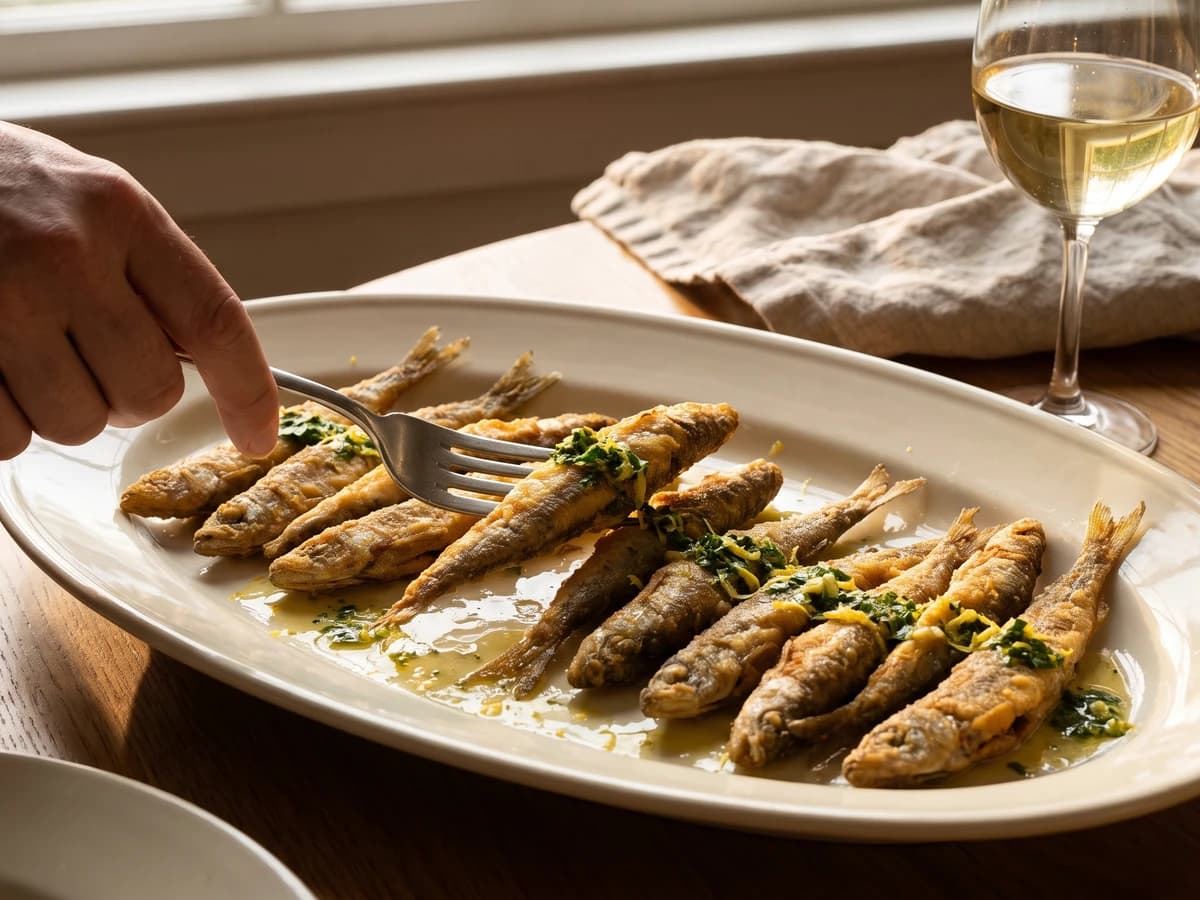
Éperlans à l’Anglaise turns small fish into a lesson in disciplined coating: boned smelts under a close, crisp crumb, pan-fried in clarified butter and finished with bright, half-melted maître d’hôtel butter.

Chef Juliette
Tiny smelts, shallot, mushrooms, white wine, gratin sauce, and fine bread raspings meet a fierce oven, where the fish must turn tender in the same breath the buttered crust bronzes.