
Chef Juliette
John Dory (St. Pierre)
John Dory has the delicacy of sole and the firmness of turbot. A light flouring, a quick butter sauté, and nut-brown beurre noisette show exactly why looks never mattered.
A cooking platform built around craft, culture, and the stories behind what we eat.

Created by Chef Juliette
Based on No. 1044, Filets de Bœuf Andalouse, from Le Guide Culinaire (1907) by Auguste Escoffier
A larded fillet glazed at the last moment, surrounded by rice-filled peppers, crisp aubergine cases, tomato concassée, and chipolatas: a grand garniture brought within reach of one attentive home cook.
Filets de Bœuf Andalouse (larded beef fillet with rice-filled peppers, aubergine, tomato, and chipolatas) teaches the discipline of a garniture, an arranged accompaniment whose parts are each cooked in their own best way. The one true thing to know before touching a pan is that timing, not complexity, decides this dish. Work backward from the beef's rest, and every hot, brightly colored element reaches the platter together.
The grand-kitchen version assumed a larding needle, several pairs of hands, a saucier beside a brown veal stockpot never off the fire, and a salamander ready to color peppers and sausages on command. At home, use chilled bacon batons and a narrow skewer, the oven broiler, and the complete preparations for Poëlings (No. 250) and Riz à la Grecque (No. 2253). Separate cooks and frantic last-second pan juggling were brigade scaffolding, so they go. The larding, individually cooked garnishes, clarified poëling gravy, and final glaze are the dish, so they stay. One cook, one stove, one evening.
Arrange the grilled pepper halves and fried aubergine cases alternately, with a chipolata between each, and the platter will look generous because it is. Glaze only after the fillet has rested and the gravy lightly coats a spoon. If that gravy tightens too far, loosen it spoonful by spoonful; ça se rattrape. The step that matters most is pulling the beef in time to rest without passing medium.
Filets de Bœuf Andalouse belongs to the French grand-kitchen vocabulary of garnitures, not to the domestic repertoire of Andalusia. Here, Andalouse identifies a composed southern palette of peppers, tomato, aubergine, rice, and sausage arranged around a prime roast, ingredients the French canon grouped for their Spanish association. The name describes the garnish and its formal service, not a regional Andalusian beef recipe.
Quantity
1 fillet, 2 lb (900 g)
trimmed of all silverskin and connective tissue
Quantity
3 oz (85 g)
cut into 8 long, thin batons and well chilled
Quantity
1 home-scale preparation Poëlings (No. 250), sufficient for a 2 lb (900 g) fillet and about 1 cup (240 ml / 240 g) poëling stock
Quantity
2 peppers, about 1 lb (450 g) total
halved lengthwise and seeded
Quantity
2 aubergines, about 1⅓ lb (600 g) total
Quantity
4 tomatoes, about 1 lb (450 g) total
Quantity
8 sausages, about 8 oz (225 g) total
Quantity
1¼ cups (300 ml / 275 g)
divided, with most remaining in the frying pan
Quantity
1½ teaspoons (7 ml / 9 g)
divided
Quantity
1 teaspoon (5 ml / 2 g)
divided
Quantity
1½ teaspoons (7 ml / 4 g)
Quantity
1 tablespoon (15 ml / 15 g)
| Ingredient | Quantity |
|---|---|
| center-cut beef fillettrimmed of all silverskin and connective tissue | 1 fillet, 2 lb (900 g) |
| fatty unsliced baconcut into 8 long, thin batons and well chilled | 3 oz (85 g) |
| Poëlings | 1 home-scale preparation Poëlings (No. 250), sufficient for a 2 lb (900 g) fillet and about 1 cup (240 ml / 240 g) poëling stock |
| Riz à la Grecquekept warm | 1½ cups (360 ml / 300 g) prepared Riz à la Grecque (No. 2253) |
| large red bell peppershalved lengthwise and seeded | 2 peppers, about 1 lb (450 g) total |
| medium globe aubergines | 2 aubergines, about 1⅓ lb (600 g) total |
| medium plum tomatoes | 4 tomatoes, about 1 lb (450 g) total |
| small chipolata sausages | 8 sausages, about 8 oz (225 g) total |
| olive oildivided, with most remaining in the frying pan | 1¼ cups (300 ml / 275 g) |
| fine saltdivided | 1½ teaspoons (7 ml / 9 g) |
| freshly ground black pepperdivided | 1 teaspoon (5 ml / 2 g) |
| arrowroot | 1½ teaspoons (7 ml / 4 g) |
| cold water | 1 tablespoon (15 ml / 15 g) |
Chill the bacon batons until firm but still flexible. Pat the fillet dry, then use a narrow boning knife to open four evenly spaced lengthwise channels from each end, each reaching halfway through the meat. Guide one bacon baton into every channel with a long metal skewer. If a strip buckles, don't force it and tear the fillet. Withdraw it, chill it again, widen the channel slightly, and try once more. Ça se rattrape. Fold the thin tail under if necessary, tie the fillet at 1½-inch (4 cm) intervals, and season it with about half the salt and pepper.
Heat the broiler and set a rack about 6 inches (15 cm) below it. Brush the pepper halves with 1 tablespoon of the olive oil, set them skin-side up on a tray, and broil until the skins blister and carry dark patches, about 6 to 10 minutes. Cover them for 5 minutes, then peel carefully without collapsing the halves. They should be tender enough to eat but sturdy enough to hold rice. If one tears, overlap the torn edges when filling it; the rice will hold the shape.
Cut four roundels from the widest parts of the aubergines, each about 2 inches (5 cm) across and 1 inch (2.5 cm) thick. Trim them round with a cutter or knife, then scoop out the center of each, leaving a base and walls about ¼ inch (6 mm) thick. Salt lightly and leave for 15 minutes, then blot completely dry. Heat the remaining olive oil to 340°F (170°C) in a deep sauté pan and fry the cases in batches, turning gently, until the rims are bronze and the flesh is tender, about 5 to 7 minutes. Drain upside down on a rack and season lightly.
Score the tomatoes, lower them into boiling water for 20 seconds, and cool them in cold water. Peel, quarter, seed, and concassé them, which means chopping the flesh roughly rather than crushing it into a sauce. Heat 1 tablespoon of the olive oil in a clean pan and toss the concassed tomatoes over medium-high heat for 3 to 4 minutes, just until their loose water cooks away. Season with salt and pepper. If they flood the pan, lift out the pieces, reduce the juice alone, then fold them back in. Fill the fried aubergine cases with the tomato concassée.
Spoon the warm Riz à la Grecque (No. 2253) generously into the grilled pepper halves, mounding it without packing it hard. Set the four peppers and four filled aubergine cases on a baking tray. Hold them at room temperature while the beef cooks, for no longer than 1 hour; they will receive their final warming during the fillet's rest.
Heat the oven to 350°F (180°C). Cook the larded fillet according to Poëlings (No. 250), using a heavy lidded casserole just larger than the meat as the home equivalent of the brigade poëling pan. Keep the preparation intact and add no liquid during its cooking stage; poëling is gentle butter-roasting, not braising. Cook until an instant-read thermometer reaches 140°F (60°C) at the center, generally 25 to 35 minutes for this size. Lift the beef out and rest it loosely covered for 12 to 15 minutes, checking that carryover heat brings the center to 145°F (63°C).
While the beef cooks, place the chipolatas in a dry heavy frying pan over medium heat. Turn them frequently until evenly browned and cooked through to 160°F (71°C), about 10 to 12 minutes. Chipolatas are small, mild sausages, not spicy chorizo, and their seasoning should support the beef rather than dominate it. Set them beside the filled vegetables on the tray.
As soon as the beef begins resting, lower the oven to 325°F (165°C) and warm the tray of garnishes for 8 to 10 minutes. Strain the poëling stock produced through Poëlings (No. 250), let it stand briefly, and spoon every visible trace of grease from the surface. Simmer about 1 cup in a clean saucepan until its flavor is concentrated. Stir the arrowroot into the cold water, then whisk in half the slurry and simmer for 20 seconds. Add only enough of the remainder to make the gravy lightly coat the back of a spoon. Reserve 2 tablespoons for glazing and pour the rest into a heated sauceboat. If the gravy becomes heavy or jelly-like, whisk in hot water a teaspoon at a time. Ça se rattrape.
Remove the strings and set the rested fillet lengthwise on a heated platter. Brush it with the reserved gravy only now, turning the surface until it gleams. Alternate the four rice-filled pepper halves and four tomato-filled aubergine cases around the beef, then place one grilled chipolata in every interval. Send the remaining gravy separately, carve the fillet thickly at the table, and serve each guest some of every garnish. À table!
1 serving (about 620g)
Culinary guides, cultural storytelling, and the editorial depth that makes cooking meaningful.
Discover Culinary ExplorerChef Juliette
John Dory has the delicacy of sole and the firmness of turbot. A light flouring, a quick butter sauté, and nut-brown beurre noisette show exactly why looks never mattered.

Chef Juliette
Fresh haddock proves its delicacy in the meunière pan: a fine flour crust, moist pearly flakes, and beurre noisette sharpened with lemon and parsley, ready from one skillet in half an hour.
Chef Juliette
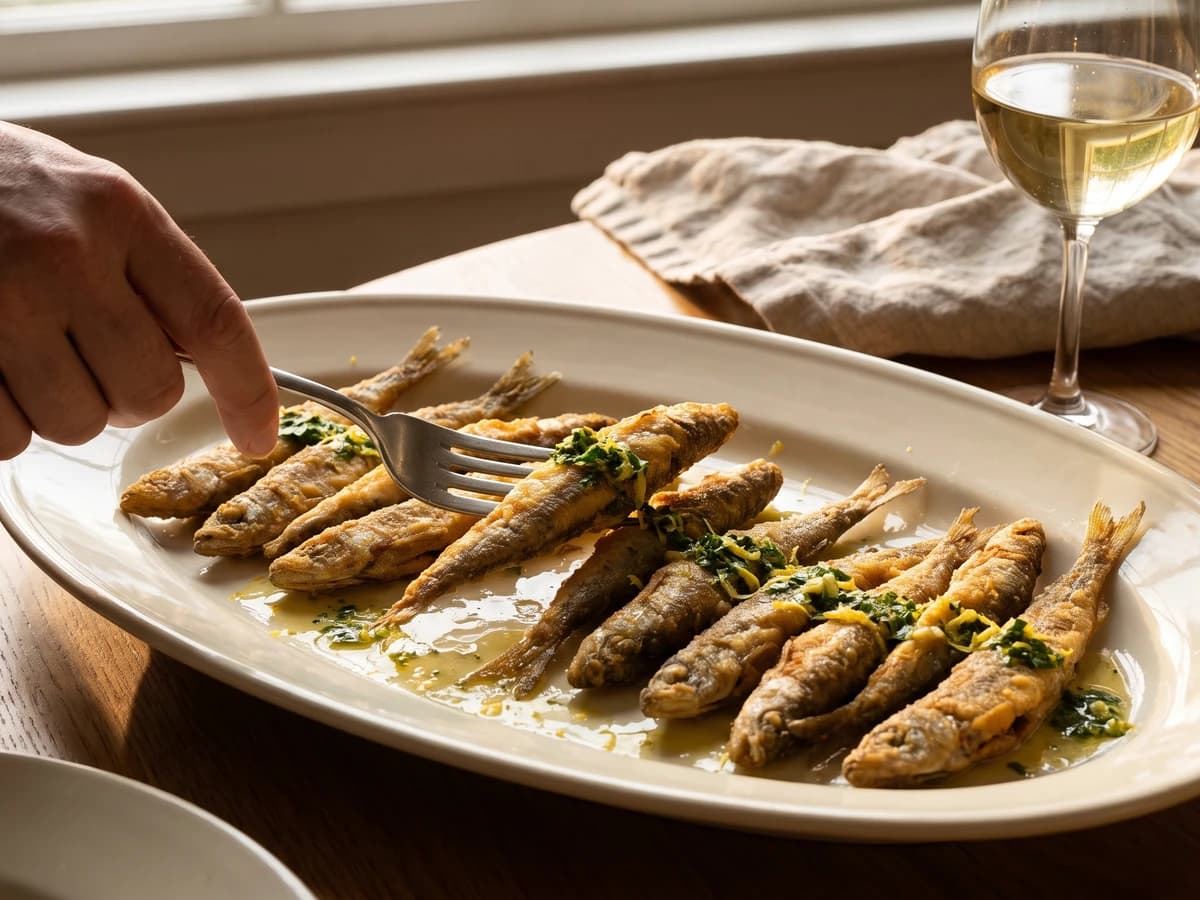
Éperlans à l’Anglaise turns small fish into a lesson in disciplined coating: boned smelts under a close, crisp crumb, pan-fried in clarified butter and finished with bright, half-melted maître d’hôtel butter.

Chef Juliette
Tiny smelts, shallot, mushrooms, white wine, gratin sauce, and fine bread raspings meet a fierce oven, where the fish must turn tender in the same breath the buttered crust bronzes.