
Chef Juliette
John Dory (St. Pierre)
John Dory has the delicacy of sole and the firmness of turbot. A light flouring, a quick butter sauté, and nut-brown beurre noisette show exactly why looks never mattered.
A cooking platform built around craft, culture, and the stories behind what we eat.
Created by Chef Juliette
Based on No. 1257, Côte de Veau à la Dreux, from Le Guide Culinaire (1907) by Auguste Escoffier
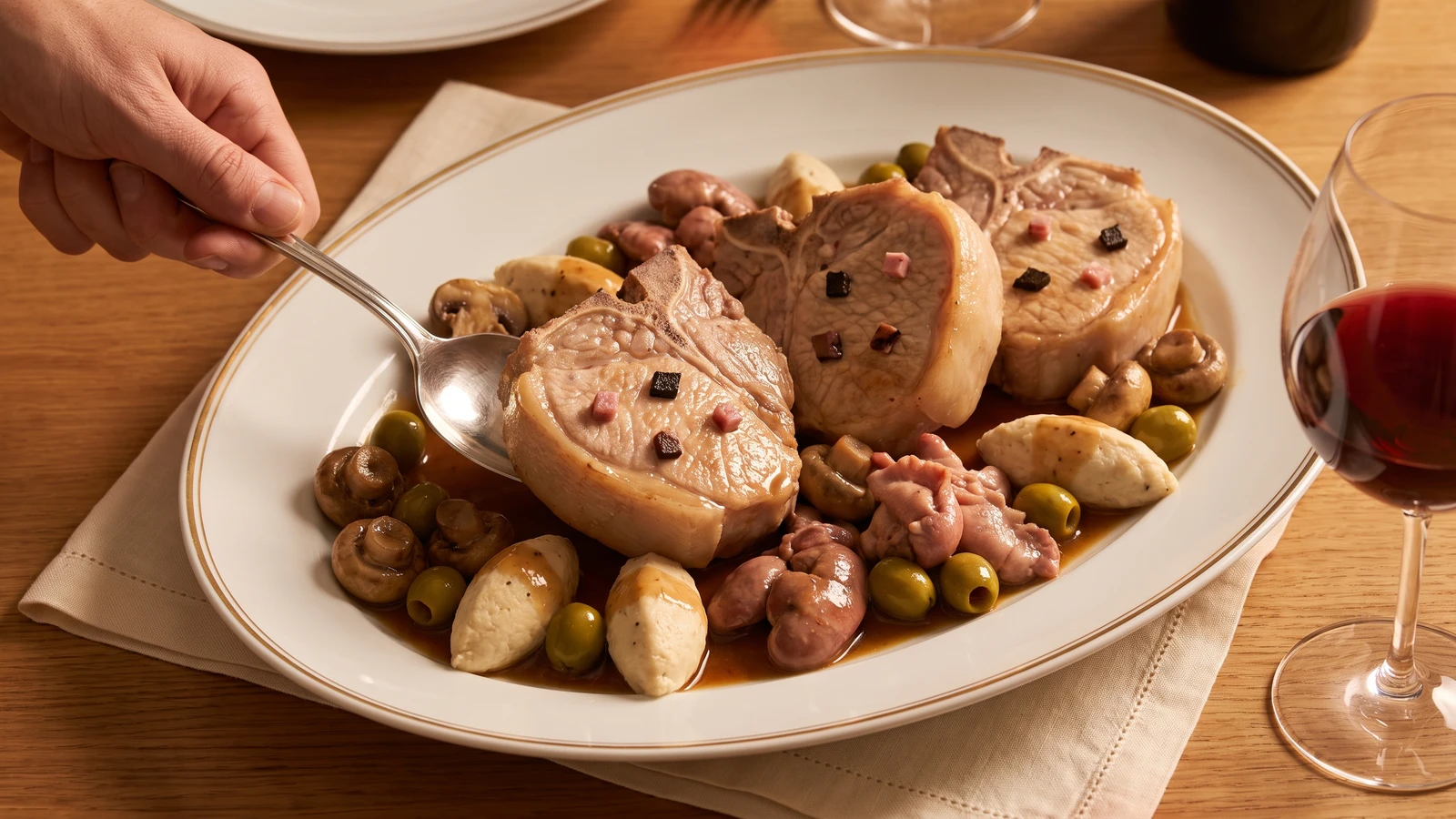
Each veal chop becomes a lesson in precision: tongue, ham and truffle show cleanly through its trimmed surface, while quenelles, mushrooms, olives and truffled demi-glace complete the generous classical garnish.
Côte de Veau à la Dreux (veal cutlet inlaid with tongue, ham and truffle) teaches that decoration can be technique rather than ornament. The one true thing to know before touching the pan is this: the ham, tongue and truffle must pass cleanly through cold meat, because the finished chop is shaved on both faces to reveal that precise little mosaic. Ragged studding has nowhere to hide.
The original kitchen assumed a larder cook cutting perfect batons, a saucier on staff, a stockpot never off the fire and a salamander waiting nearby. At home, a chilled metal skewer replaces the larding needle, prepared veal demi-glace replaces the permanent sauce station, and a low oven finishes four thick chops evenly after their gentle cooking in butter. The salamander has no useful work here. One cook, one stove, one evening.
The paper frill on the bone was service scaffolding, so it goes. The clean inlay, quenelles, mushrooms, prepared poultry offal, olives and truffle-scented sauce are the dish, so they stay, with extra quenelles standing in honestly when cocks’ combs and kidneys cannot be sourced. Chill the batons before studding and make each channel once. That is the step that decides the plate.
Despite its name, Côte de Veau à la Dreux belongs more securely to the classical Parisian dining room than to the household cooking of Dreux in Eure-et-Loir. In the canon, à la Dreux denotes a composed presentation of veal inlaid with tongue, ham and truffle, accompanied by quenelles, mushrooms, cocks’ combs and kidneys, olives and truffled demi-glace. The precise dedication behind the name remains uncertain, but generations of cooks preserved its defining idea: the cut surface of the meat becomes part of the decoration.
Quantity
4 chops, each about 1½ inches (4 cm) thick and 8 to 10 ounces (225 to 280 g)
Quantity
3 tablespoons (45 ml / 35 g)
cut into twelve firm batons slightly longer than the chops are thick
Quantity
3 tablespoons (45 ml / 35 g)
cut into twelve firm batons slightly longer than the chops are thick
Quantity
2 tablespoons (30 ml / 20 g)
cut into twelve slender batons
Quantity
10 tablespoons (150 ml / 142 g)
divided
Quantity
2½ teaspoons (12.5 ml / 15 g)
divided
Quantity
1 teaspoon (5 ml / 2 g)
Quantity
1 packed cup (240 ml / 170 g)
diced and thoroughly chilled
Quantity
1
Quantity
⅓ cup (80 ml / 80 g)
Quantity
¼ teaspoon (1.25 ml / 0.5 g)
Quantity
1 pinch
Quantity
6 cups (1.4 L / 1.4 kg)
Quantity
2 cups (480 ml / 225 g)
cleaned with stems trimmed
Quantity
4 fully cooked cocks’ combs completed through Blanchings (No. 273) plus 4 fully cooked cock kidneys, or 8 additional small quenelles
Quantity
12 olives, about ½ cup (120 ml / 90 g), turned and completed through Blanchings (No. 273)
Quantity
1 cup (240 ml / 260 g)
Quantity
1 tablespoon (15 ml / 15 g)
Quantity
¾ cup (180 ml / 180 g)
divided
| Ingredient | Quantity |
|---|---|
| bone-in veal rib chops | 4 chops, each about 1½ inches (4 cm) thick and 8 to 10 ounces (225 to 280 g) |
| cooked hamcut into twelve firm batons slightly longer than the chops are thick | 3 tablespoons (45 ml / 35 g) |
| cooked beef tonguecut into twelve firm batons slightly longer than the chops are thick | 3 tablespoons (45 ml / 35 g) |
| preserved or fresh black trufflecut into twelve slender batons | 2 tablespoons (30 ml / 20 g) |
| unsalted butterdivided | 10 tablespoons (150 ml / 142 g) |
| fine sea saltdivided | 2½ teaspoons (12.5 ml / 15 g) |
| freshly ground black pepper | 1 teaspoon (5 ml / 2 g) |
| skinless chicken breastdiced and thoroughly chilled | 1 packed cup (240 ml / 170 g) |
| large egg white | 1 |
| cold heavy cream | ⅓ cup (80 ml / 80 g) |
| ground white pepper | ¼ teaspoon (1.25 ml / 0.5 g) |
| freshly grated nutmeg | 1 pinch |
| water for poaching the quenelles | 6 cups (1.4 L / 1.4 kg) |
| small button mushroomscleaned with stems trimmed | 2 cups (480 ml / 225 g) |
| prepared cocks’ combs and cock kidneys, or additional chicken quenelles | 4 fully cooked cocks’ combs completed through Blanchings (No. 273) plus 4 fully cooked cock kidneys, or 8 additional small quenelles |
| large pitted green olives | 12 olives, about ½ cup (120 ml / 90 g), turned and completed through Blanchings (No. 273) |
| prepared veal sauce demi-glace | 1 cup (240 ml / 260 g) |
| truffle juice or bottled truffle jus | 1 tablespoon (15 ml / 15 g) |
| unsalted veal stockdivided | ¾ cup (180 ml / 180 g) |
Chill the bowl and blade of a food processor. Pulse the cold chicken with ½ teaspoon of the salt and the white pepper until it becomes a smooth, sticky paste, then add the egg white and pulse until fully absorbed. With the machine running in short bursts, add the cold cream gradually, stopping as soon as the mousseline is smooth. Season with nutmeg. If the mixture grows warm, loose or oily, stop immediately and chill it for 15 minutes. Ça se rattrape. Forcing a warm mousseline only separates its fat.
Heat the water in a broad saucepan until it barely trembles, about 175°F (80°C). Using two teaspoons dipped in cold water, shape 12 small quenelles de volaille, meaning chicken dumplings, or 20 smaller ones if they will replace the poultry offal. Slip them into the water and poach gently for 5 to 7 minutes, turning once, until firm and cooked through. Lift them onto a towel. If the first quenelle frays, the water or mousseline is too warm: lower the heat, rechill the mixture and begin again.
Chill the ham, tongue and truffle batons for 15 minutes so they stay firm. Lay each chop flat and use a narrow larding needle, or a metal skewer followed by the tip of a slim paring knife, to make nine straight channels through the kernel of the meat from one broad face to the other. Thread three batons of ham, three of tongue and three of truffle through each chop in an even pattern, leaving the ends barely proud on both faces. If a channel tears, stop, rechill the chop and make one clean channel beside it rather than widening the damage. Pat the chops dry and season with 1½ teaspoons salt and the black pepper.
Heat the oven to 325°F (165°C). Melt 6 tablespoons (90 ml / 85 g) of the butter in a heavy skillet over medium-low heat. Cook the chops in two batches, basting steadily, until each face is pale gold, about 3 minutes per side, then briefly colour the fat edge. Transfer them to a rack set over a roasting pan and finish in the oven until the centres reach 140 to 142°F (60 to 61°C), about 8 to 12 minutes. Rest for 8 minutes so they finish at a safe 145°F (63°C). Keep the butter foaming rather than scorching; if its milk solids turn dark before the veal colours, lower the heat, wipe out the bitter solids and continue with fresh butter.
Set each rested chop flat and use a very sharp slicing knife to shave a paper-thin layer from each broad face, just enough to expose clean cross-sections of ham, tongue and truffle. This is trimmer work, not carving. If the first shaving leaves an uneven patch, take one more thin slice only; cutting deeply sacrifices both juiciness and the pattern you worked to make. Reserve any resting juices for the sauce and hold the chops loosely covered in the turned-off oven.
Melt 2 tablespoons (30 ml / 28 g) butter in a wide sauté pan. Add the mushrooms with the remaining ½ teaspoon salt and cook until lightly bronzed and tender, about 6 minutes. Add ½ cup (120 ml / 120 g) veal stock, the fully cooked cocks’ combs completed through Blanchings (No. 273), the cock kidneys and the turned olives completed through Blanchings (No. 273). Cover and warm gently for 4 minutes, then add the quenelles for the final 2 minutes. If using extra quenelles instead of poultry offal, add all of them only at the end so they remain delicate. Drain the garnish well before plating.
Warm the sauce demi-glace with the truffle juice and the reserved veal juices at a bare simmer until it coats the back of a spoon in a glossy film. Remove it from the heat and swirl in the remaining 2 tablespoons (30 ml / 28 g) butter. If the sauce tightens too far, loosen it a spoonful at a time with the remaining veal stock. If it is thin, reduce it before adding the butter. Once mounted, never boil it hard or the gloss turns greasy.
Arrange the chops on a warmed platter with their bare bones facing outward and their inlaid faces clearly visible. Ring them generously with the quenelles, mushrooms, cocks’ combs and kidneys, and olives, then spoon a little truffled demi-glace over the garnish rather than hiding the veal. Leave the bones bare. The paper frill was ceremony, not flavour. Carry the platter straight to the table. À table!
1 serving (about 425g)
Culinary guides, cultural storytelling, and the editorial depth that makes cooking meaningful.
Discover Culinary ExplorerChef Juliette
John Dory has the delicacy of sole and the firmness of turbot. A light flouring, a quick butter sauté, and nut-brown beurre noisette show exactly why looks never mattered.

Chef Juliette
Fresh haddock proves its delicacy in the meunière pan: a fine flour crust, moist pearly flakes, and beurre noisette sharpened with lemon and parsley, ready from one skillet in half an hour.
Chef Juliette
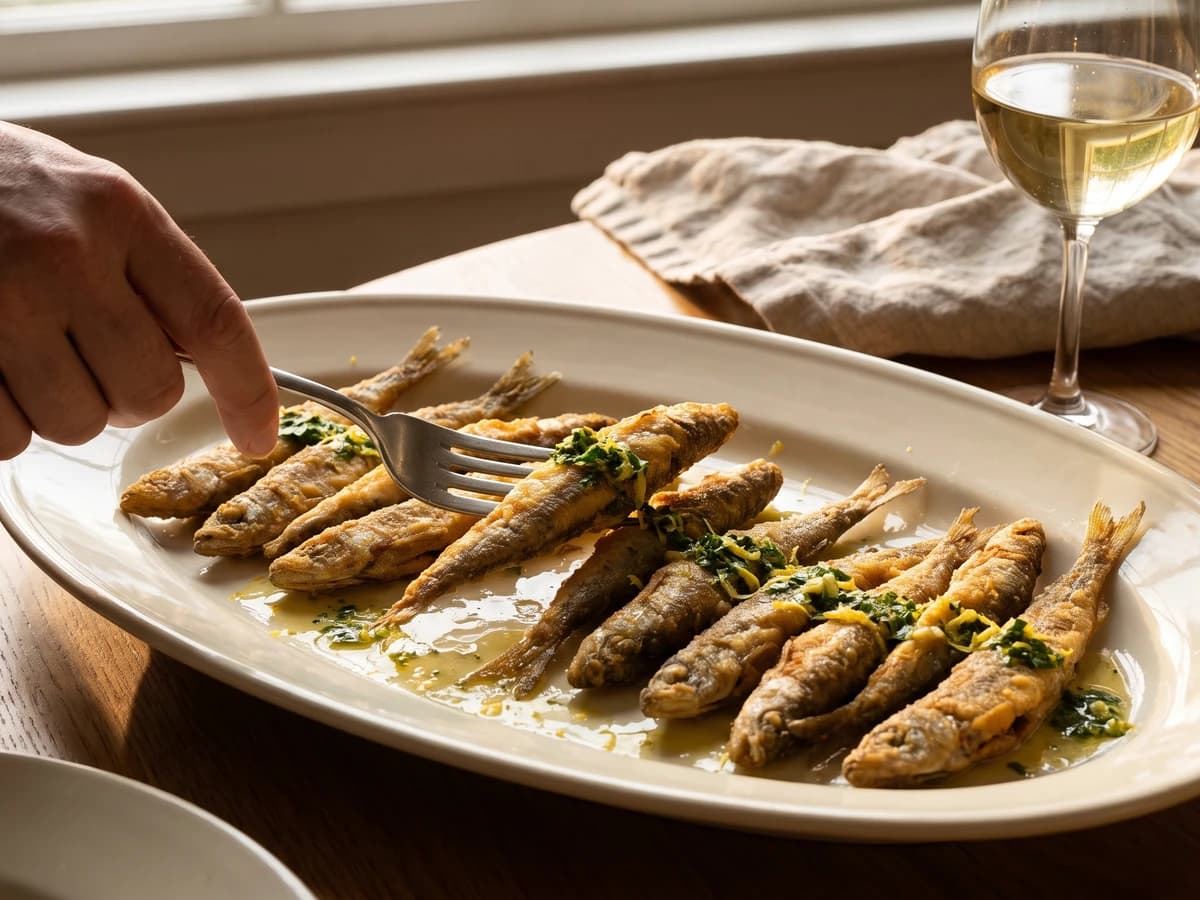
Éperlans à l’Anglaise turns small fish into a lesson in disciplined coating: boned smelts under a close, crisp crumb, pan-fried in clarified butter and finished with bright, half-melted maître d’hôtel butter.

Chef Juliette
Tiny smelts, shallot, mushrooms, white wine, gratin sauce, and fine bread raspings meet a fierce oven, where the fish must turn tender in the same breath the buttered crust bronzes.