
Chef Juliette
John Dory (St. Pierre)
John Dory has the delicacy of sole and the firmness of turbot. A light flouring, a quick butter sauté, and nut-brown beurre noisette show exactly why looks never mattered.
A cooking platform built around craft, culture, and the stories behind what we eat.

Created by Chef Juliette
Based on No. 1154, Langue de Bœuf Choucroûte, from Le Guide Culinaire (1907) by Auguste Escoffier
Langue de Bœuf Choucroûte teaches the braise from foundation to finish: tender tongue under a lacquered glaze, sharp cabbage softened slowly, cloudlike potato purée, and Madeira sauce drawn from the same rich liquor.
Langue de Bœuf Choucroûte (glazed ox tongue with braised sauerkraut) teaches one truth before all others: a braise is finished by tenderness, not by the clock. The tongue must yield to a knife without the smallest tug before you glaze it. No sauce, however splendid, can disguise meat taken from its liquor too soon.
The source sends the tongue through Ordinary Braisings (No. 247) and assumes a stock never off the fire, a saucier reducing Madeira sauce, and a salamander ready for repeated glazing. At home, a snug Dutch oven preserves the strength of the liquor, a small saucepan handles the reduction, and the broiler lays down the same glossy film in three or four thin coats. The portions are reduced to four, but the foundation remains intact. One cook, one stove, one long evening.
A second braising pan, endless transfers, and eight or ten passes before a gentle oven were brigade scaffolding, so they can go. What stays is the dish itself: slow moist cooking, complete degreasing, honest reduction, a last-minute glaze, and three accompaniments served separately. Judge the tongue with the point of your knife. That is the step that decides everything.
Choucroute belongs to Alsace, where fermented cabbage is slowly braised and served as both preservation food and a substantial table dish, while glazed ox tongue with Madeira sauce comes from the national classical repertoire. This preparation joins them in the grand-kitchen manner, presenting the tongue, cabbage, potato purée, and sauce separately so each keeps its own texture. It should not be confused with choucroute garnie: here the choucroute is an accompaniment, not a bed carrying sausages and cured pork.
Quantity
1, about 3½ lb (1.6 kg), for Ordinary Braisings (No. 247)
Quantity
3 cups (720 ml / 720 g) from Ordinary Braisings (No. 247)
Quantity
2 lb (900 g)
drained
Quantity
2 tablespoons (30 ml / 28 g)
Quantity
1 medium, about 1 cup sliced (240 ml / 170 g)
thinly sliced
Quantity
1 cup (240 ml / 240 g)
Quantity
6
lightly crushed
Quantity
1
Quantity
2 lb (900 g)
peeled and cut into even chunks
Quantity
1 tablespoon (15 ml / 18 g), plus more only if needed
Quantity
¾ cup (180 ml / 180 g)
Quantity
6 tablespoons (90 ml / 85 g)
cubed
Quantity
⅛ teaspoon (0.6 ml / 0.25 g)
Quantity
¼ teaspoon (1.25 ml / 0.5 g)
Quantity
¾ cup (180 ml / 180 g)
Quantity
2 tablespoons (30 ml / 28 g)
cubed
Quantity
1 teaspoon (5 ml / 3 g) arrowroot mixed with 1 tablespoon (15 ml / 15 g) cold water
| Ingredient | Quantity |
|---|---|
| beef tongue | 1, about 3½ lb (1.6 kg), for Ordinary Braisings (No. 247) |
| strained, completely degreased braising liquor | 3 cups (720 ml / 720 g) from Ordinary Braisings (No. 247) |
| naturally fermented sauerkrautdrained | 2 lb (900 g) |
| unsalted butter for the choucroute | 2 tablespoons (30 ml / 28 g) |
| yellow onionthinly sliced | 1 medium, about 1 cup sliced (240 ml / 170 g) |
| dry Riesling or another dry white wine | 1 cup (240 ml / 240 g) |
| juniper berrieslightly crushed | 6 |
| bay leaf | 1 |
| floury potatoes, such as russetspeeled and cut into even chunks | 2 lb (900 g) |
| fine sea salt | 1 tablespoon (15 ml / 18 g), plus more only if needed |
| heavy cream | ¾ cup (180 ml / 180 g) |
| unsalted butter for the potato puréecubed | 6 tablespoons (90 ml / 85 g) |
| freshly grated nutmeg | ⅛ teaspoon (0.6 ml / 0.25 g) |
| ground white pepper | ¼ teaspoon (1.25 ml / 0.5 g) |
| medium-dry Madeira | ¾ cup (180 ml / 180 g) |
| cold unsalted butter for the saucecubed | 2 tablespoons (30 ml / 28 g) |
| arrowroot slurry (optional) | 1 teaspoon (5 ml / 3 g) arrowroot mixed with 1 tablespoon (15 ml / 15 g) cold water |
Prepare and cook the tongue by Ordinary Braisings (No. 247), scaled to this single tongue and held in a pot that contains it snugly. Keep the liquor at the barest tremble until a thin knife enters the thickest part without resistance, usually 3½ to 4½ hours. A hard boil tightens the outer flesh before the centre softens, so lower the heat if the surface begins to bounce. Rest the cooked tongue only until it can be handled, slit the skin along the underside, and peel it away while warm. Trim the coarse tissue from the root. If the skin clings stubbornly, the tongue is underdone, not ruined. Return it to the liquor for 20 to 30 minutes. Ça se rattrape.
Strain 3 cups of braising liquor from Ordinary Braisings (No. 247) through a fine-mesh sieve into a bowl. Let it stand for 10 minutes, then lift off every visible trace of fat with a spoon or pass it through a fat separator. The source used muslin and patient settling; a fine sieve and separator are the honest home equivalents. If hard boiling has scattered fat into tiny droplets, set the bowl over ice until the fat gathers and firms, then skim again. Keep 1 cup for the choucroute and 2 cups for the Madeira sauce.
Taste a strand of sauerkraut. If it is aggressively salty or sour, rinse it once under cold water, then squeeze it dry; good balanced sauerkraut needs no rinsing. Melt 2 tablespoons butter in a covered saucepan and soften the onion for 8 minutes without browning. Add the sauerkraut, juniper, bay leaf, wine, and 1 cup braising liquor from Ordinary Braisings (No. 247). Turn everything together, cover, and cook at a very gentle simmer for 75 to 90 minutes, turning it twice, until the strands are tender but still distinct. If the pan dries before the cabbage softens, add water a few tablespoons at a time. If it remains wet at the end, uncover and reduce the liquid rather than draining away its flavour.
Begin the potato purée about 45 minutes before serving. Cover the potatoes with cold water, add the salt, and bring them gradually to a gentle simmer. Cook until a knife passes through without catching, then drain thoroughly and return them to the dry pan for 1 minute over low heat. Warm the cream in a small saucepan. Pass the potatoes through a ricer or food mill while hot, fold in the 6 tablespoons butter, then add enough hot cream to make a smooth purée that falls heavily from the spoon. Season with nutmeg and white pepper. Never use a blender, which works the starch into glue. If the purée begins to turn elastic, stop stirring and fold in the remaining hot cream with a spatula. Ça se rattrape, provided you stop in time.
Pour the remaining 2 cups braising liquor from Ordinary Braisings (No. 247) into a broad saucepan and reduce it at a lively simmer to about 1 cup, skimming any residue that rises. Add the Madeira and continue reducing until about 1¼ cups remain and the sauce coats the back of a spoon in a thin, glossy layer. Taste before chasing thickness. If the liquor becomes salty while the sauce is still thin, stop reducing and whisk in the optional arrowroot slurry; simmer for 30 seconds, no longer. Off the heat, whisk in the 2 tablespoons cold butter a cube at a time. If the butter beads on the surface, the pan is too hot. Whisk in a teaspoon of cold water away from the heat until the sauce comes together again.
Heat the broiler and set a rack about 8 inches beneath it. Place the whole warm tongue on a rack over a rimmed tray, brush it with a very thin coat of Madeira sauce, and broil only until the surface turns tacky and glossy, 30 to 60 seconds. Brush and repeat three or four times. The source's eight or ten passes suited the gentler heat at the front of an oven; the home broiler produces the same gelatinous film in fewer coats. Watch the edges closely. If a coat darkens before it sets, lower the rack, wipe away any bitter spot, and continue with thinner coats.
Remove the juniper and bay leaf from the choucroute and spoon it into a warmed deep serving bowl. Put the potato purée into a second warmed bowl and the Madeira sauce into a sauceboat. Slice the glazed tongue crosswise about ¼ inch (6 mm) thick, keeping a little of the glazed heel intact for the platter, and overlap the slices on warmed oval porcelain. Serve all four parts separately, as the source directs, so the glaze remains visible and each guest can take exactly as much sauce, cabbage, and purée as desired. À table!
1 serving (about 900g)
Culinary guides, cultural storytelling, and the editorial depth that makes cooking meaningful.
Discover Culinary ExplorerChef Juliette
John Dory has the delicacy of sole and the firmness of turbot. A light flouring, a quick butter sauté, and nut-brown beurre noisette show exactly why looks never mattered.

Chef Juliette
Fresh haddock proves its delicacy in the meunière pan: a fine flour crust, moist pearly flakes, and beurre noisette sharpened with lemon and parsley, ready from one skillet in half an hour.
Chef Juliette
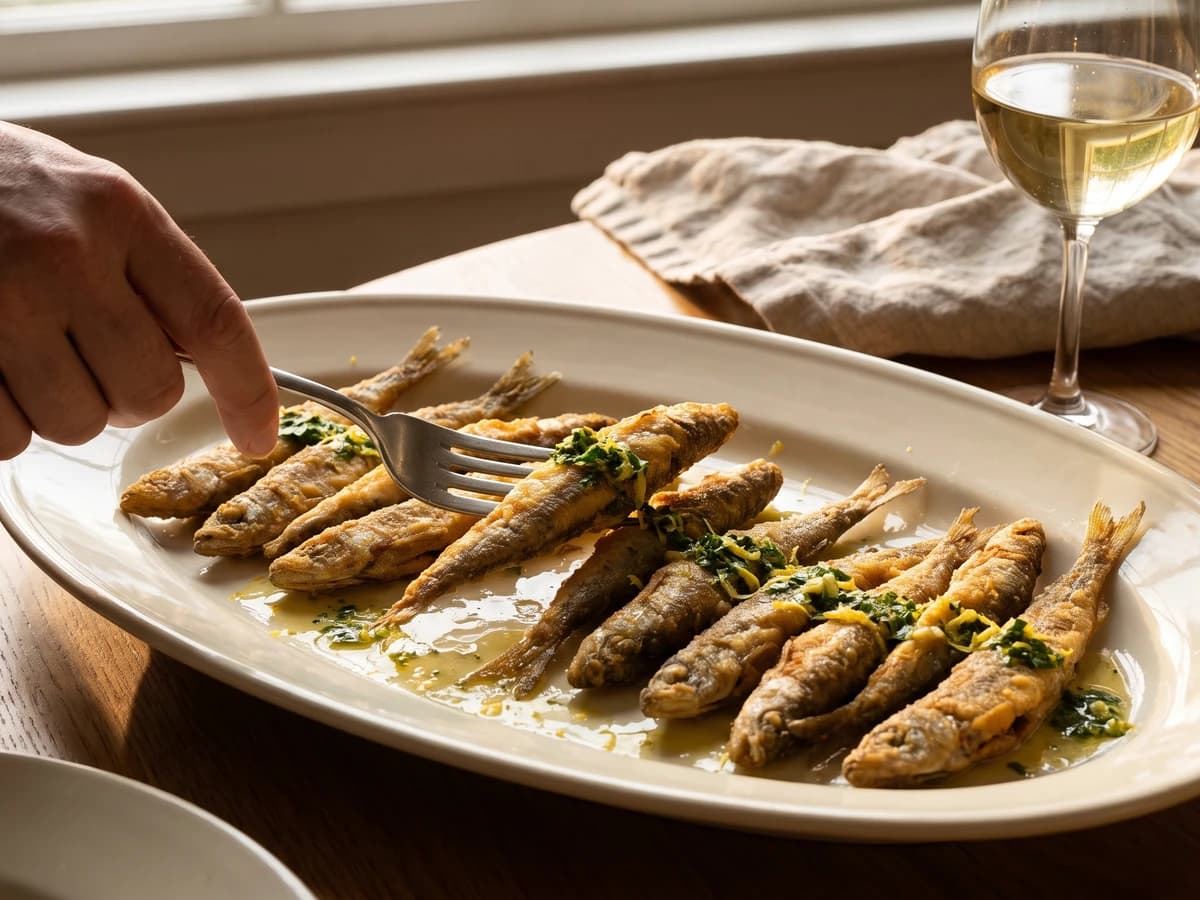
Éperlans à l’Anglaise turns small fish into a lesson in disciplined coating: boned smelts under a close, crisp crumb, pan-fried in clarified butter and finished with bright, half-melted maître d’hôtel butter.

Chef Juliette
Tiny smelts, shallot, mushrooms, white wine, gratin sauce, and fine bread raspings meet a fierce oven, where the fish must turn tender in the same breath the buttered crust bronzes.