
Chef Juliette
John Dory (St. Pierre)
John Dory has the delicacy of sole and the firmness of turbot. A light flouring, a quick butter sauté, and nut-brown beurre noisette show exactly why looks never mattered.
A cooking platform built around craft, culture, and the stories behind what we eat.

Created by Chef Juliette
Based on No. 1085, Tournedos Brabançonne, from Le Guide Culinaire (1907) by Auguste Escoffier
Butter-seared tournedos crown crisp tartlets of Brussels sprouts under a bronzed Mornay glaze, with a generous potato border gathered around the plate: a composed classic made workable for one cook.
Tournedos Brabançonne (butter-seared beef tenderloin on Brussels sprout tartlets with fondant potatoes) teaches the discipline of service. The one true thing to know is this: every garnish must be finished before the lean fillet touches the pan. Tournedos cook quickly and wait badly, while pastry, sprouts, sauce, and potatoes can each be brought calmly to readiness.
The original assumed baked tartlet cases waiting in the pastry station, a saucier holding Mornay, a separate cook tending the potatoes, and a salamander ready to glaze the sprouts. At home, four shallow tartlet tins, one small pan of Mornay, béchamel enriched with cheese, and the domestic broiler do the same work. The synchronized brigade is scaffolding and can go. The crisp pastry, sprouts stewed in butter, bronzed Mornay, and hot butter sear are the dish and must stay. One cook, one stove, one evening.
When it lands correctly, the pastry still resists the knife, the sprouts remain distinctly green beneath their ivory glaze, and the tournedos show a dark bronze crust around a rosy center. Glaze first, ready the potato border, then sear the beef hot and quick at the very last moment. That final sequence decides the dish.
Tournedos Brabançonne belongs to the classical Parisian dining room, while its name points north to Brabant, the region surrounding Brussels whose small cabbages became shorthand for the garnish. It is not a rustic Belgian steak, but a French composed service dish that arranges beef, pastry, buttered sprouts, Mornay, and potatoes as distinct preparations on one plate. The name reflects the classical kitchen's habit of honoring places through characteristic ingredients rather than reproducing an entire regional meal.
Quantity
1 cup (240 ml / 125 g)
Quantity
1/4 teaspoon (1.25 ml / 1.5 g)
Quantity
4 tablespoons (60 ml / 57 g)
cubed
Quantity
2 to 3 tablespoons (30 to 45 ml / 30 to 45 g)
Quantity
3 cups (720 ml / 340 g)
trimmed
Quantity
1 tablespoon (15 ml / 18 g)
Quantity
2 tablespoons (30 ml / 28 g)
Quantity
1 tablespoon (15 ml / 14 g)
Quantity
1 tablespoon (15 ml / 8 g)
Quantity
2/3 cup (160 ml / 165 g)
warmed, with 2 tablespoons reserved
Quantity
2 tablespoons (30 ml / 30 g)
Quantity
1/3 cup (80 ml / 35 g)
finely grated
Quantity
2 tablespoons (30 ml / 10 g)
finely grated
Quantity
1/8 teaspoon (0.6 ml / 0.25 g)
Quantity
1/8 teaspoon (0.6 ml / 0.3 g)
Quantity
1/8 teaspoon (0.6 ml / 0.75 g)
Quantity
4 tournedos, 5 oz (140 g) each
cut 1 1/2 inches (4 cm) thick and tied
Quantity
1 teaspoon (5 ml / 6 g)
Quantity
1/2 teaspoon (2.5 ml / 1 g)
Quantity
3 tablespoons (45 ml / 42 g)
divided
Quantity
1 tablespoon (15 ml / 14 g)
Quantity
12 pieces, 3 oz (85 g) each, Pommes de Terre Fondantes (No. 2214)
kept hot
| Ingredient | Quantity |
|---|---|
| all-purpose flour for the tartlet pastry | 1 cup (240 ml / 125 g) |
| fine sea salt for the tartlet pastry | 1/4 teaspoon (1.25 ml / 1.5 g) |
| cold unsalted butter for the tartlet pastrycubed | 4 tablespoons (60 ml / 57 g) |
| ice water | 2 to 3 tablespoons (30 to 45 ml / 30 to 45 g) |
| very small Brussels sproutstrimmed | 3 cups (720 ml / 340 g) |
| fine sea salt for the blanching water | 1 tablespoon (15 ml / 18 g) |
| unsalted butter for stewing the sprouts | 2 tablespoons (30 ml / 28 g) |
| unsalted butter for the Mornay sauce | 1 tablespoon (15 ml / 14 g) |
| all-purpose flour for the Mornay sauce | 1 tablespoon (15 ml / 8 g) |
| whole milkwarmed, with 2 tablespoons reserved | 2/3 cup (160 ml / 165 g) |
| heavy cream | 2 tablespoons (30 ml / 30 g) |
| Gruyèrefinely grated | 1/3 cup (80 ml / 35 g) |
| Parmesanfinely grated | 2 tablespoons (30 ml / 10 g) |
| freshly grated nutmeg | 1/8 teaspoon (0.6 ml / 0.25 g) |
| ground white pepper | 1/8 teaspoon (0.6 ml / 0.3 g) |
| fine sea salt for the Mornay sauce | 1/8 teaspoon (0.6 ml / 0.75 g) |
| center-cut beef tenderloin tournedoscut 1 1/2 inches (4 cm) thick and tied | 4 tournedos, 5 oz (140 g) each |
| fine sea salt for the beef | 1 teaspoon (5 ml / 6 g) |
| freshly ground black pepper | 1/2 teaspoon (2.5 ml / 1 g) |
| clarified butter for fryingdivided | 3 tablespoons (45 ml / 42 g) |
| unsalted butter for basting | 1 tablespoon (15 ml / 14 g) |
| prepared fondant potatoeskept hot | 12 pieces, 3 oz (85 g) each, Pommes de Terre Fondantes (No. 2214) |
Mix the flour and salt, then rub in the cold butter with your fingertips until the mixture resembles coarse crumbs with a few small flakes of butter remaining. Add 2 tablespoons of ice water and press a handful together. If it holds, stop; if it crumbles, add the remaining water a teaspoon at a time. Gather without kneading, flatten into a disc, wrap, and chill for 30 minutes. If the dough becomes sticky, chill it rather than adding handfuls of flour. Ça se rattrape.
Heat the oven to 375°F (190°C). Divide the dough into four pieces and roll each about 1/8 inch (3 mm) thick. Line four 4-inch (10 cm) shallow tartlet tins, pressing the pastry into the corners without stretching it. Trim the rims, prick the bases, and chill for 10 minutes. Line with parchment and weights, then bake for 14 minutes. Remove the weights and paper and bake for another 6 to 8 minutes, until the bases are dry and pale gold. Cool in the tins for 5 minutes, then unmold onto a baking sheet.
Bring a medium saucepan of water to a boil and add the blanching salt. Add the Brussels sprouts and parboil for 3 minutes, just until a knife begins to enter their centers. Drain thoroughly and spread them on a towel so no water follows them into the butter. Melt the butter in a wide pan over medium-low heat, add the sprouts, and roll them through it until glossy. Cover and cook gently for 4 to 5 minutes, turning once, until tender but still holding their shape. Larger sprouts may be halved after blanching; the look changes, but the dish's intent does not.
Melt the butter in a small saucepan over medium-low heat. Stir in the flour and cook this roux for 90 seconds without letting it color. Whisk in the warm milk gradually, reserving 2 tablespoons, then simmer gently for 4 minutes until smooth and thick enough to coat a spoon. Remove from the heat and whisk in the cream, Gruyère, Parmesan, nutmeg, white pepper, and salt. If the Mornay is too tight, loosen it with the reserved milk, one teaspoon at a time. If it forms lumps, pass it through a fine sieve; if the cheese releases a little oil, take the pan off the heat and whisk in a spoonful of cold cream. Ça se rattrape.
Heat the broiler with a rack about 6 inches (15 cm) below it. Divide the butter-stewed sprouts among the tartlet shells and cover each with a generous spoonful of Mornay, letting the rounded tops remain faintly visible. Broil for 2 to 4 minutes, watching without wandering away, until the sauce bubbles at the edges and takes scattered bronze spots. This domestic broiler replaces the salamander exactly where it matters. Set the glazed tartlets near the stove, uncovered, while the beef cooks.
Bring the Pommes de Terre Fondantes (No. 2214) to serving temperature according to their own preparation. Hold them covered in a 200°F (95°C) oven for no more than 15 minutes. Have the tartlets, potatoes, four warm plates, and serving utensils ready before heating the beef skillet. From this point onward, the tournedos set the clock.
Pat the tournedos completely dry and season both sides with salt and black pepper. Heat a heavy 12-inch (30 cm) skillet over high heat, add 2 tablespoons of clarified butter, and wait until it shimmers. Set in the tournedos with space between them and fry undisturbed for 2 1/2 to 3 minutes, until deeply bronzed underneath. Turn and cook for 2 minutes, then lower the heat to medium, add the fresh butter, and baste for 30 to 60 seconds. Pull the beef at 125°F (52°C) for medium-rare or 135°F (57°C) for medium. For anyone who requires fully cooked beef, take it to 145°F (63°C) and rest it for at least 3 minutes. If the butter blackens before the crust forms, lift out the steaks, carefully wipe the pan with folded paper held in tongs, add the reserved clarified butter, and continue over slightly lower heat. Ça se rattrape. Overcooked fillet does not, so trust the thermometer.
Rest the tournedos for 4 minutes, loosely covered, then remove the twine. Set one glazed Brussels sprout tartlet in the center of each warm plate and place a tournedos directly on top. Spoon a little of the basting butter over the beef and arrange three fondant potatoes around each tartlet as a generous border. Serve at once, while the pastry remains crisp and the fillet is still rosy. À table!
1 serving (about 570g)
Culinary guides, cultural storytelling, and the editorial depth that makes cooking meaningful.
Discover Culinary ExplorerChef Juliette
John Dory has the delicacy of sole and the firmness of turbot. A light flouring, a quick butter sauté, and nut-brown beurre noisette show exactly why looks never mattered.

Chef Juliette
Fresh haddock proves its delicacy in the meunière pan: a fine flour crust, moist pearly flakes, and beurre noisette sharpened with lemon and parsley, ready from one skillet in half an hour.
Chef Juliette
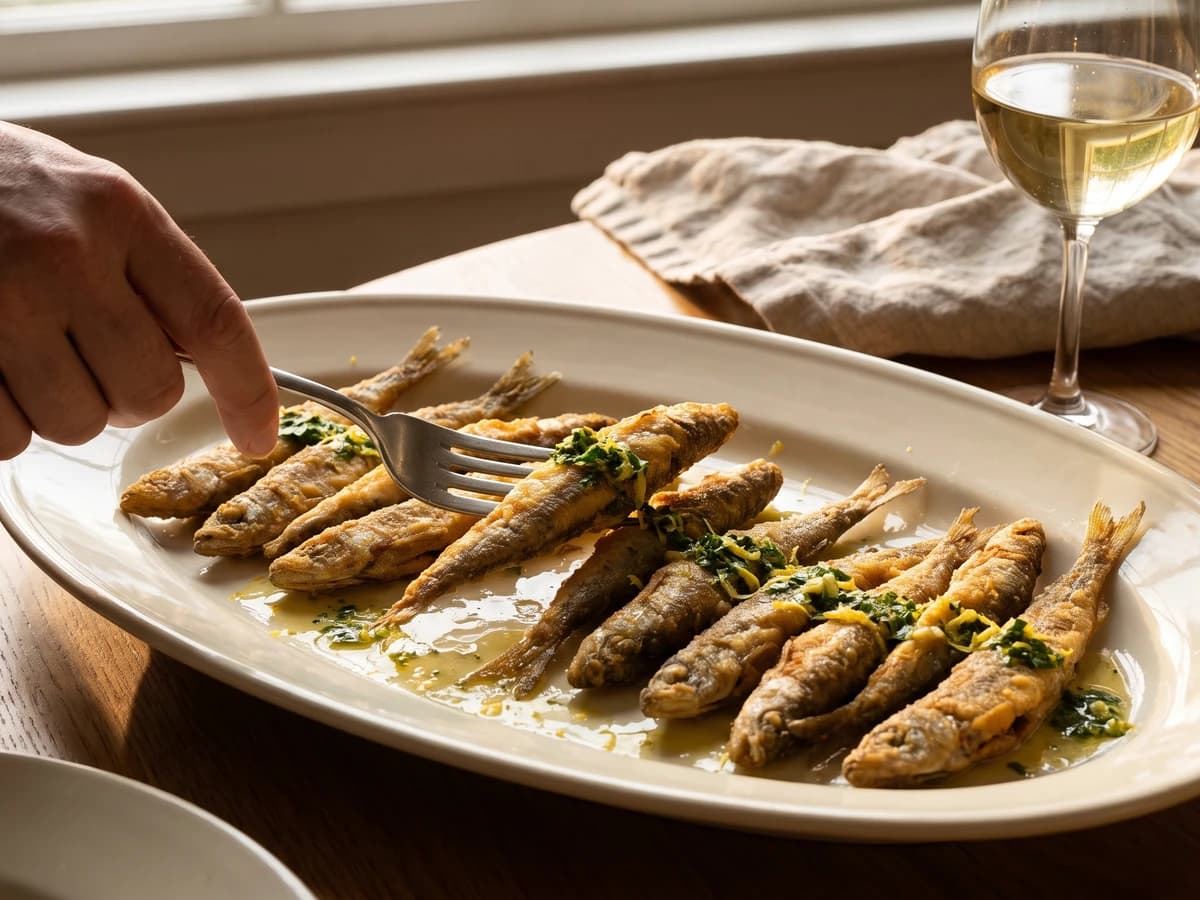
Éperlans à l’Anglaise turns small fish into a lesson in disciplined coating: boned smelts under a close, crisp crumb, pan-fried in clarified butter and finished with bright, half-melted maître d’hôtel butter.

Chef Juliette
Tiny smelts, shallot, mushrooms, white wine, gratin sauce, and fine bread raspings meet a fierce oven, where the fish must turn tender in the same breath the buttered crust bronzes.