
Chef Juliette
John Dory (St. Pierre)
John Dory has the delicacy of sole and the firmness of turbot. A light flouring, a quick butter sauté, and nut-brown beurre noisette show exactly why looks never mattered.
A cooking platform built around craft, culture, and the stories behind what we eat.
Created by Chef Juliette
Based on No. 1022, Merlan sur le Plat, from Le Guide Culinaire (1907) by Auguste Escoffier
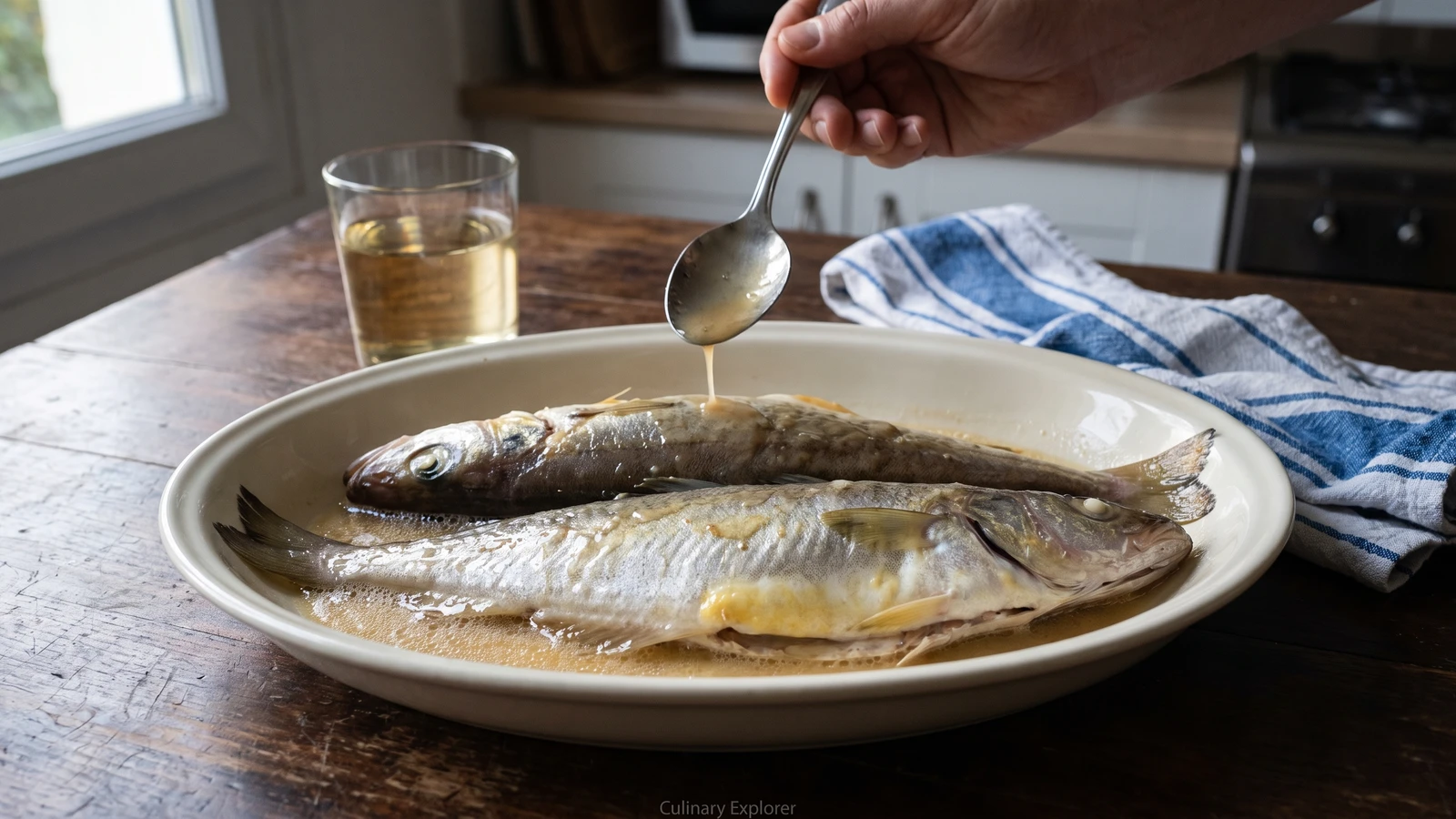
Whole whiting, butter tucked against the bones, bakes in mushroom cooking liquor while patient basting turns the liquor into a translucent glaze. Merlan sur le Plat teaches reduction by sight, spoonful by spoonful.
Merlan sur le Plat (whole whiting baked and glazed in its serving dish) teaches one true thing: the fish and its reduction share a clock. The mushroom cooking liquor must reach a syrupy gloss while the whiting remains tender, so you baste by sight and lift the fish the instant it is done.
The entry takes its method directly from Sole sur le Plat (No. 837). A brigade could count on a saucier, jus de champignons ready beside the stove, a stockpot never cold for the pale meat glaze used in wine variations, and a salamander fierce enough to hurry the finish. At home, two broad, shallow dishes encourage evaporation, and a wide pan finishes the reduction if the fish gets there first. The separate saucier and resident stockpot are scaffolding, so they go; the butter beneath the flesh, frequent basting, and reduction to syrup are the dish, so they stay. Four small whiting make this one cook, one stove, one evening.
Whiting is round rather than flat, so loosen the single upper fillet instead of forcing a sole's anatomy onto it, then tuck its walnut of butter against the bones. This is the only anatomical change, and it preserves the source's intent: melting butter bastes the flesh from within while the cooking liquor works from outside. The step that matters most is the last stretch of reduction. Baste often, and judge the glaze by the way it clings, not by the clock.
Merlan sur le plat belongs to the Parisian classical table, where inexpensive whiting arriving from Channel and Atlantic ports received the same careful treatment as dearer sole. Its explicit borrowing from Sole sur le Plat (No. 837) shows how the canon worked as a grammar: one method of buttering, moistening, basting, and reducing could move intact from one delicate whole fish to another. Sur le plat names more than the serving vessel; the fish cooks in that very dish while its liquor becomes the glaze, so a separately made sauce misses the point.
Quantity
4, 10 to 12 ounces each (1.13 to 1.36 kg total), for Sole sur le Plat (No. 837)
gutted, scaled, and fins trimmed
Quantity
2 cups (480 ml / 480 g)
strained
Quantity
6 cups (1.4 L / 450 g)
sliced
Quantity
2 1/2 cups (600 ml / 600 g)
Quantity
7 tablespoons (105 ml / 100 g)
softened and divided
Quantity
1 teaspoon (5 ml / 5 g)
Quantity
1 teaspoon (5 ml / 6 g)
Quantity
2 cups (480 ml / 475 g)
use instead of the mushroom cooking liquor
Quantity
1 tablespoon (15 ml / 20 g)
| Ingredient | Quantity |
|---|---|
| whole whitinggutted, scaled, and fins trimmed | 4, 10 to 12 ounces each (1.13 to 1.36 kg total), for Sole sur le Plat (No. 837) |
| hot, unsalted mushroom cooking liquorstrained | 2 cups (480 ml / 480 g) |
| white button mushrooms, for homemade cooking liquor (optional)sliced | 6 cups (1.4 L / 450 g) |
| cold water, for homemade cooking liquor (optional) | 2 1/2 cups (600 ml / 600 g) |
| unsalted buttersoftened and divided | 7 tablespoons (105 ml / 100 g) |
| fresh lemon juice | 1 teaspoon (5 ml / 5 g) |
| fine sea salt | 1 teaspoon (5 ml / 6 g) |
| good dry white or red wine, for wine variation (optional)use instead of the mushroom cooking liquor | 2 cups (480 ml / 475 g) |
| melted pale meat glaze, for wine variation (optional) | 1 tablespoon (15 ml / 20 g) |
If the mushroom cooking liquor isn't already prepared, combine the sliced button mushrooms and cold water in a covered saucepan. Bring them to a bare simmer, cook gently for 10 minutes, then strain without pressing, which would cloud the pale liquor. Measure 2 cups, topping up with water if necessary, and keep it hot; reserve the cooked mushrooms for another meal. Heat the oven to 475°F (245°C). Spread 3 tablespoons of the softened butter generously over two shallow ovenproof dishes.
Pat each whiting thoroughly dry, including the cavity, and season with the fine sea salt. Following the method of Sole sur le Plat (No. 837), lay a fish on its side and slide a narrow flexible knife between the exposed upper fillet and the ribs, working from the dorsal edge toward the backbone. Loosen the flesh only partway, leaving it attached along the outer edge, head, and tail. Slip 1 tablespoon of butter into the pocket against the bones, then repeat with the remaining fish. Arrange two whiting head-to-tail in each buttered dish, loosened sides facing up.
Divide the hot mushroom cooking liquor between the dishes, about 1 cup per dish, and sprinkle the lemon juice over the fish. The liquor should surround the whiting in a shallow layer without covering it. For the wine variation, use the white or red wine instead of the mushroom liquor, first stirring the melted pale meat glaze into the wine; do not use both liquids. Set the dishes on the upper-middle oven rack and bake for 4 minutes before beginning to baste.
Open the oven and spoon the bubbling liquor over the fish, directing some into each butter pocket. Repeat every 2 to 3 minutes. Begin checking the whiting after 12 minutes: it is done when the flesh beside the backbone has turned opaque, releases cleanly when nudged, and reaches 145°F (63°C) at its thickest point. The liquor should reduce at the same time into small, glossy bubbles that cling to the spoon. If it thickens before the fish is ready, add a tablespoon of hot water and lower the oven to 450°F (230°C).
If the whiting is cooked before the liquor becomes syrupy, lift the fish carefully onto a warm tray. Pour the liquor into a wide sauté pan and boil it briskly until it coats the back of a spoon in a thin, translucent film, then return it to the baking dishes. This replaces the brigade's fierce finishing heat without sacrificing the fish. If the glaze turns oily instead of glossy, remove it from the heat and whisk in 1 teaspoon of cool water. Ça se rattrape. If it becomes sticky, loosen it with hot water a teaspoon at a time.
Return the whiting to their dishes if they were lifted out, then spoon the reduced liquor repeatedly over each fish until the skin wears a translucent, butter-gold coat. The glaze should flow slowly, not sit like paste, and only a shallow spoonful should remain around the fish. Carry the dishes straight to the table and serve the whiting from the vessels in which they cooked. À table!
1 serving (about 225g)
Culinary guides, cultural storytelling, and the editorial depth that makes cooking meaningful.
Discover Culinary ExplorerChef Juliette
John Dory has the delicacy of sole and the firmness of turbot. A light flouring, a quick butter sauté, and nut-brown beurre noisette show exactly why looks never mattered.

Chef Juliette
Fresh haddock proves its delicacy in the meunière pan: a fine flour crust, moist pearly flakes, and beurre noisette sharpened with lemon and parsley, ready from one skillet in half an hour.
Chef Juliette
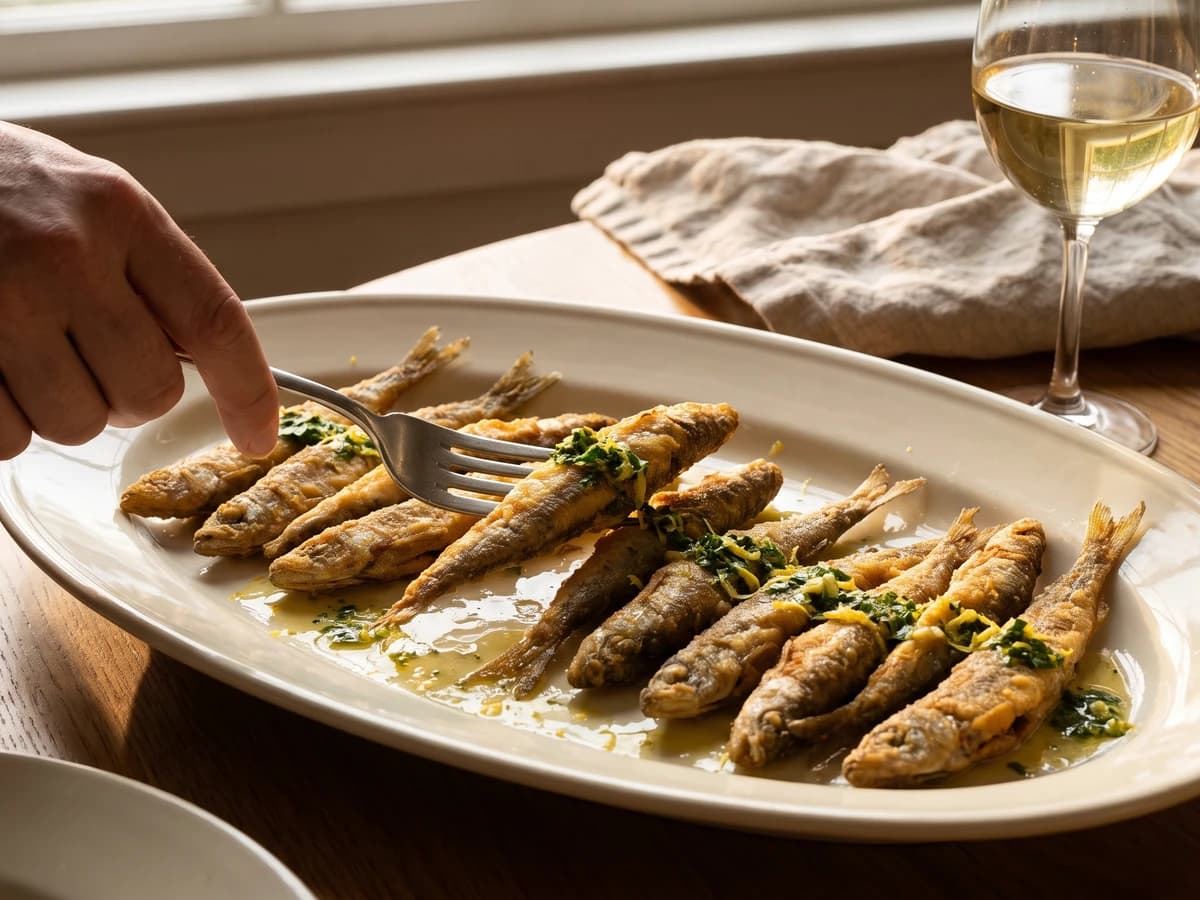
Éperlans à l’Anglaise turns small fish into a lesson in disciplined coating: boned smelts under a close, crisp crumb, pan-fried in clarified butter and finished with bright, half-melted maître d’hôtel butter.

Chef Juliette
Tiny smelts, shallot, mushrooms, white wine, gratin sauce, and fine bread raspings meet a fierce oven, where the fish must turn tender in the same breath the buttered crust bronzes.