
Chef Juliette
John Dory (St. Pierre)
John Dory has the delicacy of sole and the firmness of turbot. A light flouring, a quick butter sauté, and nut-brown beurre noisette show exactly why looks never mattered.
A cooking platform built around craft, culture, and the stories behind what we eat.

Created by Chef Juliette
Based on No. 837, Sole sur le Plat, from Le Guide Culinaire (1907) by Auguste Escoffier
Sole baked where it will be served, butter tucked beneath the fillets, then basted until fish liquor turns syrupy and translucent. The basting is the dish; stay close and watch the glaze form.
Sole sur le plat (whole sole baked and glazed in its own dish) teaches reduction by attention. The one true thing to know before you touch a pan is this: the basting is the dish. Butter melts from beneath the partly lifted fillets, fish liquor concentrates around them, and each spoonful returned over the flesh builds the translucent coat. Walk away and you have baked sole with broth, not sole sur le plat.
The classical kitchen assumed a saucier on staff, a fish stockpot never off the fire, individual serving platters, and a salamander waiting if the finish needed correction. At home, strong unsalted fish cooking liquor supplies the foundation, while one broad platter gives enough surface for reduction. The individual platters were brigade scaffolding, so two larger soles now feed four; the source proportion of roughly a scant half cup of liquor per fish remains intact. No salamander is needed because the finish should gleam, not brown. One cook, one stove, one evening.
Partly freeing the upper fillets and tucking butter beneath them must stay, as must the repeated basting. Those steps are the dish. When it is right, the flesh lifts pearly from the bone and the cooking liquor clings like clear amber satin. Keep the spoon in your hand through the final ten minutes; that is the step that matters most.
Sole sur le plat belongs to the Parisian classical table and to cuisine bourgeoise, where a whole flatfish could pass directly from oven to dining room in its shallow serving dish. The phrase sur le plat names the method, not a garnish: the fish is cooked and sauced in the platter brought to the table, rather than poached elsewhere and transferred. The Chambertin, vin rouge, Champagne, and Chablis variations show how the method traveled through the wine list; those names identify the liquid in the glaze, not competing regional birthplaces for the dish.
Quantity
2 fish, 1¼ to 1½ pounds (570 to 680 g) each
skinned and gutted, heads removed, bones and fillets left intact
Quantity
6 tablespoons (90 ml / 85 g)
divide into 2 tablespoons softened and 4 tablespoons cut into 4 walnut-size pieces and kept cool
Quantity
1 cup minus 1 tablespoon (225 ml / 225 g)
warmed
Quantity
½ teaspoon (2.5 ml / 2.5 g)
Quantity
1 teaspoon (5 ml / 6 g)
divided
Quantity
2 tablespoons (30 ml / 30 g)
use only if needed to rescue the glaze
| Ingredient | Quantity |
|---|---|
| whole Dover solesskinned and gutted, heads removed, bones and fillets left intact | 2 fish, 1¼ to 1½ pounds (570 to 680 g) each |
| unsalted butterdivide into 2 tablespoons softened and 4 tablespoons cut into 4 walnut-size pieces and kept cool | 6 tablespoons (90 ml / 85 g) |
| strong unsalted fish cooking liquorwarmed | 1 cup minus 1 tablespoon (225 ml / 225 g) |
| fresh lemon juice | ½ teaspoon (2.5 ml / 2.5 g) |
| fine sea saltdivided | 1 teaspoon (5 ml / 6 g) |
| hot water (optional)use only if needed to rescue the glaze | 2 tablespoons (30 ml / 30 g) |
Set a rack in the upper third of the oven and heat it to 450°F (230°C). Coat a shallow 16 by 12-inch (40 by 30 cm) ovenproof platter generously with the softened butter, carrying it over the entire base and slightly up the sides. Warm the fish cooking liquor to a bare simmer in a small saucepan; starting it hot lets reduction begin at once instead of making the sole wait in a cool bath.
Pat the soles thoroughly dry and place them pale side down. On the upper side of each fish, find the line running from the head end to the tail above the central bone. Cut shallowly along that line, then hold a flexible knife almost flat and work outward over the bones, partly freeing both upper fillets without cutting through their outer edges. Lift each fillet just enough to make a pocket. The flesh must remain attached around the perimeter so the sole keeps its whole shape.
Season inside the four pockets and over both fish with most of the salt. Slip one walnut-size piece of cool butter beneath each upper fillet, then settle the fillets back over it. Lay the soles upper side up in the buttered platter. Pour the warmed fish cooking liquor around them, add the lemon juice to the liquid, and carry the platter carefully to the oven. The liquor should form a shallow pool around the fish, not cover them.
Bake for 4 minutes, then draw the rack forward and spoon the bubbling liquor over every exposed part of the soles. Repeat every 2 minutes, rotating the platter once if one side reduces faster. Tilt the platter carefully with a dry towel so the liquid gathers beneath the spoon. Watch the change: the liquor first looks thin, then the butter and gelatin bind it into a glossy glaze that runs more slowly from the spoon. Frequent basting cooks the exposed surface while laying down the coat the dish is named for.
Begin checking after 16 minutes. The soles are ready when the flesh beside the central bone is opaque, lifts cleanly with the point of a knife, and reaches 145°F (63°C) at its thickest part. The liquor should be reduced to a light syrup that coats the spoon and leaves a translucent shine over the fish. If the glaze thickens before the flesh is cooked, add hot water 1 tablespoon at a time and continue basting. If the fish is ready while the liquor remains thin, lift the soles briefly to a warm platter and reduce the liquid briskly in the same pan, or in a small saucepan if the platter cannot sit over a burner. If the butter separates into greasy beads, take the liquid off the heat and whisk in a teaspoon of hot water. Ça se rattrape.
Return the soles to their platter if they were lifted, then spoon the syrupy liquor repeatedly over them until every fillet wears an even gloss. Taste one drop of the glaze and add the remaining salt only if it needs it. Bring the platter directly to the table. To portion, lift away the two upper fillets from each sole, remove the central skeleton in one piece, and free the lower fillets; give each person one upper and one lower fillet, with the glaze spooned generously over both. Serve at once. À table!
1 serving (about 180g)
Culinary guides, cultural storytelling, and the editorial depth that makes cooking meaningful.
Discover Culinary ExplorerChef Juliette
John Dory has the delicacy of sole and the firmness of turbot. A light flouring, a quick butter sauté, and nut-brown beurre noisette show exactly why looks never mattered.

Chef Juliette
Fresh haddock proves its delicacy in the meunière pan: a fine flour crust, moist pearly flakes, and beurre noisette sharpened with lemon and parsley, ready from one skillet in half an hour.
Chef Juliette
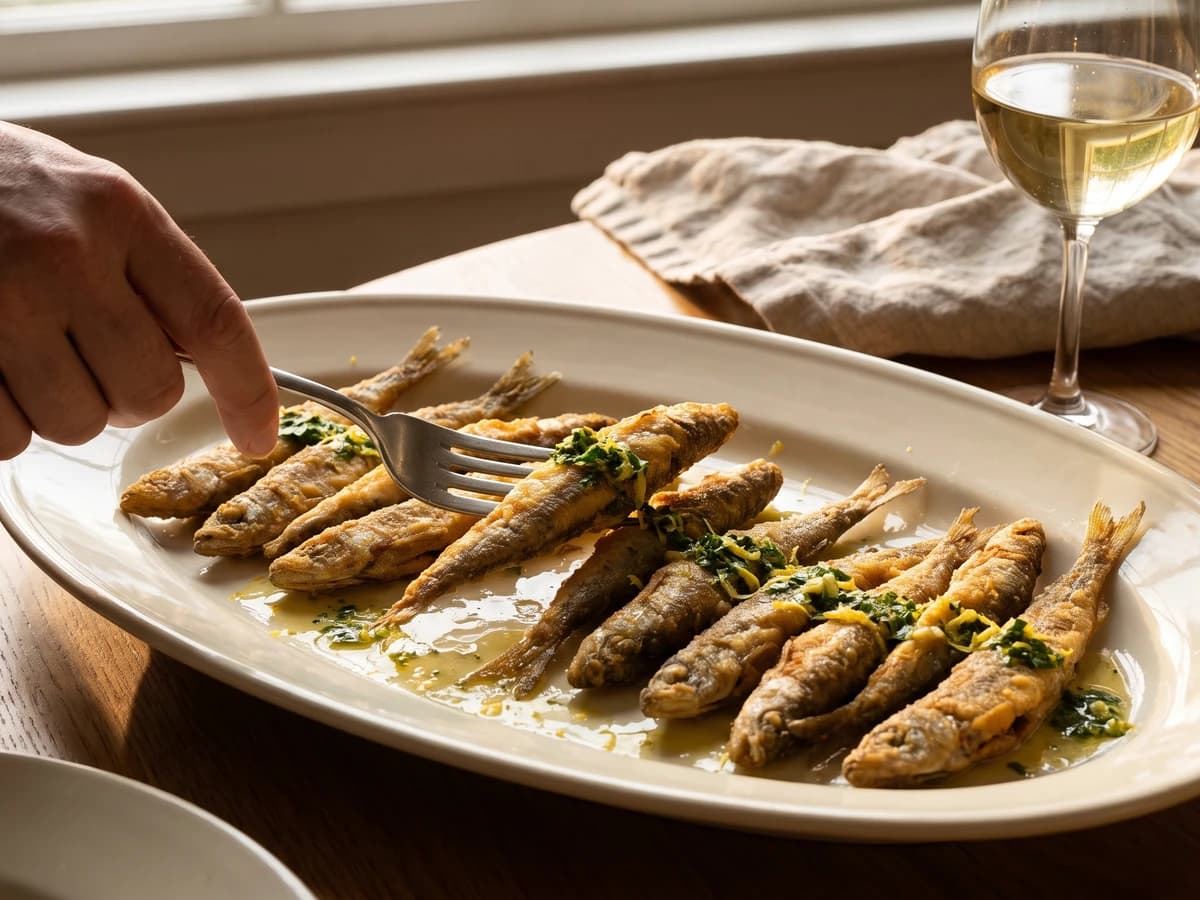
Éperlans à l’Anglaise turns small fish into a lesson in disciplined coating: boned smelts under a close, crisp crumb, pan-fried in clarified butter and finished with bright, half-melted maître d’hôtel butter.

Chef Juliette
Tiny smelts, shallot, mushrooms, white wine, gratin sauce, and fine bread raspings meet a fierce oven, where the fish must turn tender in the same breath the buttered crust bronzes.