
Chef Fai
Dry Egg Noodles (Ba Mee Haeng)
The four pillars live at the bottom of the bowl before the noodles ever touch it: nam pla for salt, sugar for sweet, vinegar for sour, chili for heat. Every noodle cart in Bangkok runs on this principle.
A cooking platform built around craft, culture, and the stories behind what we eat.

Created by
The paste IS the sausage. Every ingredient in the kreung tam becomes the meat itself. Lemongrass, galangal, kaffir lime zest, turmeric, shrimp paste, all pounded and folded into pork. Charcoal does the rest.
Sai oua is the purest proof that the kreung tam is everything. In most Thai dishes, the paste is a foundation you build on: you fry it, you simmer it, you add protein and liquid. In sai oua, there is no building. The paste IS the sausage. You pound it, you mix it into the pork, you stuff it into a casing. That's it. The kreung tam doesn't support the dish. It becomes the dish.
Ajarn always said: understand the paste, understand Thai food. Sai oua is the most literal expression of that principle I've ever encountered. Lemongrass (takhrai), galangal (kha), kaffir lime zest (phiu makrut), turmeric (khamin), cilantro root (rak phak chi), shallots (hom daeng), garlic (krathiam), dried chilies (prik haeng), shrimp paste (kapi). That's the kreung tam of the North. And every single gram of it goes directly into the meat.
This is not Central Thai cooking. This is Lanna. The North has its own paste traditions, its own spice logic. Turmeric is everywhere up here. It stains your mortar yellow, it colors the sausage gold, it tells you immediately that you're in Chiang Mai territory, not Bangkok. The dried spices are warmer, earthier. The herbs hit different when they're grown in mountain soil at elevation.
I watched a vendor at Warorot market in Chiang Mai spend forty-five minutes pounding her sai oua paste for one batch. She didn't use a food processor. She didn't rush. She told me her grandmother made it the same way, same mortar, same rhythm. When the sausages came off the charcoal grill an hour later, the skin crackled and the inside was so fragrant you could smell the lemongrass from three stalls away. That's what a proper kreung tam does when fire meets it. There are no shortcuts to that result.
Sai oua is the signature sausage of the Lanna kingdom, the historical territory encompassing modern Chiang Mai, Chiang Rai, Lamphun, and Lampang. Its herb-heavy paste reflects the Northern Thai pantry's overlap with Myanmar and Shan State cooking traditions, particularly the heavy use of turmeric, which is far less common in Central Thai preparations. Unlike the fermented sour sausages of Isan (sai krok Isan) or the Chinese-influenced sai oua of Bangkok markets, Chiang Mai sai oua is defined by its fresh herb paste and is never fermented, relying entirely on the kreung tam and charcoal smoke for its complex flavor.
Quantity
700g
not lean, at least 20% fat
Quantity
100g
finely diced
Quantity
3 stalks
tender inner part only, thinly sliced
Quantity
5 cm piece
peeled and sliced
Quantity
zest of 4 kaffir limes
finely sliced
Quantity
6
central vein removed, very finely sliced
Quantity
3 cm piece
peeled and sliced (or 1 teaspoon ground)
Quantity
4
scraped and chopped
Quantity
8
roughly chopped
Quantity
10 cloves
Quantity
8
soaked 15 minutes, deseeded
Quantity
1 tablespoon
Quantity
2 tablespoons
Quantity
1 teaspoon
Quantity
1/2 teaspoon
Quantity
1/2 teaspoon
Quantity
about 2 meters
rinsed and soaked in water
| Ingredient | Quantity |
|---|---|
| ground porknot lean, at least 20% fat | 700g |
| pork back fatfinely diced | 100g |
| lemongrass (takhrai)tender inner part only, thinly sliced | 3 stalks |
| galangal (kha)peeled and sliced | 5 cm piece |
| kaffir lime zest (phiu makrut)finely sliced | zest of 4 kaffir limes |
| kaffir lime leaves (bai makrut)central vein removed, very finely sliced | 6 |
| fresh turmeric (khamin)peeled and sliced (or 1 teaspoon ground) | 3 cm piece |
| cilantro roots (rak phak chi)scraped and chopped | 4 |
| shallots (hom daeng)roughly chopped | 8 |
| garlic (krathiam) | 10 cloves |
| dried long red chilies (prik haeng)soaked 15 minutes, deseeded | 8 |
| shrimp paste (kapi) | 1 tablespoon |
| fish sauce (nam pla) | 2 tablespoons |
| palm sugar (nam tan pip) | 1 teaspoon |
| white peppercorns (prik thai) | 1/2 teaspoon |
| salt | 1/2 teaspoon |
| natural pork casingrinsed and soaked in water | about 2 meters |
Start with the dried chilies and white peppercorns in a heavy granite mortar (krok hin). Pound them to a coarse powder. Add the salt and shrimp paste (kapi). Pound again until combined. Now add the garlic and shallots, pounding each addition into the paste before adding the next. Then the cilantro roots. Then the lemongrass, galangal, and turmeric. These fibrous ingredients take the most work. You're breaking down cell walls, releasing essential oils, turning solid roots into a rough but cohesive paste. Finally, add the kaffir lime zest. Pound until the paste is fragrant, slightly coarse, and holds together when you press it. Your mortar will be stained yellow from the turmeric. Good. That's the Lanna signature.
Remove the tough central vein from each kaffir lime leaf. Stack the leaves, roll them into a tight cylinder, and slice as finely as you possibly can. These go directly into the pork mixture, not into the mortar. They're too delicate to pound. Sliced this fine, they melt into the sausage and release their citrus oil in every bite.
In a large bowl, combine the ground pork, diced pork back fat, the entire kreung tam paste, the sliced kaffir lime leaves, fish sauce (nam pla), and palm sugar (nam tan pip). Now get your hands in there. Mix and knead for a solid 3 to 4 minutes. You're not gently folding. You're working the paste into the meat until every strand of pork is coated, stained yellow-green with turmeric and herb. The mixture should smell intensely of lemongrass and galangal. If it doesn't, your paste wasn't pounded enough. Pinch off a small piece, flatten it, and fry it in a dry pan. Taste it. Adjust the fish sauce or salt now, before it goes into the casing. You cannot fix seasoning after stuffing.
Slide the soaked pork casing onto the end of a sausage stuffer or a wide funnel. Tie a knot at one end. Feed the pork mixture through, packing it firmly but not so tight that the casing bursts. You want the sausage plump, with no air pockets. When air gets trapped, the casing pops on the grill. If you see a bubble, prick it with a toothpick. Twist or tie the sausage into coils about 15 cm in diameter, the classic Chiang Mai spiral. If you prefer links, twist every 15 cm.
Lay the coiled or linked sausages on a tray and refrigerate uncovered for at least 1 hour, or overnight. This firms up the filling so it holds its shape on the grill, and the casing dries slightly, which helps it get crisp over the coals. An overnight rest also lets the kreung tam penetrate deeper into the meat. Time is a seasoning.
Build a charcoal fire and let it burn down to white-hot coals with no active flame. You want radiant heat, not fire. Flames char the casing before the inside cooks. Place the sai oua coils on the grill grate about 15 cm above the coals. Grill slowly, turning every 3 to 4 minutes, for 20 to 25 minutes total. The casing should turn deep golden-brown, tight and glistening with rendered fat. The sausage will feel firm when you press it. If fat drips and causes flare-ups, move the sausage to a cooler zone. Patience. This is low and slow, not a stir-fry.
Pull the sausage off the grill and let it rest for 5 minutes on a cutting board. This lets the juices redistribute. Slice on a diagonal into rounds about 2 cm thick. The cross-section should show flecks of green and yellow herb throughout the pink pork. If the color is even and pale, your kreung tam ratio was too low. Serve with sticky rice (khao niew), raw cabbage wedges, sliced ginger, fresh bird's eye chilies, and a small dish of nam prik noom (roasted green chili dip) if you have it. That's the Lanna way.
1 serving (about 150g)
Culinary guides, cultural storytelling, and the editorial depth that makes cooking meaningful.
Discover Culinary ExplorerChef Fai
The four pillars live at the bottom of the bowl before the noodles ever touch it: nam pla for salt, sugar for sweet, vinegar for sour, chili for heat. Every noodle cart in Bangkok runs on this principle.

Chef Fai
The kreung tam fried in cracked coconut cream until the oil bleeds red. That's the technique. Concentrated, semi-dry, spooned thick over crispy fish. This is what happens when the four pillars meet restraint.
Chef Fai
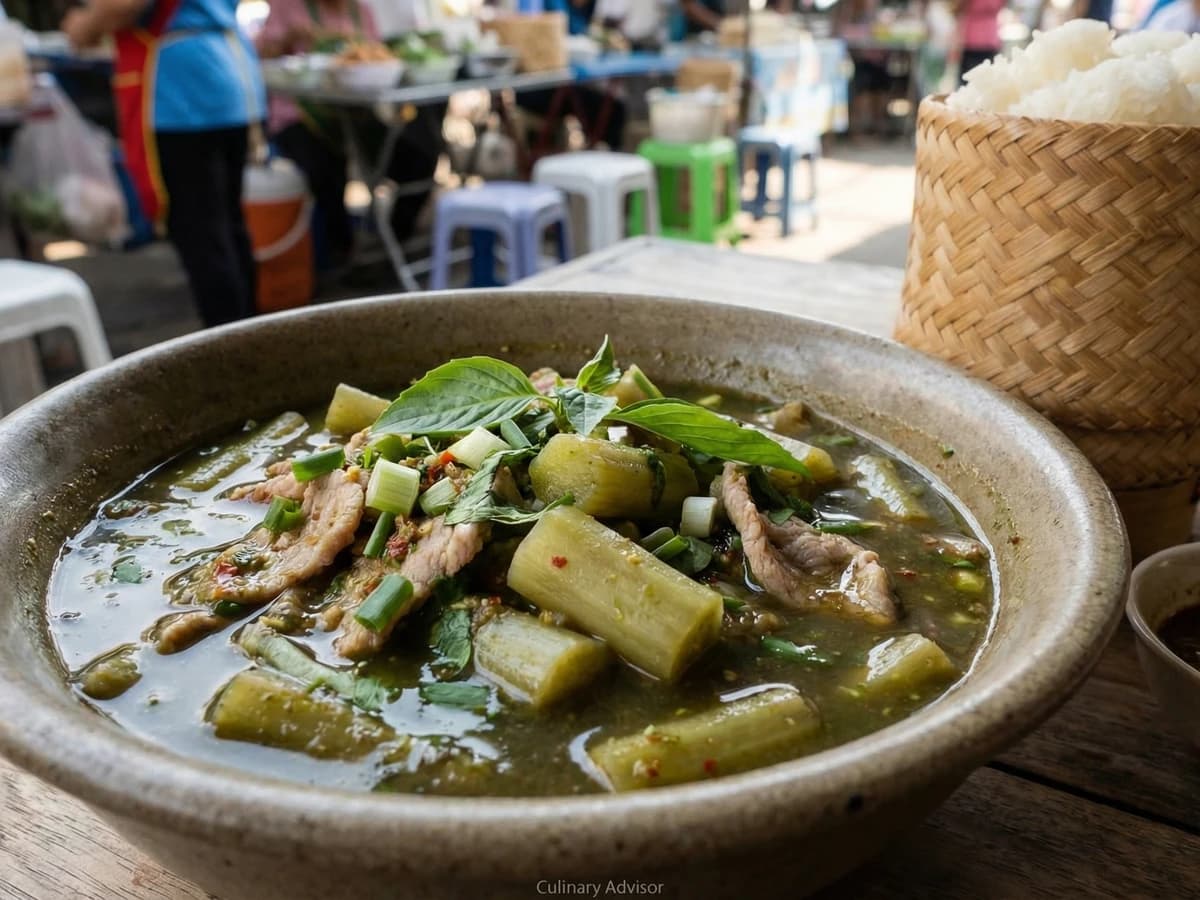
Isan foraging in a bowl: wild taro stems stripped of their sting, simmered in padaek broth with a pounded chili paste and yanang leaf extract. The land feeds you if you know the rules.

Chef Fai
Lanna's kreung tam breaks from Central Thai rules: ginger over galangal, cumin and coriander from Burmese spice routes, tamarind for sour instead of lime. The North has its own system, and this curry is its crown.