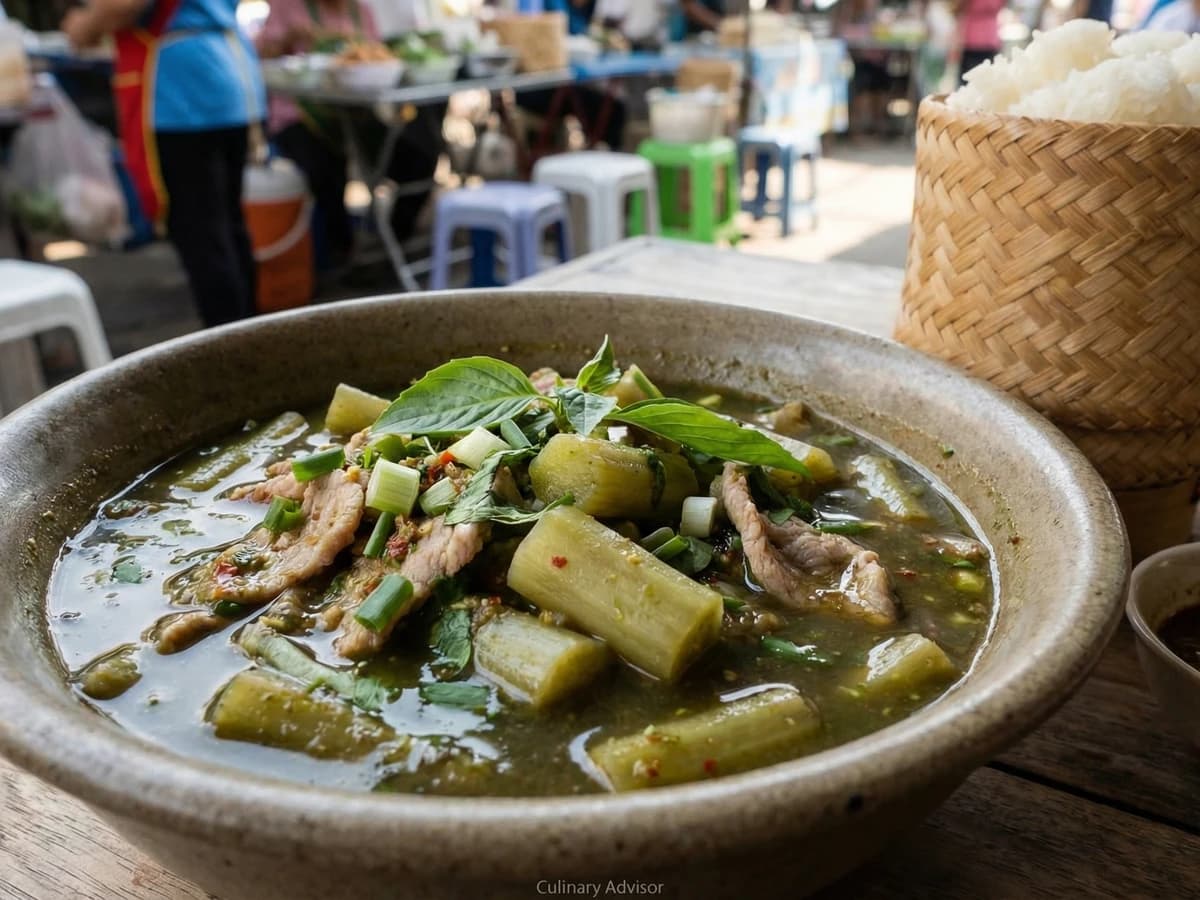
The four pillars live at the bottom of the bowl before the noodles ever touch it: nam pla for salt, sugar for sweet, vinegar for sour, chili for heat. Every noodle cart in Bangkok runs on this principle.
Main Dishes
Thai
Weeknight
Quick Meal
20 min
Active Time
10 min cook•30 min total
Yield2 servings
The sauce goes in the bowl first. That's the rule.
Before the noodles are blanched, before the pork is sliced, before anything else happens, the vendor builds the dressing at the bottom of an empty bowl. Fish sauce. Sugar. Vinegar with chilies. A shake of white pepper. Sometimes a spoon of lard or pork cracklings oil. That's the foundation. When the hot noodles land on top and you toss, every strand gets coated. Every bite is seasoned. There's no pooling dressing at the bottom, no dry patch on top. The method is the principle.
Ajarn always said the four pillars define Thai cuisine: fish sauce for salt, palm sugar for sweet, tropical acids for sour, chili for heat. Ba mee haeng is proof that the system works even without a kreung tam. There's no paste here. No mortar. But the pillars are all present in that sauce at the bottom of the bowl. Nam pla (fish sauce) handles the salt and umami. Sugar handles the sweet. Vinegar with chilies handles the sour and the heat simultaneously. Four pillars, four ingredients, built in ten seconds by a vendor who's done it ten thousand times.
I watched the ba mee cart near my parents' stall in Khlong Toei for years before I understood what I was seeing. The vendor never measured. She'd grab a bowl, flick fish sauce from a bottle, scoop sugar with a spoon, splash vinegar from a jar with chilies floating in it, shake white pepper. Done. Five seconds. Then she'd turn to the boiling pot, blanch the noodles for exactly the right number of seconds (never more), shake the basket dry, drop them in the bowl. Greens on top. Sliced moo daeng (red roast pork). Fried garlic. A side bowl of broth with a single wonton floating in it. Thirty baht. Perfect meal. She didn't know the word "pillar." She didn't need to. Her hands knew the system.
The noodle blanch is where most people fail at home. Ba mee (egg noodles) cook in forty to sixty seconds. That's it. Pull them too late and they're gummy. Pull them right and they're springy, bouncy, with just enough chew to stand up to the dressing. Shake the basket hard to get the water off. Wet noodles dilute the sauce. Dry noodles absorb it. That's the difference between a good bowl and a great one.
Ba mee (egg noodles) arrived in Thailand with Chinese immigrants, primarily Cantonese and Teochew, who settled in Bangkok's Chinatown (Yaowarat) in the late 19th and early 20th centuries. The haeng (dry) preparation is a Thai adaptation that replaced Chinese soy-based sauces with the Thai four-pillar dressing of fish sauce, sugar, and vinegar. The noodle cart (rod khen, รถเข็น) became the dominant delivery system for this dish by the mid-20th century, and ba mee haeng remains one of Bangkok's most consumed street lunches, ordered by pointing and holding up fingers for number of servings.
The technique, the tradition, and the story behind every dish.
morning glory (pak bung) or Chinese broccery (pak kana)
Quantity
100g
cut into 3-inch lengths
fish sauce (nam pla)
Quantity
2 tablespoons
granulated sugar
Quantity
2 teaspoons
white vinegar with chilies (nam som prik dong)
Quantity
1 tablespoon
white pepper
Quantity
1 teaspoon
rendered pork fat or vegetable oil
Quantity
1 tablespoon
fried garlic (kratiem jiew)
Quantity
3 tablespoons
fried garlic oil
Quantity
2 tablespoons
dark soy sauce (si ew dam)
Quantity
1 tablespoon
pork broth
Quantity
4 cups
wontons (optional)
Quantity
2
green onion (ton hom)
Quantity
2 stalks
sliced
fresh cilantro leaves (pak chi)
Quantity
for topping
phrik pon (dried chili flakes)
Quantity
for serving
nam pla prik (fish sauce with chilies)
Quantity
for serving
Ingredient
Quantity
fresh ba mee (thin egg noodles)
200g
moo daeng (Thai red roast pork)sliced
150g
morning glory (pak bung) or Chinese broccery (pak kana)cut into 3-inch lengths
100g
fish sauce (nam pla)
2 tablespoons
granulated sugar
2 teaspoons
white vinegar with chilies (nam som prik dong)
1 tablespoon
white pepper
1 teaspoon
rendered pork fat or vegetable oil
1 tablespoon
fried garlic (kratiem jiew)
3 tablespoons
fried garlic oil
2 tablespoons
dark soy sauce (si ew dam)
1 tablespoon
pork broth
4 cups
wontons (optional)
2
green onion (ton hom)sliced
2 stalks
fresh cilantro leaves (pak chi)
for topping
phrik pon (dried chili flakes)
for serving
nam pla prik (fish sauce with chilies)
for serving
Equipment Needed
•Large pot for boiling broth and blanching
•Noodle basket or spider strainer
•Small pan for frying garlic
•Fine mesh strainer
Instructions
1
Fry the garlic
If you're making your own fried garlic (and you should), peel and mince 8 to 10 cloves. Heat half a cup of vegetable oil in a small pan over medium heat. Add the garlic and stir constantly. Watch it like a hawk. Garlic goes from golden to burnt in about five seconds. The moment it turns light gold, pour everything through a fine strainer. The garlic will continue darkening from residual heat. Spread it on paper to crisp. Save the oil. That garlic oil is going into your bowl. It's half the flavor of the dressing.
Buy fried garlic from a Thai grocer if you're in a hurry. The jar stuff works. But fresh-fried garlic has a sweetness and crunch that the pre-made version can't touch. Your call.
2
Build the bowl sauce
For each bowl: add 1 tablespoon fish sauce (nam pla), 1 teaspoon sugar, half a tablespoon vinegar with chilies (nam som prik dong), half a teaspoon white pepper, half a tablespoon dark soy sauce, half a tablespoon rendered pork fat or vegetable oil, and 1 tablespoon fried garlic oil. That's the foundation. It sits at the bottom of the bowl waiting for the noodles. Don't stir it yet. The hot noodles will do the work.
This is the four pillars in ten seconds. Nam pla for salt. Sugar for sweet. Vinegar for sour. The chili flakes in the vinegar and the white pepper for heat. Every noodle vendor in Bangkok builds this by feel. You'll get there too. Start with these measurements and adjust after you taste the finished bowl.
3
Prepare the broth and greens
Bring your pork broth to a boil in a pot. This broth serves double duty: you blanch the greens and noodles in it, and you serve a small bowl on the side. If using wontons, drop them in the broth now and cook for 2 to 3 minutes until they float. Remove and set aside. Blanch the morning glory or pak kana in the broth for 30 seconds, just until the stems turn bright green and bend without snapping. Remove with a slotted spoon or spider. Set aside.
4
Blanch the noodles
This is where concentration matters. Drop the fresh ba mee into the boiling broth. Stir immediately with chopsticks to separate the strands. Fresh egg noodles cook in 40 to 60 seconds. Not two minutes. Not three. Under a minute. They should be springy and bouncy with resistance when you bite, not soft and starchy. Pull them with a noodle basket or tongs. Shake the basket hard, three or four violent shakes, to get every drop of water off. Wet noodles equal a watered-down dressing. That's a ruined bowl.
If you can only find dried ba mee, cook according to the package but pull them 30 seconds early. Dried noodles absorb more liquid than fresh. The dressing will soften them further. Always err on the side of underdone.
5
Toss and assemble
Drop the hot, well-drained noodles directly into the bowl with the sauce. Toss immediately with chopsticks or tongs, lifting and turning the noodles so every strand hits the dressing at the bottom. Twenty seconds of aggressive tossing. The noodles should look glossy, slightly dark from the soy, and evenly coated. No pool of liquid at the bottom. If there's a pool, your noodles were too wet.
6
Top and serve
Lay the blanched greens alongside the noodles. Fan the sliced moo daeng on top. Scatter fried garlic generously. Add sliced green onion and cilantro leaves. Ladle a small bowl of the pork broth on the side with a wonton floating in it if you have them. Set out the krueng prung (condiment set): sugar, phrik pon (chili flakes), nam pla (fish sauce), and nam som prik (vinegar with chilies). The condiment tray is not a suggestion. It's part of the dish. The cook builds the base. The eater finishes it.
Chef Tips
•The sauce goes in the bowl before the noodles. Always. This is the noodle cart method and it exists for a reason. Hot noodles landing on the dressing warm it, melt the sugar, and the tossing coats every strand evenly. If you sauce the noodles after they're in the bowl, you get uneven seasoning and a puddle at the bottom.
•Fresh ba mee comes in different sizes: thin (ba mee lek) and thick (ba mee yai). For haeng (dry) preparations, go thin. More surface area means more dressing contact per strand. Thick noodles are better in soup where the broth does the flavoring work.
•Moo daeng (Thai red roast pork) is available at any Chinatown roast meat shop or Thai grocer. If you can't find it, moo krob (crispy pork belly) or even char siu works. The protein on a ba mee haeng is a topping, not the star. The star is the dressing and the noodle.
•The krueng prung condiment caddy on every noodle cart in Thailand has four jars: sugar, phrik pon (dried chili flakes), nam pla (fish sauce), and nam som prik dong (vinegar with sliced chilies). This is the adjustment system. Too bland? Fish sauce. Not sweet enough? Sugar. Need acid? Vinegar. Want heat? Chili flakes. Ajarn always said the four pillars are in the cook's hands and in the eater's hands. The condiment tray is the proof.
Advance Preparation
•Fried garlic and garlic oil can be made a day ahead. Store the garlic in an airtight container at room temperature (it stays crispy for about 3 days). Store the oil separately in the fridge.
•Pork broth can be made well in advance and frozen. Thaw and bring to a rolling boil before using.
•The bowl sauce can be pre-portioned into serving bowls up to 30 minutes ahead. Cover with plastic. But do not add noodles until the moment of serving. Ba mee haeng waits for no one. The noodles stick and the dressing gets absorbed unevenly if it sits.
Frequently Asked Questions
Nutrition Information
1 serving (about 450g)
Calories
785 calories
Total Fat
37 g
Saturated Fat
9 g
Trans Fat
0 g
Unsaturated Fat
27 g
Cholesterol
120 mg
Sodium
2820 mg
Total Carbohydrates
74 g
Dietary Fiber
4 g
Sugars
9 g
Protein
36 g
Where cooking meets culture.
Culinary guides, cultural storytelling, and the editorial depth that makes cooking meaningful.