
Chef Fai
Dry Egg Noodles (Ba Mee Haeng)
The four pillars live at the bottom of the bowl before the noodles ever touch it: nam pla for salt, sugar for sweet, vinegar for sour, chili for heat. Every noodle cart in Bangkok runs on this principle.
A cooking platform built around craft, culture, and the stories behind what we eat.

Created by
The kreung tam fried in cracked coconut cream until the oil bleeds red. That's the technique. Concentrated, semi-dry, spooned thick over crispy fish. This is what happens when the four pillars meet restraint.
Cracking the coconut cream. That's the principle this dish lives or dies by.
Every rich Thai curry starts the same way: you take the thick head of the coconut cream (hua kati, หัวกะทิ), heat it in a dry wok until the fat separates from the solids, and then you fry your kreung tam in that separated oil. When you see pools of red-orange oil floating on the surface, that's the crack. That's when the paste is cooked. If you dump everything in at once, cream and paste and coconut milk together, you get a murky, flat sauce that tastes like compromise. Choo chee is the dish that punishes you hardest for skipping this step, because there's nowhere to hide. No broth. No vegetables. Just concentrated curry sauce over fish. Every flaw is visible.
Ajarn always said choo chee is a test of your fundamentals. The kreung tam must be pounded properly. The coconut cream must crack cleanly. The seasoning must hit all four pillars: nam pla (fish sauce) for salt, nam tan pip (palm sugar) for sweet, the acidity from the kaffir lime leaves for a citrus edge, prik (chili) baked into the paste itself. Sour plays a quieter role here than in a tom yam or a som tam. It whispers through the kaffir lime zest in the paste and the shredded leaves on top. But it's there. The system is always there.
The name tells you everything. "Choo chee" (ฉู่ฉี่) is the sound the paste makes when it hits the hot cracked cream. That sizzle. If your kitchen doesn't sound like that, your cream didn't crack. Go back. Try again. When you hear it, you know the Maillard reaction is happening, the paste is toasting in coconut fat, and the essential oils from the lemongrass and galangal and kaffir lime zest are blooming into something extraordinary. That sound is the dish telling you it's working.
The fish gets a simple pan-fry first, skin side down until it's golden and holds its shape. Then the sauce goes over. Not under, not mixed in. Over. A thick, glossy, red-orange blanket of curry with fine shreds of kaffir lime leaf scattered across the top like confetti. That's choo chee. Concentrated. Restrained. Every element doing exactly one job.
Choo chee (ฉู่ฉี่) is a Central Thai semi-dry curry technique dating to the Ayutthaya period, where the onomatopoeic name mimics the sizzling sound of curry paste hitting cracked coconut cream. It was traditionally prepared with freshwater fish from the Chao Phraya river basin and served at family meals rather than royal banquets. The technique of frying paste in separated coconut oil, then reducing the sauce to a thick glaze rather than thinning it into soup, makes choo chee the purest expression of the "crack the cream" method that defines Central Thai coconut curries.
Quantity
10
soaked in warm water 15 minutes, seeded
Quantity
3
dried or fresh
Quantity
1 tablespoon
toasted
Quantity
1 teaspoon
Quantity
1 teaspoon
toasted
Quantity
1 tablespoon
Quantity
1 tablespoon
finely sliced, tender lower bulb only
Quantity
1 tablespoon
sliced
Quantity
2 teaspoons
Quantity
2 tablespoons
finely sliced
Quantity
1 tablespoon
chopped
Quantity
1 tablespoon
chopped
Quantity
1 tablespoon
Quantity
400ml
thick first press
Quantity
100ml
thin second press
Quantity
600g
skin on, cut into 2 portions or left whole
Quantity
2 tablespoons
Quantity
1 tablespoon
Quantity
5
central vein removed, finely shredded into hair-thin strips
Quantity
2
sliced on the bias
Quantity
for pan-frying
Quantity
for serving
| Ingredient | Quantity |
|---|---|
| dried red spur chilies (prik chi fa haeng)soaked in warm water 15 minutes, seeded | 10 |
| bird's eye chilies (prik khi nu)dried or fresh | 3 |
| coriander seeds (met phak chi)toasted | 1 tablespoon |
| white peppercorns (prik thai) | 1 teaspoon |
| cumin seeds (yira)toasted | 1 teaspoon |
| sea salt | 1 tablespoon |
| lemongrass (takhrai)finely sliced, tender lower bulb only | 1 tablespoon |
| galangal (kha)sliced | 1 tablespoon |
| kaffir lime zest (phiu makrut) | 2 teaspoons |
| shallots (hom daeng)finely sliced | 2 tablespoons |
| garlic (kratiam)chopped | 1 tablespoon |
| cilantro root (rak phak chi)chopped | 1 tablespoon |
| shrimp paste (kapi) | 1 tablespoon |
| coconut cream (hua kati)thick first press | 400ml |
| coconut milk (hang kati)thin second press | 100ml |
| snapper fillets (pla krapong daeng)skin on, cut into 2 portions or left whole | 600g |
| fish sauce (nam pla) | 2 tablespoons |
| palm sugar (nam tan pip) | 1 tablespoon |
| kaffir lime leaves (bai makrut)central vein removed, finely shredded into hair-thin strips | 5 |
| fresh red spur chilies (prik chi fa)sliced on the bias | 2 |
| vegetable oil | for pan-frying |
| steamed jasmine rice | for serving |
In a dry pan over medium heat, toast the coriander seeds, cumin seeds, and white peppercorns until they smell warm and nutty. About 2 minutes. Shake the pan constantly. Burnt spices are bitter spices and there's no coming back from that. Let them cool, then grind them to a fine powder in the mortar. This is your spice base. Sweep it out and set it aside.
Start with the salt and drained chilies in the granite mortar. Pound until the chilies break down into a fibrous paste. This takes effort. The salt acts as an abrasive, grinding the chili skins. Add the lemongrass and galangal. Pound again until no fibers remain. Then the kaffir lime zest. Then the cilantro root, shallots, and garlic, one ingredient at a time, pounding each addition into the mass before adding the next. Add the ground spice powder and incorporate. Finally, the shrimp paste. Pound until you have a smooth, fragrant, deep red paste. The aroma should fill the room: sharp, herbal, warm. If it doesn't, keep pounding.
Score the skin side of each fillet with three shallow cuts. Pat the fish completely dry with paper towels. Wet fish doesn't crisp, it steams. Heat a generous layer of oil in a non-stick or well-seasoned pan over medium-high. Lay the fillets in skin side down. Press gently with a spatula for the first 30 seconds to prevent curling. Cook for 3 to 4 minutes until the skin is golden and crisp. Flip carefully and cook 1 minute more. The fish should be just cooked through, not falling apart. Transfer to a serving plate and set aside.
This is the step. Pour the thick coconut cream into a dry wok over medium heat. No oil. The cream itself contains all the fat you need. Stir occasionally as it heats. After 5 to 7 minutes, you'll see the cream split: pools of clear oil floating on the surface, the solids turning slightly grainy underneath. That's the crack. The fat has separated from the protein. If your cream isn't cracking, your heat is too low or your coconut cream is too diluted. Use a quality brand with high fat content, at least 70%.
Add 3 to 4 tablespoons of your kreung tam to the cracked coconut cream. Listen. You should hear it sizzle, that "choo chee" sound. Stir constantly, frying the paste in the coconut oil for 3 to 4 minutes. The paste will darken slightly and the oil will turn red-orange as it absorbs the color from the chilies. The raw shrimp paste smell will transform into something rich and toasty. When the oil separates again and pools in red-orange slicks around the edges, the paste is cooked. This is the foundation of your sauce.
Add the thin coconut milk. Stir to combine. This loosens the sauce just enough to be spoonable but keeps it thick, not soupy. Choo chee is a concentrated curry. It coats the back of a spoon. Season with the fish sauce and palm sugar. Stir until the sugar dissolves. Taste. Salty, sweet, rich, with the heat building from the paste. The balance should lean savory. The sweetness rounds the edges without pushing forward. Adjust. Let the sauce simmer gently for 2 to 3 minutes until it thickens slightly and looks glossy.
Reserve half of the shredded kaffir lime leaves and all the sliced red chili for garnish. Stir the remaining kaffir lime shreds into the sauce. Spoon the hot curry sauce generously over the fish fillets on the plate. The sauce goes over the fish. Not the fish into the sauce. That's the difference. It should pool around the base and glaze the top. Scatter the reserved kaffir lime shreds and red chili slices over the surface. Serve immediately with steamed jasmine rice.
1 serving (about 300g)
Culinary guides, cultural storytelling, and the editorial depth that makes cooking meaningful.
Discover Culinary ExplorerChef Fai
The four pillars live at the bottom of the bowl before the noodles ever touch it: nam pla for salt, sugar for sweet, vinegar for sour, chili for heat. Every noodle cart in Bangkok runs on this principle.
Chef Fai
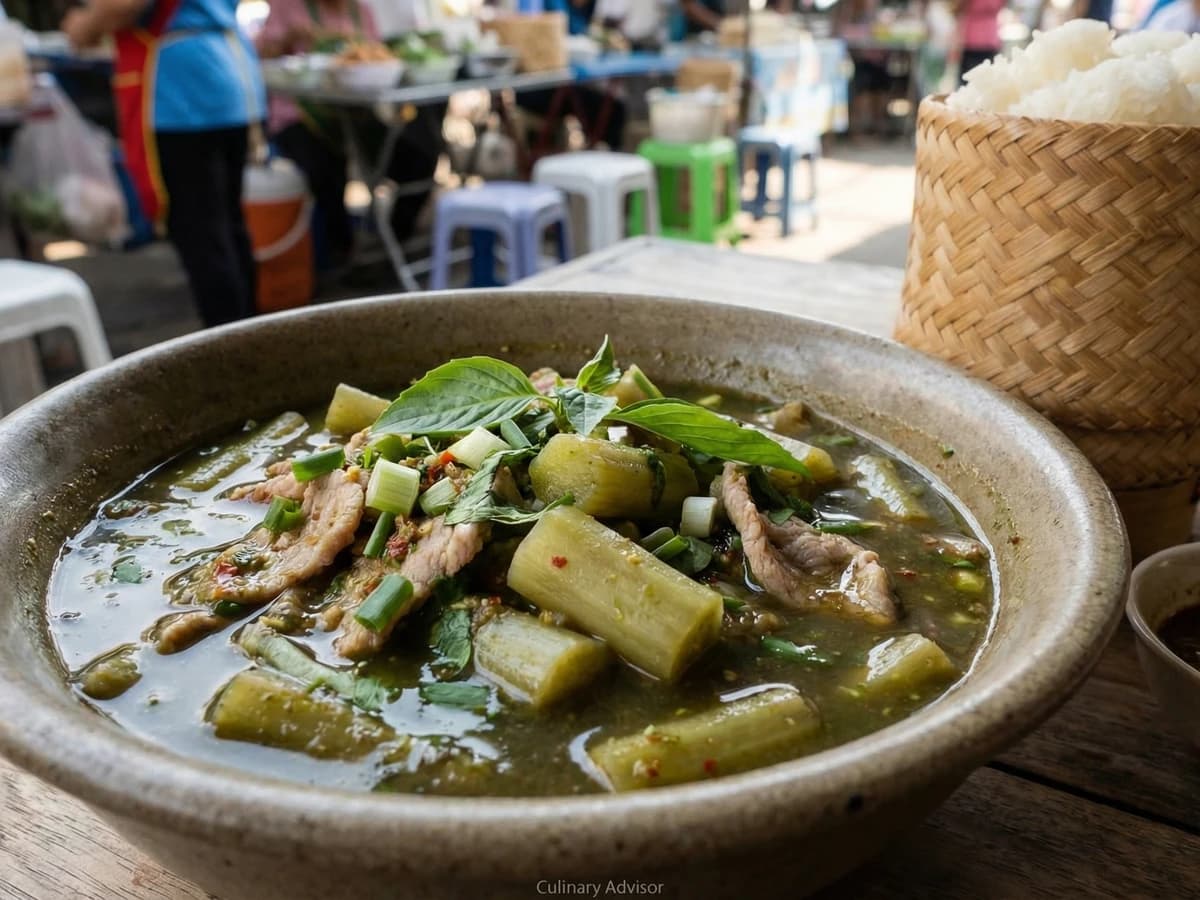
Isan foraging in a bowl: wild taro stems stripped of their sting, simmered in padaek broth with a pounded chili paste and yanang leaf extract. The land feeds you if you know the rules.

Chef Fai
Lanna's kreung tam breaks from Central Thai rules: ginger over galangal, cumin and coriander from Burmese spice routes, tamarind for sour instead of lime. The North has its own system, and this curry is its crown.

Chef Fai
The kreung tam lives twice. Yesterday's gaeng hang le hits a screaming wok with glass noodles and bamboo, and the Lanna kitchen proves that a day-old curry isn't a leftover. It's a foundation waiting for its second life.