
Chef Fai
Dry Egg Noodles (Ba Mee Haeng)
The four pillars live at the bottom of the bowl before the noodles ever touch it: nam pla for salt, sugar for sweet, vinegar for sour, chili for heat. Every noodle cart in Bangkok runs on this principle.
A cooking platform built around craft, culture, and the stories behind what we eat.

Created by
Ginger is the governing aromatic here, slivered and seared in a screaming wok, coating delicate fish in a light glaze that proves Thai stir-frying isn't always about brute force. Sometimes the wok whispers.
Not every Thai stir-fry is a violent act. Pad kra pao demands aggression. Pad khing demands finesse. The wok is still screaming hot, the garlic still hits the oil first, but the moment the fish enters, your hands need to be gentle. You're not smashing minced pork against carbon steel. You're coaxing a piece of snapper through hot oil without letting it fall apart.
Ginger is the governing aromatic of this dish. Not pounded into a paste, but slivered into thin matchsticks that fry until their edges crisp and their oils perfume the entire wok. Ajarn always said that Thai cooking has nine essential aromatics. Ginger (khing) is one of them, and this is its showcase. Every strand of ginger in the wok is doing the same job a kreung tam does in a curry: building the aromatic foundation that everything else rests on. The method is different. The principle is the same.
The sauce here is light. Fish sauce for salt, oyster sauce for body and gloss, a touch of light soy sauce (si ew khao) because this dish carries Chinese-Thai DNA and the soy belongs here, plus palm sugar to round the edges. No lime. No chili paste. Pad khing sits in the quieter corner of the four-pillar system: salty and sweet dominate, with heat coming only from the ginger's natural bite and a few sliced chilies for color. That restraint is the point. The system doesn't demand all four pillars at full volume in every dish. It demands that whatever you use is in balance.
I teach this dish at Fai Thai workshops specifically because it breaks people's assumption that Thai wok cooking is all fire and fury. The wok is the second most important tool after the mortar. Learning to use it gently is just as important as learning to use it with force.
Pad khing (ginger stir-fry) is one of the clearest examples of Chinese culinary influence absorbed into the Central Thai repertoire. Bangkok's Chinese community, concentrated in Yaowarat (Chinatown) since the late 18th century, brought the technique of stir-frying protein with slivered ginger, and Thai cooks adapted it by replacing soy-heavy seasoning with fish sauce as the primary salt. The technique is applied to pork, chicken, and fish interchangeably, but pla pad khing (the fish version) is considered the most technically demanding because the protein must hold its shape through high heat.
Quantity
400g
cut into bite-sized pieces, about 1 inch thick
Quantity
80g
peeled and cut into fine matchsticks
Quantity
15g
soaked in warm water 15 minutes, drained and torn into bite-sized pieces
Quantity
4 cloves
roughly chopped
Quantity
2 tablespoons
Quantity
1 tablespoon
Quantity
1 tablespoon
Quantity
1 teaspoon
Quantity
1 tablespoon
Quantity
3 stalks
cut into 1.5-inch lengths
Quantity
1
sliced diagonally
Quantity
3 stalks
cut into 1.5-inch lengths
Quantity
3 tablespoons
Quantity
pinch
Quantity
for serving
| Ingredient | Quantity |
|---|---|
| firm white fish fillets (pla kapong/snapper or sea bass)cut into bite-sized pieces, about 1 inch thick | 400g |
| fresh ginger (khing)peeled and cut into fine matchsticks | 80g |
| dried cloud ear mushrooms (het hu nu)soaked in warm water 15 minutes, drained and torn into bite-sized pieces | 15g |
| garlicroughly chopped | 4 cloves |
| fish sauce (nam pla) | 2 tablespoons |
| oyster sauce | 1 tablespoon |
| light soy sauce (si ew khao) | 1 tablespoon |
| palm sugar (nam tan pip) | 1 teaspoon |
| water | 1 tablespoon |
| spring onion (ton hom)cut into 1.5-inch lengths | 3 stalks |
| fresh red spur chili (prik chi fa daeng)sliced diagonally | 1 |
| Chinese celery (khuen chai)cut into 1.5-inch lengths | 3 stalks |
| vegetable oil | 3 tablespoons |
| white pepper | pinch |
| steamed jasmine rice | for serving |
Pat the fish pieces completely dry with paper towels. This is not optional. Wet fish in a hot wok doesn't sear. It steams. It sticks. It falls apart. Dry fish, hot oil, clean sear. Season lightly with a pinch of white pepper. Set aside on a plate, ready to go.
Combine the fish sauce, oyster sauce, light soy sauce, palm sugar, and water in a small bowl. Stir until the sugar dissolves. This is your entire seasoning. Fish sauce is the salt. Oyster sauce is the body. The soy is there because this dish has Chinese roots and the flavor belongs. Palm sugar rounds the edges. Have it within arm's reach. Once the wok is hot, there's no time to measure.
Get your wok screaming hot over high heat. Add 2 tablespoons of oil, swirl it up the sides. When the oil shimmers and a wisp of smoke appears, lay the fish pieces in gently, away from you so the oil doesn't splash. Don't touch them for 45 seconds. Let the wok do the work. The bottom should develop a light golden crust. Flip each piece once, carefully, using a wok spatula with a gentle sliding motion. Another 30 seconds on the other side. The fish doesn't need to be cooked through; it'll finish in the sauce. Transfer to a clean plate. Handle it like it matters, because it does.
Wipe the wok if there are burnt bits. Back on high heat. Add the remaining tablespoon of oil. Garlic goes in first. Always. Two seconds until fragrant. Then the ginger matchsticks, all of them. Spread them out across the wok surface. Fry for about 30 seconds, tossing once or twice. The edges of the ginger should start to curl and turn golden. This is where the dish gets its name and its soul. That sharp, warm ginger aroma filling the kitchen is the signal that you're on track.
Add the cloud ear mushrooms to the wok. Toss them with the ginger for 15 seconds. They soak up flavor like sponges, which is exactly their job. Pour in the sauce mixture. It'll hit the hot wok and reduce almost instantly into a glossy glaze. That's what you want: a coating, not a pool of liquid.
Slide the fish pieces back into the wok. Don't toss. Don't flip aggressively. Use the spatula to gently turn each piece, spooning the glaze over the top. Add the spring onion, Chinese celery, and sliced red chili. Toss once, gently, letting the vegetables wilt for 10 seconds in the residual heat. The spring onions should still have bite. The celery should still be bright green. The fish should be glazed, glossy, and intact. Plate it immediately over jasmine rice. If every piece of fish survived the wok in one piece, you cooked it right.
1 serving (about 270g)
Culinary guides, cultural storytelling, and the editorial depth that makes cooking meaningful.
Discover Culinary ExplorerChef Fai
The four pillars live at the bottom of the bowl before the noodles ever touch it: nam pla for salt, sugar for sweet, vinegar for sour, chili for heat. Every noodle cart in Bangkok runs on this principle.

Chef Fai
The kreung tam fried in cracked coconut cream until the oil bleeds red. That's the technique. Concentrated, semi-dry, spooned thick over crispy fish. This is what happens when the four pillars meet restraint.
Chef Fai
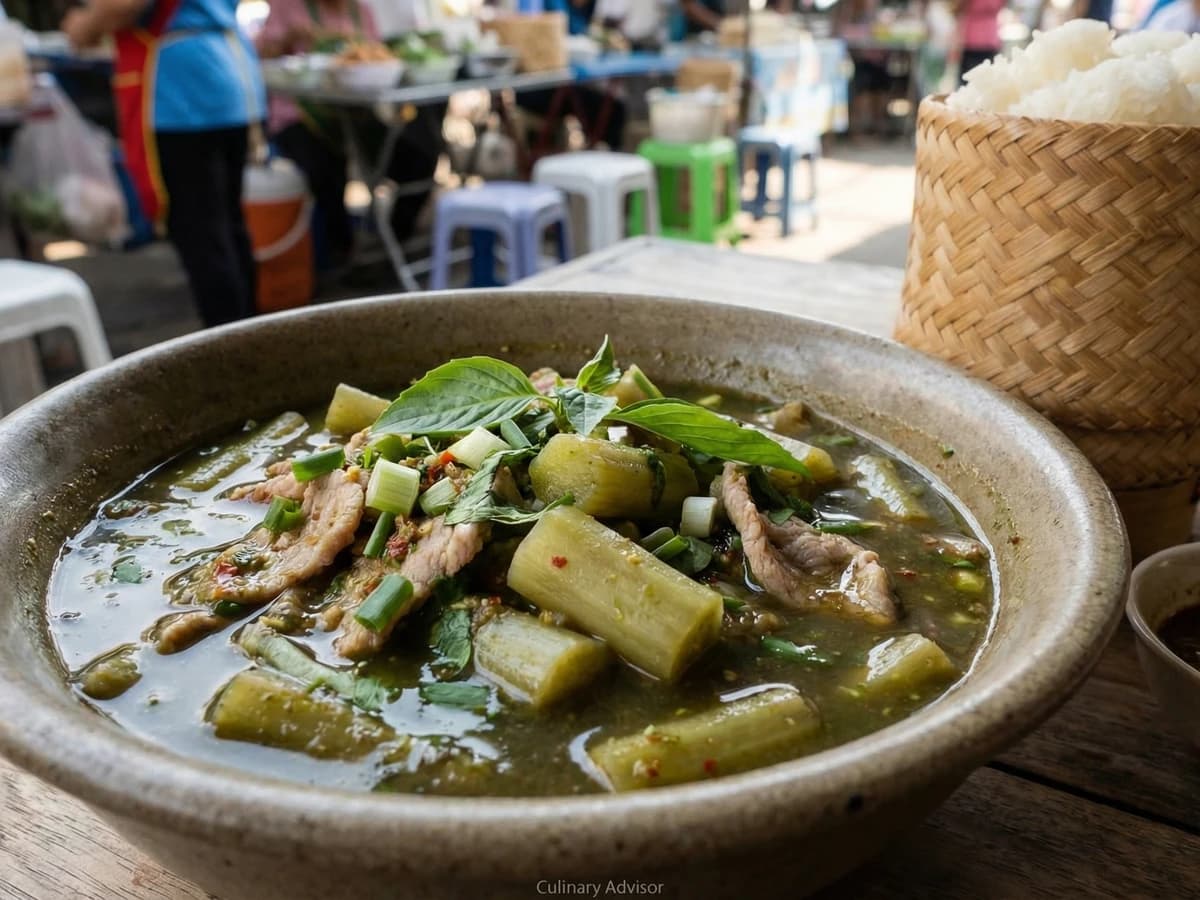
Isan foraging in a bowl: wild taro stems stripped of their sting, simmered in padaek broth with a pounded chili paste and yanang leaf extract. The land feeds you if you know the rules.

Chef Fai
Lanna's kreung tam breaks from Central Thai rules: ginger over galangal, cumin and coriander from Burmese spice routes, tamarind for sour instead of lime. The North has its own system, and this curry is its crown.