
Chef Fai
Southern Cucumber Relish (Ajad)
The one Thai condiment where vinegar replaces lime as the sour pillar, and the system still holds. Palm sugar for sweet, nam pla for salt, prik for heat. Ajad is the four pillars in a jar.
A cooking platform built around craft, culture, and the stories behind what we eat.

Created by
Three ingredients. Three days. Salt, water, and mustard greens become the sour backbone of the Northern Thai table. Fermentation is the oldest principle in the system, and the simplest one to learn.
Fermentation is the original sour. Before anyone squeezed a lime, before nam pla (fish sauce) ever dripped from a clay pot, there was salt and time. Phak kad dong is the proof. Three ingredients: mustard greens, salt, water. That's it. The simplicity isn't a limitation. It's the entire point.
Ajarn always said the four pillars define Thai cuisine: nam pla for salt, nam tan pip (palm sugar) for sweet, tropical acids for sour, prik (chili) for heat. But he also taught me that fermentation predates every one of those pillars as a flavoring technique. Lactic acid, the sourness that salt fermentation produces, is older than your grandmother's grandmother's kitchen. Phak kad dong connects you to that timeline. You're not making a condiment. You're practicing the oldest preservation science in Southeast Asian cooking.
At Fai Thai workshops, I use this pickle to teach patience. Everyone wants to learn the flashy stuff, the wok toss, the mortar work. But fermentation teaches you something no five-minute dish can: that time is an ingredient. Salt pulls water from the mustard greens through osmosis. Lactobacillus bacteria, already living on the leaves, start converting natural sugars into lactic acid. The brine goes cloudy. The greens turn from bright green to olive-gold. After three days in Chiang Mai's warm air, you have a pickle that cuts through the richness of khao soi, stands up beside nam prik noom (roasted green chili relish), and gives sticky rice something to sing against.
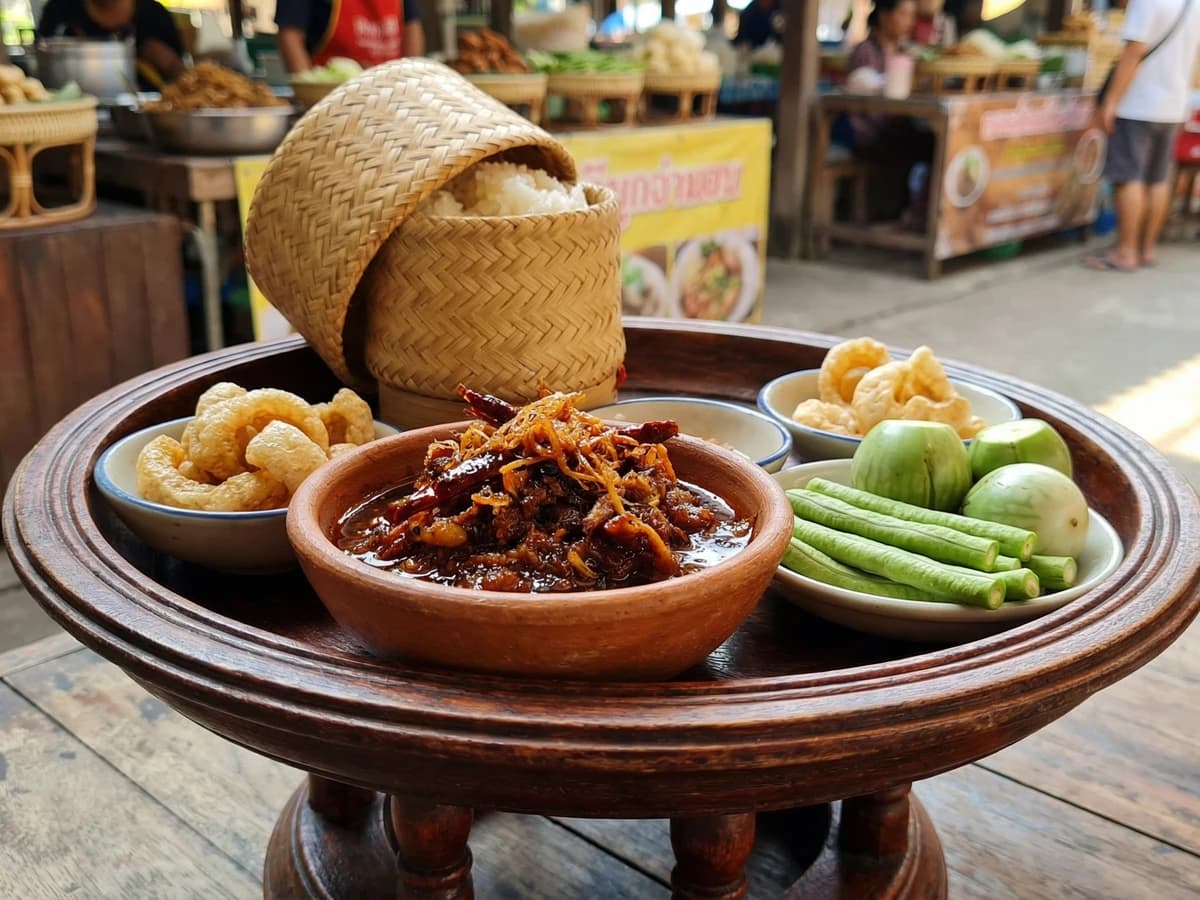
This is Lanna cooking at its most honest. No paste. No mortar. No fire. Just the discipline to let salt and bacteria do their work. On a khan tok (ขันโตก) tray, phak kad dong sits beside kab moo (pork rinds), beside nam prik, beside a basket of sticky rice. Every element does its job. The pickle's job is sourness and crunch. It does it perfectly.
Phak kad dong is a foundational Lanna (Northern Thai) condiment with roots in the broader lacto-fermentation traditions shared across mainland Southeast Asia, southern China, and the Shan States. Chinese mustard greens (Brassica juncea) thrive in Northern Thailand's cooler mountain climate, where temperatures drop enough for brassicas to grow well, unlike the hotter Central Plains. The pickle's omnipresence on the Northern Thai table, from khan tok trays to khao soi bowls to night bazaar stalls, reflects a preservation logic that predates refrigeration: salt fermentation kept vegetables edible through the hot season and provided a reliable source of sourness and probiotics year-round.
Quantity
500g
whole stalks with leaves, washed and trimmed
Quantity
2 tablespoons
Quantity
4 cups
room temperature
Quantity
1 teaspoon
| Ingredient | Quantity |
|---|---|
| Chinese mustard greens (phak kad)whole stalks with leaves, washed and trimmed | 500g |
| coarse sea salt or kosher salt (kluea) | 2 tablespoons |
| waterroom temperature | 4 cups |
| palm sugar (nam tan pip) (optional) | 1 teaspoon |
Wash the mustard greens thoroughly and shake off the excess water. Lay them out on a clean rack or tray in direct sunlight for 3 to 4 hours, turning once halfway through. You want them visibly wilted: the leaves should be soft and floppy, the stems pliable but not limp. This step is not optional. Sun-wilting reduces the water content in the greens so they stay crunchy after fermentation instead of turning to mush. If you skip this, you'll get soggy pickles. If you don't have strong sun, leave them in a well-ventilated spot overnight.
Dissolve the salt in the water, stirring until no granules remain. If you're using the palm sugar, dissolve it now too. The sugar isn't for flavor. It's food for the bacteria, a small boost to kickstart fermentation. The brine should taste noticeably salty, like seawater. If it doesn't taste salty enough, add another half teaspoon. Too little salt and harmful bacteria compete with the lactobacillus. Too much and the fermentation stalls. Two tablespoons per liter is the zone.
Cut the wilted greens into pieces that fit your jar, roughly 3 to 4 inches long. Pack them tightly into a clean glass jar or ceramic crock, pressing down firmly with your hand or a spoon to eliminate air pockets. The greens should be packed snug, not loose. Air is the enemy of clean fermentation. Pour the brine over the greens until they're completely submerged. Every piece must be under the liquid. Anything above the waterline will mold.
Place a weight on top of the greens to keep them submerged. A small plate, a zip-lock bag filled with brine, or a clean stone all work. Cover the jar loosely with a cloth, a loose lid, or plastic wrap with a few holes poked in it. The fermentation produces carbon dioxide and it needs to escape. A sealed jar will build pressure. Don't seal it tight.
Leave the jar at room temperature, out of direct sunlight. In a warm kitchen (28 to 35 degrees Celsius, which is normal for Chiang Mai), the fermentation takes 2 to 3 days. In a cooler climate, give it 4 to 5 days. You'll see small bubbles rising through the brine within 24 hours. That's the lactobacillus working. The brine will go cloudy. The greens will shift from bright green to olive-gold. After 2 days, taste a piece. It should be sour, tangy, with a pleasant funkiness and still crunchy. If it's not sour enough, give it another day. When the sourness hits the level you want, move the jar to the refrigerator to slow the fermentation. Trust your tongue. It'll tell you when it's ready.
1 serving (about 60g)
Culinary guides, cultural storytelling, and the editorial depth that makes cooking meaningful.
Discover Culinary ExplorerChef Fai
The one Thai condiment where vinegar replaces lime as the sour pillar, and the system still holds. Palm sugar for sweet, nam pla for salt, prik for heat. Ajad is the four pillars in a jar.

Chef Fai
Every grilled dish in Isan answers to this dip. Roasted dried chilies, nam pla, manao, khao khua, and shallots: the four pillars in a condiment that's structural, not optional.
Chef Fai
Roasted dried chilies and galangal pounded to a rough paste, folded with shredded pork skin and palm sugar until it becomes something sweet, smoky, and chewy that belongs on every khantoke tray in Chiang Mai.

Chef Fai
The kreung tam that proves the system adapts. Ginger instead of galangal, cumin and star anise alongside lemongrass. Lanna's mortar holds the whole Burma-to-Chiang Mai trade route in a single paste.