
Chef Fai
Southern Cucumber Relish (Ajad)
The one Thai condiment where vinegar replaces lime as the sour pillar, and the system still holds. Palm sugar for sweet, nam pla for salt, prik for heat. Ajad is the four pillars in a jar.
A cooking platform built around craft, culture, and the stories behind what we eat.
Created by
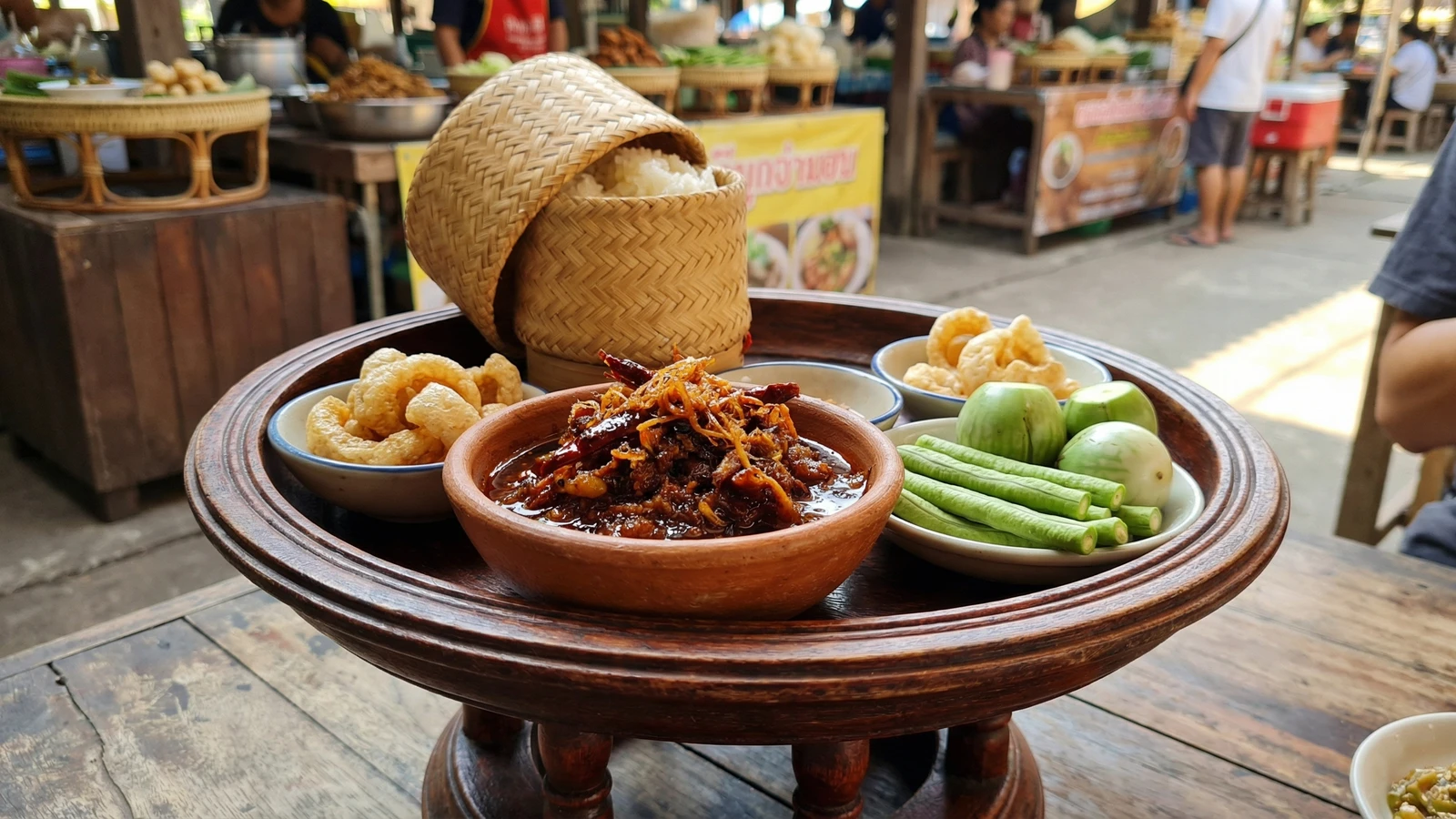
Roasted dried chilies and galangal pounded to a rough paste, folded with shredded pork skin and palm sugar until it becomes something sweet, smoky, and chewy that belongs on every khantoke tray in Chiang Mai.
Jaew bong is what happens when the kreung tam meets fire. Not wok fire. Charcoal fire. Every element of this paste, the dried chilies, the galangal, the garlic, the shallots, gets roasted until the surface blackens and the inside goes soft and smoky. Then you pound. That roasting step changes everything. Raw garlic is sharp and aggressive. Roasted garlic is sweet, mellow, deep. Raw galangal is piney and medicinal. Roasted galangal is warm and rounded. The fire does half the work before your mortar even touches it.
Ajarn always said the kreung tam is the foundation of Thai cooking. Jaew bong proves it from the Lanna side. This isn't a Central Thai nam prik. There's no shrimp paste here. There's no lime. The four pillars shift in the North: fish sauce still carries the salt, palm sugar brings a sweetness that's much more forward than you'd find in any Central Thai relish, and the roasted dried chilies (prik haeng) deliver heat that's smoky rather than sharp. Sour is absent entirely. This paste doesn't need it. The sweetness and smoke carry the balance.
What makes jaew bong unmistakable is the nang moo, pork skin boiled until tender then shredded into thin, chewy strips and folded into the paste. It sounds strange if you've never had it. It's genius once you do. The pork skin gives the relish body, chew, and a collagen richness that turns a dipping paste into something you eat by the spoonful with sticky rice. It's not a garnish. It's structural.
This is khantoke food. The low round tray with bowls of relish, curry, and vegetables arranged around a central basket of sticky rice. Jaew bong sits on that tray alongside nam prik num, nam prik ong, kab moo. In a Chiang Mai teak house during cool season, this is what dinner looks like. Simple, shared, mortar-pounded. The way Lanna families have eaten for longer than anyone can remember.
Jaew bong is a Lanna relish with deep roots shared between Northern Thailand and Laos, where the term 'jaew' (แจ่ว) denotes a category of pounded dipping pastes distinct from the Central Thai 'nam prik.' The inclusion of pork skin (nang moo) is characteristic of Lanna and Lao cuisines, where pork products are woven into relishes, sausages, and larb in ways uncommon in Central or Southern Thai cooking. The relish's pronounced sweetness from palm sugar and the absence of sour elements mark it as uniquely Northern, reflecting a regional palate that favors smoky-sweet combinations over the sour-salty-hot balance dominant in Central Thai cuisine.
Quantity
10
stems removed, seeds shaken out
Quantity
1 piece, about 3 inches
sliced into 1/4-inch rounds
Quantity
1 head (8-10 cloves)
unpeeled
Quantity
4
unpeeled
Quantity
200g
Quantity
3 tablespoons
shaved or chopped
Quantity
2 tablespoons
Quantity
3-4 tablespoons
Quantity
pinch
| Ingredient | Quantity |
|---|---|
| large dried red chilies (prik haeng)stems removed, seeds shaken out | 10 |
| galangal (kha)sliced into 1/4-inch rounds | 1 piece, about 3 inches |
| garlicunpeeled | 1 head (8-10 cloves) |
| shallots (hom daeng)unpeeled | 4 |
| pork skin (nang moo) | 200g |
| palm sugar (nam tan pip)shaved or chopped | 3 tablespoons |
| fish sauce (nam pla) | 2 tablespoons |
| pork skin cooking liquid or water | 3-4 tablespoons |
| salt | pinch |
Place the pork skin in a pot and cover with water. Bring to a boil, then reduce heat and simmer for 30-40 minutes until the skin is soft enough to cut with a spoon but still has chew. It shouldn't be falling apart. Drain, reserving about half a cup of the cooking liquid. Let the skin cool enough to handle, then slice it into very thin strips, about 1 inch long and as thin as you can manage. The thinner the strips, the better they integrate into the paste. Set aside.
While the pork skin simmers, set up your roasting. Charcoal is traditional and gives the best smoke. A gas flame works. A dry cast iron pan on high heat is your backup. Roast the dried chilies first: press them flat on the grill or pan and turn frequently until they darken two shades and become brittle, about 2-3 minutes. They go from fragrant to burnt in seconds, so watch them. Next, roast the unpeeled garlic cloves and shallots until the skins are charred black and the insides are completely soft, 8-10 minutes, turning occasionally. Roast the galangal slices until they're charred at the edges and softened, about 5-6 minutes. The kitchen should smell like a Chiang Mai cool-season bonfire. Peel the garlic and shallots once they're cool enough to handle.
Start with the roasted dried chilies in your granite mortar (krok hin). Pound them first because they're the driest and hardest ingredient. Break them down into rough flakes, not powder. You want texture. Add a pinch of salt as an abrasive to help the pounding. Next, add the roasted galangal and pound it into the chili. Galangal is fibrous even when roasted, so this takes effort. Keep pounding until the fibers break down and it integrates with the chili. Then the roasted garlic and shallots. These are soft and will meld quickly. Pound everything into a rough, coarse paste. Not smooth. Jaew bong has texture. You should still see distinct flecks of chili and strands of galangal fiber. The color should be deep brick red with dark flecks from the char.
Transfer the pounded paste to a small saucepan or wok over low heat. Add the palm sugar, fish sauce, and 3 tablespoons of the reserved pork skin cooking liquid. Stir until the palm sugar dissolves completely. The paste will loosen slightly and become glossy. Now fold in the shredded pork skin. Stir gently to distribute the strips evenly throughout the paste. Let it simmer on the lowest heat for 5-8 minutes, stirring occasionally. The paste will thicken as the sugar caramelizes slightly and the pork skin absorbs the flavors. It should be thick, sticky, and cohesive, not watery, not stiff.
Take it off the heat. Taste. The balance should be: sweet first (this is a notably sweet nam prik, that's correct, not a mistake), then smoky heat, then salt from the fish sauce. If it's not sweet enough, add more palm sugar. If the salt is weak, a splash more fish sauce. If the paste is too thick, a tablespoon more cooking liquid. Let it cool to room temperature before serving. Jaew bong is served at room temperature, never hot. Spoon it into a small bowl on the khantoke tray alongside sticky rice, raw vegetables, and kab moo. Eat with your hands: tear off a piece of sticky rice, press it into the jaew bong, get a strip of pork skin in the bite. That's how it's done.
1 serving (about 55g)
Culinary guides, cultural storytelling, and the editorial depth that makes cooking meaningful.
Discover Culinary ExplorerChef Fai
The one Thai condiment where vinegar replaces lime as the sour pillar, and the system still holds. Palm sugar for sweet, nam pla for salt, prik for heat. Ajad is the four pillars in a jar.

Chef Fai
Every grilled dish in Isan answers to this dip. Roasted dried chilies, nam pla, manao, khao khua, and shallots: the four pillars in a condiment that's structural, not optional.

Chef Fai
The kreung tam that proves the system adapts. Ginger instead of galangal, cumin and star anise alongside lemongrass. Lanna's mortar holds the whole Burma-to-Chiang Mai trade route in a single paste.
Chef Fai
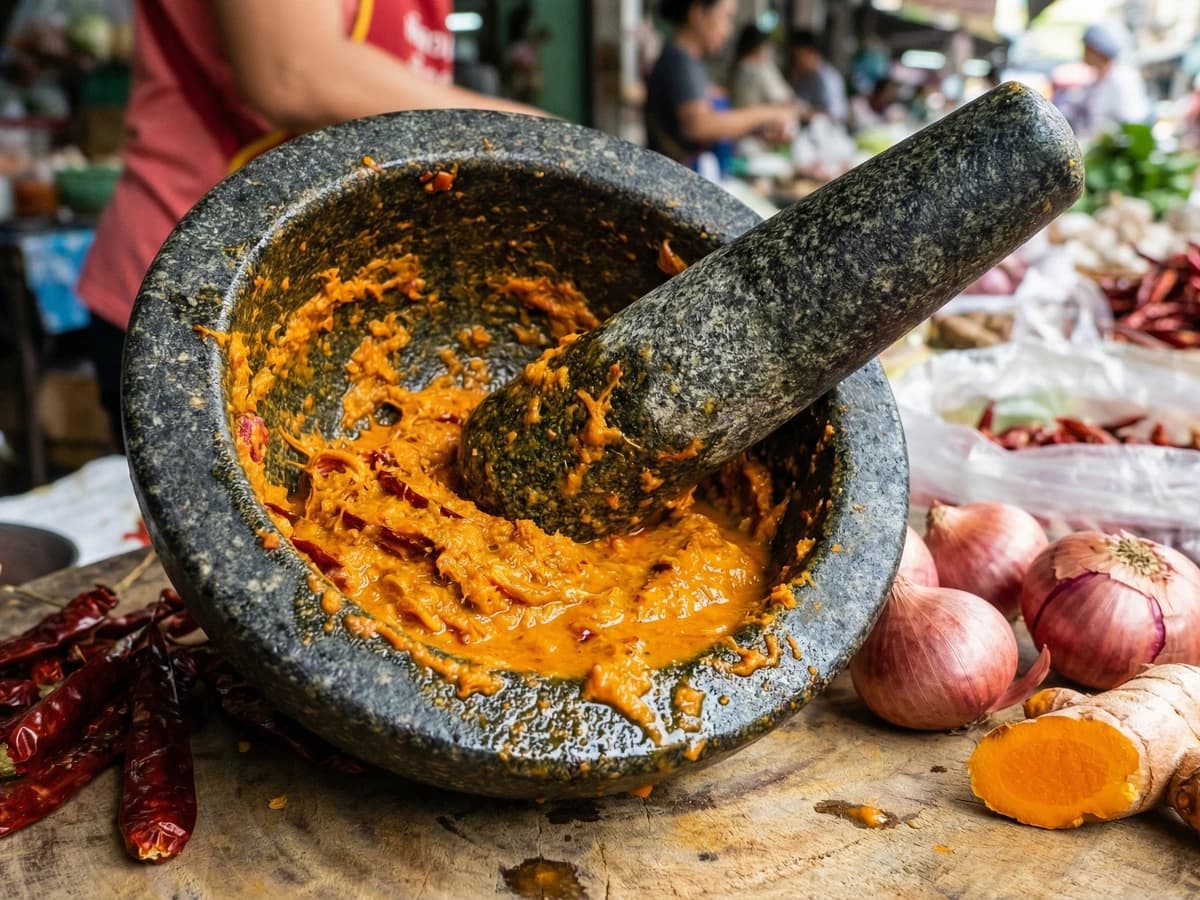
Four ingredients pounded clean in a granite mortar. This is the kreung tam stripped to its essence: dried chilies for heat, shallots for aromatics, turmeric for earth, kapi for depth. The foundation of Thailand's most underestimated curry.