
Chef Fai
Southern Cucumber Relish (Ajad)
The one Thai condiment where vinegar replaces lime as the sour pillar, and the system still holds. Palm sugar for sweet, nam pla for salt, prik for heat. Ajad is the four pillars in a jar.
A cooking platform built around craft, culture, and the stories behind what we eat.

Created by
Four ingredients pounded clean in a granite mortar. This is the kreung tam stripped to its essence: dried chilies for heat, shallots for aromatics, turmeric for earth, kapi for depth. The foundation of Thailand's most underestimated curry.
This is the kreung tam at its most honest. No long ingredient list. No exotic herbs. Just four ingredients in a mortar, pounded until they become something greater than their parts. Ajarn always said: "If you understand the kreung tam, you understand Thai food." He didn't mean green curry paste with its nine components. He meant this. The principle that a pounded paste of aromatics, chilies, and kapi creates a foundation you can build any curry on. Gaeng som paste is where you learn that lesson, because there's nowhere to hide. Four ingredients. If your technique is lazy, the paste tells on you immediately.
Here's what each ingredient does. The dried red chilies (prik haeng) provide heat, color, and body. The shallots (hom daeng) provide the aromatic sweetness that carries everything else. The fresh turmeric (kha min) gives that signature golden-orange hue and an earthy, slightly bitter depth. The fermented shrimp paste (kapi) delivers umami, the savory backbone that ties it together. Four ingredients, four jobs. No redundancy. No waste.
The paste itself is not sour. That's the part most people miss. The word "som" (ส้ม) means sour, but the sourness comes later: from tamarind pulp (makham piak) or from sour fruits and vegetables cooked in the curry. The paste provides the aromatic foundation. When you build gaeng som from this paste, you complete the four pillars. Chili heat from the paste. Nam pla for salt. Nam tan pip for sweet. Makham for sour. The system at work.
At my Fai Thai workshops, this is always the first paste I teach. Not green curry. Not red curry. Gaeng som. Because if you can pound four ingredients into a proper paste, you understand what the mortar does. You understand why the order matters, why salt goes in first as an abrasive, why the hardest ingredients get pounded before the soft ones. Master this, and every other kreung tam is just a longer version of the same principle. Krok ก่อน.
Gaeng som is one of the oldest curry styles in Central Thai cooking, predating the coconut-heavy curries influenced by Indian and Malay culinary traditions. The word "som" (ส้ม) originally meant any sour-tasting food in Thai, and the curry's reliance on tamarind and sour tropical fruits for acidity rather than coconut cream for body places it in a distinctly pre-trade-route lineage. Southern Thailand has its own version, sometimes called gaeng lueng (yellow curry), which uses fresh turmeric more aggressively and tends toward sharper, more intense heat; the Central Thai version taught here is the cleaner, more restrained paste that anchors Bangkok home cooking.
Quantity
15
deseeded and soaked in warm water for 15 minutes
Quantity
1/2 teaspoon
Quantity
30g (about one 2-inch piece)
peeled and sliced
Quantity
100g (about 7 small)
peeled and roughly sliced
Quantity
1 tablespoon
| Ingredient | Quantity |
|---|---|
| dried red spur chilies (prik haeng)deseeded and soaked in warm water for 15 minutes | 15 |
| fine sea salt | 1/2 teaspoon |
| fresh turmeric (kha min)peeled and sliced | 30g (about one 2-inch piece) |
| shallots (hom daeng)peeled and roughly sliced | 100g (about 7 small) |
| fermented shrimp paste (kapi) | 1 tablespoon |
Remove the stems from the dried red spur chilies and shake out the seeds. You don't need to get every last seed, but removing most of them keeps the heat controlled and the paste color clean. Soak the chilies in warm water for 15 minutes until they're pliable. Squeeze out the excess water before pounding. Waterlogged chilies make a watery paste. You want them soft, not soaked through.
Add the salt to the granite mortar first, then the drained chilies. The salt acts as an abrasive, grinding against the chili flesh and breaking down the fibers. This is the hardest ingredient in the paste, so it goes in first. Pound with firm, steady strikes. Rotate the pestle as you go. You're not smashing. You're grinding. The chilies should break down into rough, fibrous strands first, then gradually become a thick, slightly chunky paste. This takes 3-4 minutes of steady pounding. Your arm will know.
Add the sliced fresh turmeric to the mortar. Pound it into the chili paste. Turmeric is fibrous, almost woody, so it needs real force. Work it until the bright yellow-orange color bleeds completely into the chili base and no white fibers remain visible. The paste should shift from dark red to a warm, vivid orange. Another 2 minutes of focused work. Your fingers will be stained yellow for the rest of the day. That's turmeric doing its job.
Add the sliced shallots to the mortar. They're softer than everything that came before, so they'll break down faster. Pound and scrape. Use a spoon to fold the mixture back toward the center after each strike. The shallots release moisture as they crush, which helps bind the paste together. You want them fully incorporated: no visible chunks, just a smooth aromatic base carrying the chili and turmeric. The paste should be getting wetter and more cohesive now. Another 3-4 minutes of pounding and scraping down the sides.
Add the kapi last. It's the softest ingredient and the most potent. Pound it into the paste until everything is homogeneous, about 1 minute. The kapi should disappear into the mixture completely, leaving behind its deep, funky umami but no visible lumps. The finished paste should be smooth, slightly wet, vivid orange, and should hit your nose immediately: pungent shrimp, earthy turmeric, chili heat all layered together. Scrape it out of the mortar with a spoon. That's your kreung gaeng som. The kreung tam is everything. Done.
1 serving (about 50g)
Culinary guides, cultural storytelling, and the editorial depth that makes cooking meaningful.
Discover Culinary ExplorerChef Fai
The one Thai condiment where vinegar replaces lime as the sour pillar, and the system still holds. Palm sugar for sweet, nam pla for salt, prik for heat. Ajad is the four pillars in a jar.

Chef Fai
Every grilled dish in Isan answers to this dip. Roasted dried chilies, nam pla, manao, khao khua, and shallots: the four pillars in a condiment that's structural, not optional.
Chef Fai
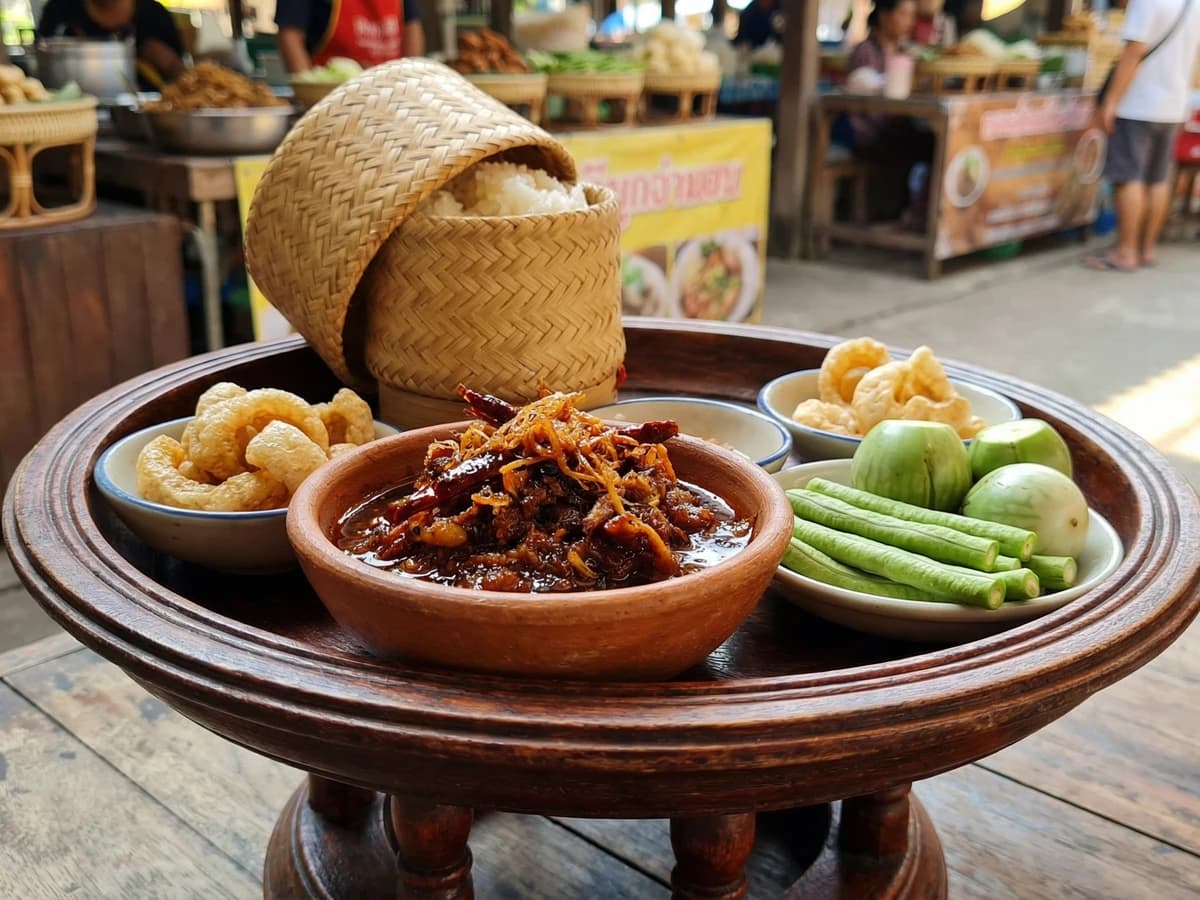
Roasted dried chilies and galangal pounded to a rough paste, folded with shredded pork skin and palm sugar until it becomes something sweet, smoky, and chewy that belongs on every khantoke tray in Chiang Mai.

Chef Fai
The kreung tam that proves the system adapts. Ginger instead of galangal, cumin and star anise alongside lemongrass. Lanna's mortar holds the whole Burma-to-Chiang Mai trade route in a single paste.