
Chef Graziella
Castagnaccio Toscano
The austere chestnut cake of the Tuscan mountains, where poverty created genius and a single flour, water, and olive oil became something extraordinary without a grain of sugar.
A cooking platform built around craft, culture, and the stories behind what we eat.
Created by
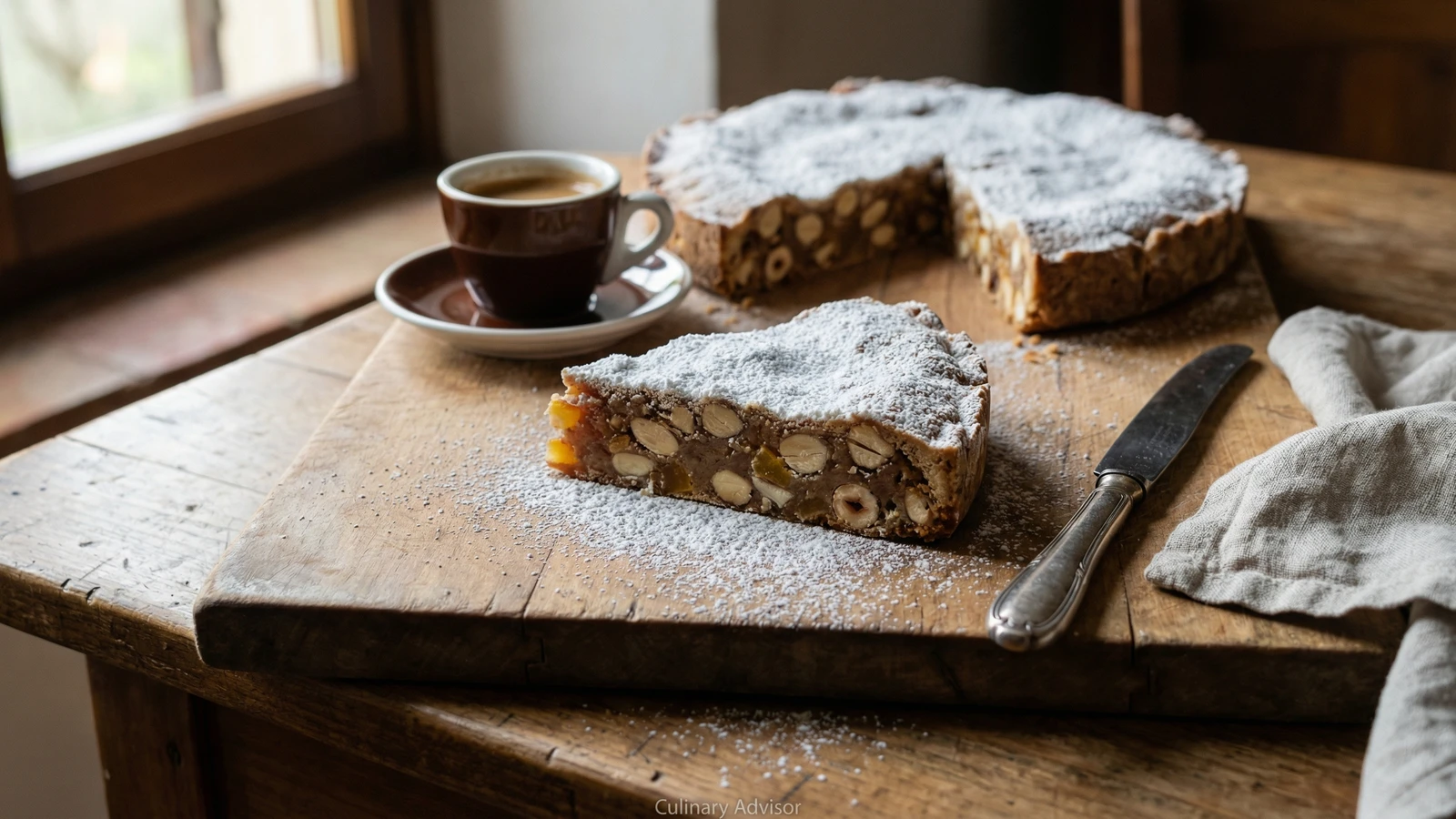
The medieval spiced confection of Siena, where almonds, hazelnuts, candied citrus, and honey become something that lasts for months and improves with age. This is not a cake. This is edible history.
Panforte is not a cake, and calling it one betrays a fundamental misunderstanding. It is a confection, a dense slab of nuts and candied fruit bound together with honey and dusted with spice. It has the texture of the best nougat and the shelf life of fruitcake without any of fruitcake's sins. The Sienese have made it the same way since the Middle Ages, and they were right the first time.
The name means 'strong bread,' which tells you nothing useful about what it actually is. The strength comes from the spices, not from any bread-like quality. Cinnamon dominates, supported by coriander, cloves, nutmeg, and white pepper. This is the spice trade of medieval Italy preserved in confectionery form. When you bite into panforte, you taste what wealthy Sienese merchants tasted seven hundred years ago.
What you keep out matters here as much as anywhere. There is no butter, no eggs, no leavening. The flour exists only to bind, not to provide structure. The honey and sugar do the work, cooked to the soft-ball stage and then folded with the nuts and fruit. If your candied peel is cheap and bitter, everyone will know. If your nuts are stale, there is nowhere to hide.
Panforte emerged from the apothecary shops of medieval Siena, where spices were sold as medicine and combined with local honey and nuts. The earliest written recipe dates to 1205, making this one of Italy's oldest surviving confections. In 1879, a version dusted white with confectioners' sugar was created to honor the visit of Queen Margherita, and that 'Panforte Margherita' became the standard we know today.
Quantity
1 cup (about 5 ounces)
Quantity
1 cup (about 5 ounces)
Quantity
1 cup (about 6 ounces)
diced
Quantity
1/2 cup (about 3 ounces)
diced
Quantity
1/2 cup
Quantity
2 tablespoons
Quantity
1 teaspoon
Quantity
1/2 teaspoon
Quantity
1/4 teaspoon
Quantity
1/4 teaspoon
freshly grated
Quantity
1/4 teaspoon
Quantity
3/4 cup
Quantity
3/4 cup
Quantity
2 tablespoons
Quantity
for dusting
Quantity
for lining pan
| Ingredient | Quantity |
|---|---|
| whole blanched almonds | 1 cup (about 5 ounces) |
| whole hazelnuts | 1 cup (about 5 ounces) |
| candied orange peeldiced | 1 cup (about 6 ounces) |
| candied citrondiced | 1/2 cup (about 3 ounces) |
| all-purpose flour | 1/2 cup |
| unsweetened cocoa powder | 2 tablespoons |
| ground cinnamon | 1 teaspoon |
| ground coriander | 1/2 teaspoon |
| ground cloves | 1/4 teaspoon |
| nutmegfreshly grated | 1/4 teaspoon |
| ground white pepper | 1/4 teaspoon |
| honey | 3/4 cup |
| granulated sugar | 3/4 cup |
| unsalted butter | 2 tablespoons |
| confectioners' sugar | for dusting |
| edible rice paper (optional) | for lining pan |
Line the bottom of a 9-inch springform pan with edible rice paper, or butter it thoroughly and dust with flour, tapping out the excess. Preheat your oven to 300 degrees Fahrenheit. This low temperature is essential. Panforte must dry more than bake.
Spread the almonds on one baking sheet and the hazelnuts on another. Toast in the oven until fragrant and golden, about 10 to 12 minutes for the almonds and 12 to 15 minutes for the hazelnuts. The hazelnuts should slip easily from their skins when rubbed in a clean kitchen towel. Rub them while still warm to remove most of the skins. Let all nuts cool, then chop them coarsely. You want visible pieces, not crumbs.
In a large bowl, combine the chopped almonds, hazelnuts, candied orange peel, and candied citron. In a separate small bowl, whisk together the flour, cocoa powder, cinnamon, coriander, cloves, nutmeg, and white pepper. Add the spiced flour to the nuts and fruit and toss thoroughly to coat every piece.
In a heavy saucepan, combine the honey, sugar, and butter. Set over medium heat and stir until the sugar dissolves completely. Attach a candy thermometer to the side of the pan. Stop stirring. Let the syrup cook undisturbed until it reaches 244 degrees Fahrenheit, the soft-ball stage. This takes 8 to 10 minutes. Watch it carefully toward the end. The temperature rises quickly once it nears the target.
Working quickly, pour the hot syrup over the nut and fruit mixture. Stir vigorously with a wooden spoon until everything is thoroughly combined and glistening. The mixture will be very sticky and stiff. Scrape it into the prepared pan. Wet your hands with cold water and press the mixture firmly and evenly into the pan. The surface should be level and compact. Work fast. The mixture becomes unmanageable as it cools.
Bake at 300 degrees Fahrenheit for 30 to 35 minutes. The panforte will not look different, but it will feel slightly firm when pressed gently in the center. Do not expect browning or rising. It should remain dense and flat. If the edges darken before the center sets, tent loosely with foil.
Let the panforte cool completely in the pan on a wire rack. This takes at least two hours. Do not rush it. When completely cool, remove the springform ring. Dust the top generously with confectioners' sugar, pressing it gently into the surface. The white coating is traditional and helps prevent sticking when sliced.
Use a sharp knife dipped in hot water to cut the panforte into thin wedges. This is a confection, not a dessert course. Small pieces are correct. Serve with espresso or vin santo at the end of a meal, or wrap pieces in parchment and give them as gifts. Panforte improves for at least a month and keeps for several more, tightly wrapped at room temperature.
1 serving (about 42g)
Culinary guides, cultural storytelling, and the editorial depth that makes cooking meaningful.
Discover Culinary ExplorerChef Graziella
The austere chestnut cake of the Tuscan mountains, where poverty created genius and a single flour, water, and olive oil became something extraordinary without a grain of sugar.

Chef Juliette
Five almond preparations, one discipline: remove the skins cleanly, dry every kernel through, then cut, toast, or cloak it in pale caramel without letting its fragrant oils escape.

Chef Juliette
A pastry pantry lesson in one tray: filberts warmed only until their red skins release, rubbed clean, cooled, and chopped into a fragrant mise-en-place for cakes, creams, pralines, and petits fours.

Chef Juliette
The smallest pâtisserie discipline decides whether a cake leaves its mould intact: clarified butter in every corner, followed by the lightest veil of dry flour or fécule.