
Chef Lupita
Acambaritas de Acámbaro
Guanajuato's daily bread from Acámbaro, a small glazed roll built on pata, enriched with manteca de cerdo, and baked until the top shines lightly for merienda.
A cooking platform built around craft, culture, and the stories behind what we eat.

Created by
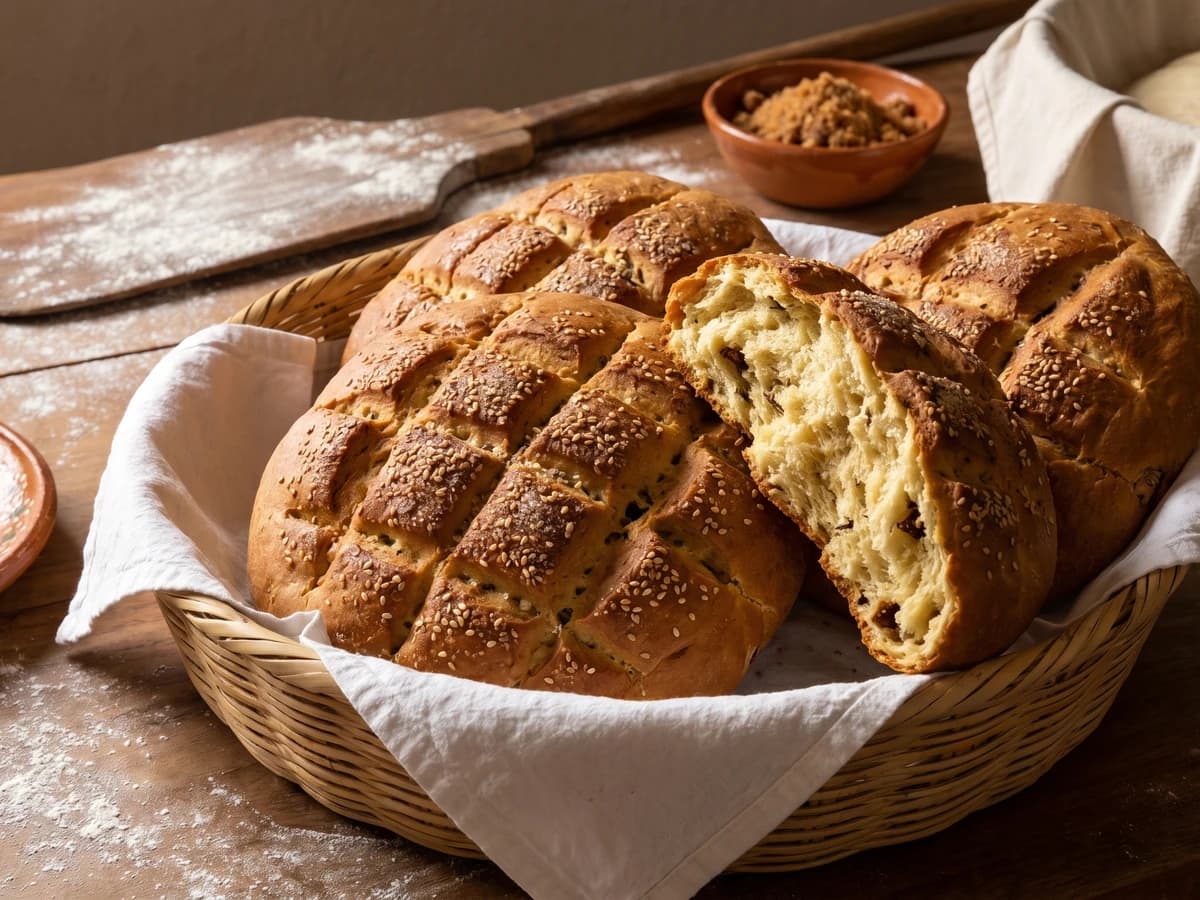
Tijuana's twisted crusty roll, kneaded with manteca and a splash of lime, baked dark and hollow-sounding. The bread that holds a carne asada torta without surrendering to the juices.
This is from Baja California. Tijuana, specifically. The pan torcido is the roll that sits in the basket at every torta stand from Avenida Revolucion to the colonias on the city's east side, and it is the bread that holds a carne asada torta together when a softer roll would dissolve under the juices.
The shape is older than the city. The torcido descends from the cocolli, a pre-Hispanic twisted bread documented in central Mexico before the conquest, and the form survived in the north where wheat country gave it new life. Baja is wheat country, not corn country. The flour mills of the Mexicali valley and the wheat fields of the Valle de Guadalupe have fed the panaderias of the Noroeste for over a century, and the torcido is what those bakers shape every morning before sunrise.
The technique is not complicated but it is specific. Manteca de cerdo, not butter and not vegetable shortening. La manteca es el sabor and it gives the crumb that slightly waxy density that holds up to a wet filling. A splash of lime juice for the gluten and the faint sour edge that distinguishes a true torcido from a regular bolillo. Piloncillo, not refined sugar, for the touch of caramel in the background. And the twist itself, the move that gives the roll its name, two ends rolled in opposite directions and folded together so the dough braids itself.
My mother did not bake torcidos. She was from Jalisco and her bread instincts went toward bolillo and pan dulce. I learned this one from a panadero in Colonia Cacho in Tijuana, a man named Don Lalo who shaped six hundred torcidos every morning by hand and who told me the only thing that matters is the twist. Get the twist right and the rest follows. Cada estado, su propia cocina.
The pan torcido descends from the cocolli, a pre-Hispanic twisted wheat bread that emerged in central Mexico after the introduction of wheat by the Spanish in the 1520s and that retained an indigenous shaping technique echoing pre-conquest corn-dough forms. The Noroeste, particularly Baja California and Sonora, became Mexico's wheat belt in the 19th century, and the torcido entrenched itself as the regional everyday bread, the northern counterpart to the bolillo of the central plateau. Tijuana's specific torcido, denser and slightly sour, evolved in the early 20th century alongside the rise of the carne asada torta as the city's defining street food, a co-evolution where the bread was engineered to hold up to the grilled meat and its juices without collapsing.
Quantity
500 grams (about 4 cups)
plus more for dusting
Quantity
10 grams (about 2 teaspoons)
Quantity
7 grams (one packet, about 2 1/4 teaspoons)
Quantity
15 grams (about 1 tablespoon)
grated, or substitute turbinado sugar
Quantity
30 grams (about 2 tablespoons)
softened
Quantity
1 tablespoon
Quantity
320 grams (about 1 1/3 cups)
around 95F
Quantity
as needed
for greasing the bowl and pans
Quantity
for dusting the baking sheet
| Ingredient | Quantity |
|---|---|
| bread flourplus more for dusting | 500 grams (about 4 cups) |
| kosher salt | 10 grams (about 2 teaspoons) |
| instant yeast | 7 grams (one packet, about 2 1/4 teaspoons) |
| piloncillograted, or substitute turbinado sugar | 15 grams (about 1 tablespoon) |
| manteca de cerdosoftened | 30 grams (about 2 tablespoons) |
| fresh lime juice | 1 tablespoon |
| warm wateraround 95F | 320 grams (about 1 1/3 cups) |
| additional manteca de cerdofor greasing the bowl and pans | as needed |
| rice flour or semolina | for dusting the baking sheet |
In a large mixing bowl, combine the warm water, grated piloncillo, and yeast. Stir until the piloncillo dissolves. Let it sit for ten minutes. You want to see a soft foam form on the surface. If nothing happens, your yeast is dead. Buy new yeast. No me vengas con atajos.
Add the bread flour, kosher salt, softened manteca de cerdo, and the lime juice to the yeast mixture. The lime juice is not for flavor. It is for the sour edge the tijuanenses expect in a torcido, and it strengthens the gluten. Stir with a wooden spoon until a shaggy mass forms, then turn it onto a clean counter.
Knead the dough by hand for ten to twelve minutes. Push, fold, turn, repeat. The dough will start sticky and finish smooth, elastic, and slightly tacky. When you pull a small piece and stretch it between your fingers, it should form a thin window without tearing. That is the gluten. That is what gives the torcido its chewy, dense crumb. A stand mixer with a dough hook works in eight minutes at medium-low speed if your hands are tired, but the hand kneader always feels the dough better.
Grease a clean bowl with a thin film of manteca. Roll the dough in the bowl so it is lightly coated, then cover with a damp cloth. Let it rise in a warm corner of the kitchen for about ninety minutes, until doubled. In a cold kitchen, this takes longer. In Tijuana in August, faster. The dough tells you when it is ready, not the clock.
Punch the dough down gently to release the gas. Turn it onto a lightly floured counter and divide into twelve equal pieces of about seventy grams each. Use a scale. Even pieces bake evenly. Round each piece into a tight ball by cupping your hand over it and dragging it in small circles against the counter. Cover the balls with a cloth and let them rest for fifteen minutes. The gluten needs to relax before you shape, otherwise the dough fights you.
Take one rested ball and roll it under your palms into a rope about twenty-five centimeters long, tapered slightly at the ends. Lift the rope by both ends and twist them in opposite directions, the right hand rolling toward you, the left hand away. Then fold the twisted rope in half so the two ends meet and pinch them together. The rope will coil itself into the signature torcido shape, a thick twisted braid with two pointed ends. This is the form. The twist is not decoration. It creates the crevices that crisp in the oven and the dense interior that holds carne asada juices without falling apart.
Place the shaped torcidos on a baking sheet lined with parchment and dusted with rice flour or semolina, leaving four centimeters between each one. Cover loosely with a cloth and let them rise for forty-five minutes to an hour. They should look puffed but not doubled. Press a floured finger gently against one. The dent should slowly spring back halfway. That is the proof you are looking for.
Thirty minutes before baking, place a heavy cast iron skillet or sheet pan on the bottom rack of the oven. Heat the oven to 230C (450F). The skillet must be screaming hot when the bread goes in. You will pour water into it to create steam, which is what gives the torcido its crackling crust.
Slide the baking sheet of torcidos onto the middle rack. Immediately pour one cup of hot water into the preheated skillet on the bottom rack and shut the oven door fast. Bake for twenty to twenty-five minutes, until the rolls are deep golden, almost mahogany at the ridges of the twist, and they sound hollow when you tap the bottom. Do not open the oven for the first fifteen minutes. The steam is doing the work.
Transfer the torcidos to a wire rack and let them cool for at least twenty minutes before slicing. A hot torcido is a gummy torcido on the inside. The crumb needs to set. When they are cool enough to handle but still warm, split one lengthwise. The interior should be cream-colored, dense but airy, with the slight sour edge that tells you the lime did its job. Asi se hace y punto.
1 serving (about 65g)
Culinary guides, cultural storytelling, and the editorial depth that makes cooking meaningful.
Discover Culinary ExplorerChef Lupita
Guanajuato's daily bread from Acámbaro, a small glazed roll built on pata, enriched with manteca de cerdo, and baked until the top shines lightly for merienda.

Chef Lupita
Michoacan's Tinguindin aguacatas are flat, leaf-scored sweet breads made with harina de trigo, piloncillo, anise, and manteca de cerdo, shaped by hand for the wood oven.
Chef Lupita
From Ajijic on Lake Chapala, Pan Tachihual is a lightly sweet wedding loaf built with harina de trigo, harina de maiz, piloncillo, manteca, anise, and the old Guadalajara pata.

Chef Lupita
Comitán's pan de yema shaped into little pigs, birds, and rabbits, a Chiapas bakery bread rich with egg yolks, manteca de cerdo, and anís, baked golden on hoja de plátano.