
Chef Lupita
Acambaritas de Acámbaro
Guanajuato's daily bread from Acámbaro, a small glazed roll built on pata, enriched with manteca de cerdo, and baked until the top shines lightly for merienda.
A cooking platform built around craft, culture, and the stories behind what we eat.

Created by
Oaxaca's Day of the Dead bread. Egg-yolk dough leavened with pulque, perfumed with toasted anise, and crowned with a cabecita, a small painted dough head that represents the soul returning to eat.
This is from Oaxaca. Not Mexico City. The pan de muerto you see in supermarkets, round, sugar-dusted, with crossed bone shapes on top, is the Mexico City version. It is a different bread. The Oaxacan pan de muerto is pan de yema, an egg-yolk bread that the panaderías of the Valles Centrales bake all year, dressed up in late October with a painted cabecita, a small dough head, that represents the soul who is coming home for Día de Muertos. Two breads, two states, two traditions. Cada estado, su propia cocina.
The dough takes pulque. Not yeast, pulque. The fermented agave is the leavener and it has been the leavener of Oaxacan pan de yema since long before commercial yeast existed in Mexico. Pulque gives the bread its tang, its slow rise, its character. If your pulque vendor only carries the canned stuff, find a different vendor. The wild yeasts in fresh pulque from the pulquería are what you are after. The eight egg yolks and the manteca de cerdo carry the flavor the pulque builds. La manteca es el sabor.
The cabecita is the part most people outside Oaxaca have never seen. The panaderas at Mercado Alarii in Zaachila and the Sánchez family in Miahuatlán shape the little heads two days before they bake, dry them out on a cloth in the open air, then paint them red with grana de cochinilla and dark with añil. The face goes onto the bread before it bakes. When the bread comes out of the oven, the painted face has set hard, and the bread is placed on the ofrenda with a jícara of chocolate de agua. My mother was from Jalisco and she did not bake pan de muerto, but I learned this one in a wood-fired bakery in Tlacolula from a woman named Doña Esperanza who had been making them for fifty-three years. She told me: 'El cabecita es el alma. Trátalo como tal.' The little head is the soul. Treat it as such. Saber cocinar es saber vivir.
Pan de yema, the egg-yolk bread that forms the base of Oaxacan pan de muerto, descends from the Spanish panadería tradition introduced after the 16th-century conquest, but its leavening with pulque rather than commercial yeast is an indigenous adaptation: pulque, the fermented sap of the maguey, was already a sacred drink in pre-Columbian Mesoamerica and its wild yeasts naturally suited bread fermentation. The cabecita figure, distinct to the Valles Centrales of Oaxaca and especially associated with the towns of Mitla, Tlacolula, Zaachila, and Miahuatlán, evolved from the broader Mesoamerican tradition of crafting anthropomorphic offerings for the dead, and its painted face uses the same grana de cochinilla red that Oaxacan weavers in Teotitlán del Valle have used to dye wool for over five hundred years. The dish is sometimes confused with the bone-shaped pan de muerto of central Mexico, but the two are independent regional traditions that converged only in the national Día de Muertos imagination of the 20th century.
Quantity
1 1/4 cups
at room temperature, the leavener of the dough; if truly impossible to source, substitute 1 1/4 cups whole milk warmed to 100F with 2 1/4 teaspoons active dry yeast
Quantity
1/2 cup
Quantity
5 cups, plus more for kneading
Quantity
3/4 cup
Quantity
1 1/2 teaspoons
Quantity
1 tablespoon
lightly toasted on a comal until fragrant
Quantity
1 teaspoon
freshly grated
Quantity
8 large
at room temperature
Quantity
2 large
at room temperature
Quantity
3/4 cup
softened to the consistency of a paste
Quantity
1/4 cup
softened
Quantity
1/4 cup
raw, for pressing into the cabecita
Quantity
1 yolk + 1 tablespoon water
beaten until smooth
Quantity
1/2 cup dissolved in 2 tablespoons water
for painting the cabecita red; beet powder is the domestic substitute
Quantity
2 tablespoons
for the eyes and mouth of the cabecita; unsweetened cocoa with water is the substitute
| Ingredient | Quantity |
|---|---|
| pulque frescoat room temperature, the leavener of the dough; if truly impossible to source, substitute 1 1/4 cups whole milk warmed to 100F with 2 1/4 teaspoons active dry yeast | 1 1/4 cups |
| all-purpose flour (for the sponge) | 1/2 cup |
| all-purpose flour | 5 cups, plus more for kneading |
| granulated sugar | 3/4 cup |
| fine sea salt | 1 1/2 teaspoons |
| anís en grano (whole anise seed)lightly toasted on a comal until fragrant | 1 tablespoon |
| orange zestfreshly grated | 1 teaspoon |
| egg yolksat room temperature | 8 large |
| whole eggsat room temperature | 2 large |
| manteca de cerdo (pork lard)softened to the consistency of a paste | 3/4 cup |
| unsalted buttersoftened | 1/4 cup |
| ajonjolí (sesame seeds)raw, for pressing into the cabecita | 1/4 cup |
| egg washbeaten until smooth | 1 yolk + 1 tablespoon water |
| grana de cochinilla powder dissolved in waterfor painting the cabecita red; beet powder is the domestic substitute | 1/2 cup dissolved in 2 tablespoons water |
| añil (indigo) or huitlacoche-based dark dyefor the eyes and mouth of the cabecita; unsweetened cocoa with water is the substitute | 2 tablespoons |
Two days before you bake, you make the cabecitas. Not the morning of. Not the night before. Two days. Mix 1 cup of the flour, 2 tablespoons of the sugar, 1 egg yolk, 2 tablespoons of the lard, and enough water to bring it together into a stiff, dry dough. Pinch off pieces the size of a walnut and shape each one into a small head: round skull, pinched nose, two thumbprint eye sockets, a slit for the mouth. Set them on a clean cloth on a tray and leave them, uncovered, in a dry corner of the kitchen for two days. They will harden and dry. This is the panadera tradition from Mitla and Zaachila and Tlacolula. The cabecita has to be dry going onto the bread, otherwise it cracks in the oven and the soul cracks with it.
In a wide bowl, whisk the pulque fresco with the 1/2 cup of flour for the sponge until smooth. Cover with a cloth and leave it on the counter for 4 to 6 hours, until it foams, doubles, and smells sour and bright. Pulque is the leavener. It is not a substitute for yeast, it is the leavener. The wild yeasts in pulque give pan de yema a tang and a slow, deep rise that commercial yeast cannot replicate. If you truly cannot find pulque, the milk-and-yeast substitute will give you bread, but it will not give you Oaxacan pan de yema.
Heat a dry comal over medium-low. Toast the anise seeds for about a minute, shaking the pan, until they turn fragrant. Do not let them brown. Crush them lightly in a molcajete to wake the oils. In a large bowl, combine the 5 cups of flour, sugar, salt, toasted anise, and orange zest. Whisk to distribute everything evenly.
Make a well in the dry ingredients. Pour in the foamy pulque sponge, then add the 8 egg yolks and the 2 whole eggs. Mix with your hands or with a wooden spoon until a shaggy dough forms. Now add the softened manteca and butter in pieces. Work them in slowly. The dough will look broken and greasy at first. Keep going. After about ten minutes of kneading, the lard surrenders and the dough turns golden, soft, and elastic. This is pan de yema. The yolks and the manteca together are what give it that yellow crumb and that tender, slightly cakey bite that does not exist in any other Mexican bread.
Turn the dough onto a lightly floured wooden surface. Knead for 12 to 15 minutes. Push it away from you with the heel of your hand, fold it back, turn a quarter, repeat. The dough is enriched and slack: it will fight you. Resist the urge to add more flour. Too much flour and your bread is dry. The dough is ready when it pulls away from the table cleanly and a small piece stretched between your fingers turns translucent without tearing.
Place the dough in a clean, lightly greased bowl, cover with a cotton servilleta, and leave to rise in a warm corner of the kitchen for 3 to 4 hours, until doubled. Pulque is slower than commercial yeast. Do not rush it. The slow rise is what builds the flavor. La cocina no es decoracion, es trabajo.
Punch the dough down gently and divide into 8 equal pieces. Roll each piece into a smooth, taut ball, tucking the seam underneath. Set the balls on parchment-lined baking sheets, four per sheet, leaving space between them. With your fingertips, press a small dimple into the top of each ball, deep enough to seat the cabecita firmly when the time comes.
Cover the shaped panes loosely with a cotton cloth and let them rise for 2 hours, until they have grown by half and feel pillowy when you press a finger gently against the side. The dough should spring back slowly, leaving a faint mark.
While the panes finish rising, paint the dried cabecitas. The face is painted red with grana de cochinilla, the cochineal red that Oaxaca has dyed wool and bread with for centuries. Use a small brush. Paint the whole face red. Then paint the eye sockets and the mouth dark with the añil or cocoa wash. Press a few sesame seeds into the crown of the head. The cabecita is the returning soul, dressed for the ofrenda. Recetas probadas y garantizadas, but only if you treat the cabecita with the respect it is owed.
Heat the oven to 350F. Brush each pan gently with the egg wash. Press a painted cabecita into the dimple at the top of each pan, seating it firmly so it does not slide off as the bread rises. Bake for 28 to 35 minutes, rotating the trays halfway through, until the panes are deeply golden and the bottoms sound hollow when tapped. The cabecitas will set hard and the painted face will hold its color through the heat. If the tops are browning too fast, tent loosely with foil for the last ten minutes.
Cool the panes on a wire rack for at least 30 minutes before you touch them. Pan de yema oaxaqueño is an everyday bread in Oaxaca: pan de muerto is its November dress. Place them on the ofrenda with a jícara of chocolate de agua, the way it is done in Mitla and Tlacolula. The bread feeds the living and signals the dead. Asi se hace y punto.
1 serving (about 210g)
Culinary guides, cultural storytelling, and the editorial depth that makes cooking meaningful.
Discover Culinary ExplorerChef Lupita
Guanajuato's daily bread from Acámbaro, a small glazed roll built on pata, enriched with manteca de cerdo, and baked until the top shines lightly for merienda.

Chef Lupita
Michoacan's Tinguindin aguacatas are flat, leaf-scored sweet breads made with harina de trigo, piloncillo, anise, and manteca de cerdo, shaped by hand for the wood oven.
Chef Lupita
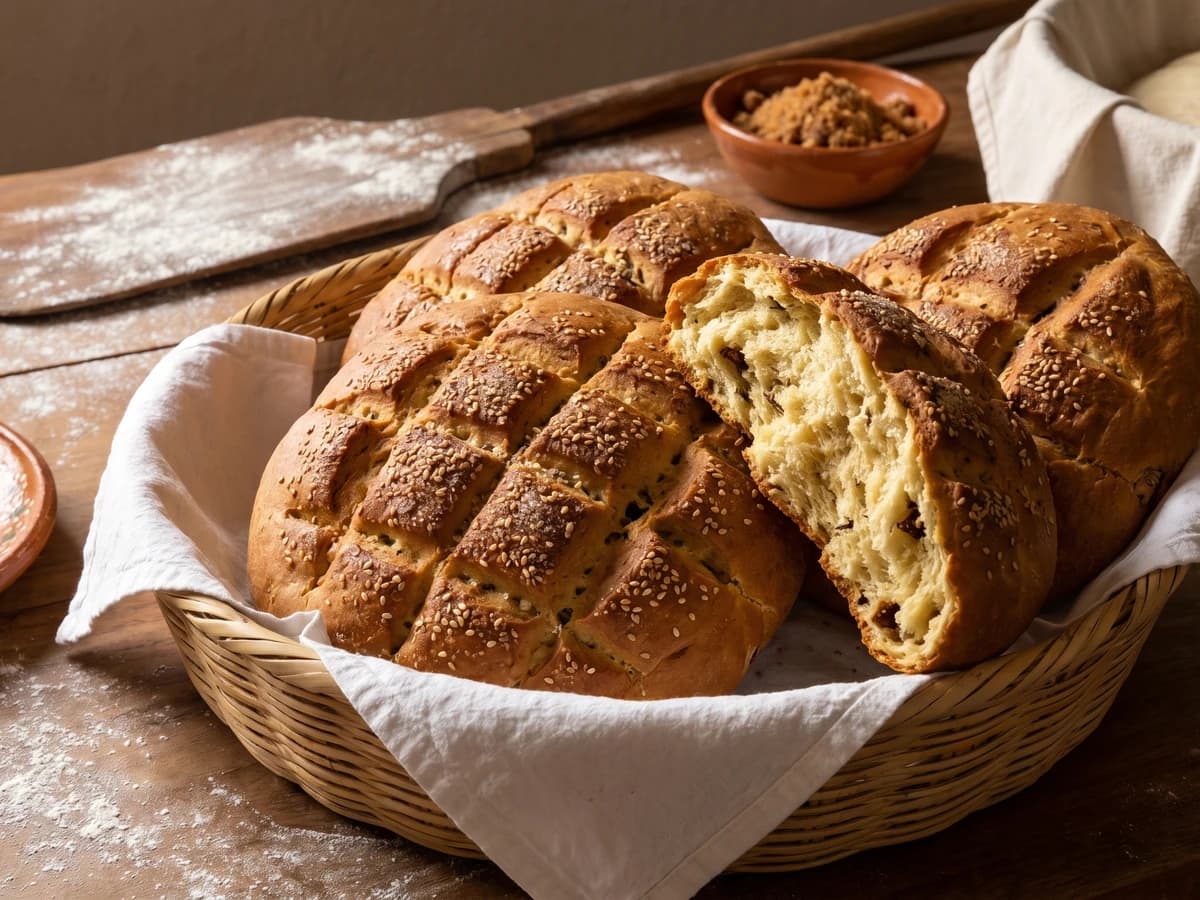
From Ajijic on Lake Chapala, Pan Tachihual is a lightly sweet wedding loaf built with harina de trigo, harina de maiz, piloncillo, manteca, anise, and the old Guadalajara pata.

Chef Lupita
Comitán's pan de yema shaped into little pigs, birds, and rabbits, a Chiapas bakery bread rich with egg yolks, manteca de cerdo, and anís, baked golden on hoja de plátano.