
Chef Fai
Dry Egg Noodles (Ba Mee Haeng)
The four pillars live at the bottom of the bowl before the noodles ever touch it: nam pla for salt, sugar for sweet, vinegar for sour, chili for heat. Every noodle cart in Bangkok runs on this principle.
A cooking platform built around craft, culture, and the stories behind what we eat.

Created by
Wide rice noodles seared against a screaming wok, stained black with si ew dam, charred at the edges, tangled with egg and Chinese broccoli. Wok hei is not a technique. It is the dish.
Wok hei. The breath of the wok. That's the entire recipe. If your wok isn't hot enough to scar the noodles on contact, you're making something, but it's not pad see ew. It's boiled noodles with sauce.
Ajarn always said: technique before ingredients. A vendor with a battered carbon steel wok over a jet burner and three bottles of sauce will produce a pad see ew that makes you close your eyes. A home cook with imported noodles and a cold pan will produce sadness. The difference is temperature. The difference is always temperature.
Pad see ew is the Central Thai wok dish that breaks one of my own rules. I tell everyone: fish sauce is the salt, not soy sauce. That's the law. But pad see ew is the exception, and understanding why it's the exception teaches you more about the system than any rule. Dark soy sauce (si ew dam) isn't here for salinity. It's here for color, for body, for that caramelized sweetness that hits the screaming wok and turns to smoke and char. Fish sauce is still present, still doing the salt work. The dark soy is doing something else entirely. It's painting the noodles black and giving them that smoky-sweet edge that no other sauce can deliver. The name tells you: pad (stir-fried) see ew (soy sauce). The soy sauce IS the dish.
The noodles are sen yai, wide fresh rice noodles. They have to be fresh. Dried won't work. They need to be slippery, pliable, and ready to take on the dark soy. You separate them gently before they hit the wok because once they're in, you don't stir. You let them sit. You let them char. Then you flip. That restraint, that patience to let the noodles sear instead of tossing them around, is what separates street vendor pad see ew from the pale, floppy version you get at tourist restaurants. The wok does the work. You just have to trust it.
Pad see ew descends from Chinese chao fen (stir-fried rice noodles), adapted by the Thai-Chinese community in Bangkok's Yaowarat (Chinatown) district, likely in the early 20th century. The dish sits within a family of Thai-Chinese wok noodles including pad thai, kuay tiew khua gai, and rad na, all shaped by Chinese wok technique but governed by Thai seasoning principles. The name itself is Thai-Chinese: "pad" (Thai: stir-fry) and "see ew" (from Teochew Chinese: soy sauce), reflecting the dish's hybrid lineage.
Quantity
400g
gently separated
Quantity
200g
sliced thin against the grain
Quantity
2
Quantity
200g
stems sliced diagonally, leaves separated
Quantity
4 cloves
roughly chopped
Quantity
3 tablespoons
Quantity
1 tablespoon
Quantity
1 tablespoon
Quantity
1 tablespoon
Quantity
2 teaspoons
Quantity
1/2 teaspoon
Quantity
3 tablespoons
Quantity
for serving
| Ingredient | Quantity |
|---|---|
| fresh wide rice noodles (sen yai)gently separated | 400g |
| pork loin or chicken thighsliced thin against the grain | 200g |
| eggs | 2 |
| Chinese broccoli (pak kana)stems sliced diagonally, leaves separated | 200g |
| garlicroughly chopped | 4 cloves |
| dark soy sauce (si ew dam) | 3 tablespoons |
| light soy sauce (si ew khao) | 1 tablespoon |
| fish sauce (nam pla) | 1 tablespoon |
| oyster sauce | 1 tablespoon |
| white sugar | 2 teaspoons |
| white pepper | 1/2 teaspoon |
| vegetable oil | 3 tablespoons |
| prik nam som (chili vinegar) (optional) | for serving |
If your fresh rice noodles are stuck together in a block, gently separate them with your hands. Don't break them. They're fragile. If they've been refrigerated, microwave them for 30 seconds to loosen them up, or leave them at room temperature for 20 minutes until they're pliable. Stiff cold noodles will shatter in the wok. You want them soft and slippery, ready to take on the dark soy.
In a small bowl, combine the dark soy sauce, light soy sauce, fish sauce, oyster sauce, and sugar. Stir until the sugar dissolves. This is your entire seasoning. The dark soy gives color and caramelized depth. The light soy and fish sauce give salt. The oyster sauce gives body and gloss. The sugar balances. Everything measured, everything ready before the wok goes on. Once the fire is lit, there's no time to measure.
Get your wok screaming hot over the highest heat your stove can produce. Add 2 tablespoons of oil. The oil should shimmer and smoke within two seconds. If it doesn't, your wok isn't hot enough. Walk away and wait. Add the pork slices in a single layer. Don't touch them. Let them sear for 30 seconds until they get color on the bottom, then flip and sear the other side. Another 30 seconds. Remove the pork and set aside. It doesn't need to be cooked through. It's going back in.
Wok back on high heat. Add the remaining tablespoon of oil. Throw in the garlic. Two seconds of sizzle, then crack both eggs directly into the wok. Let them set on the bottom for about 10 seconds, then break the yolks and scramble roughly. You want big, uneven curds, not a fine scramble. The eggs should still be slightly wet when you move to the next step.
Add the separated noodles to the wok on top of the egg. Here's where most people fail. Do not stir. Press the noodles flat against the wok surface with your spatula. Let them sit. Let them char. You'll hear them hiss and pop. After 30 to 45 seconds, flip a section. You should see dark, caramelized edges where the noodles made contact with the metal. That char is wok hei. That's the whole point. If your noodles are pale and soft, your wok wasn't hot enough.
Pour the sauce mixture over the noodles. Toss once, folding from the bottom up so the dark soy coats every strand. The noodles should turn a deep mahogany. Add the pak kana stems first, they need more time, and toss for 30 seconds. Then add the leaves. Toss for another 15 seconds. The stems should be crisp-tender, the leaves barely wilted. Return the seared pork. One final toss. Hit it with white pepper. Plate immediately.
Slide the noodles onto a plate. Serve with prik nam som (chilies in white vinegar) on the side. A few drops of that vinegar cut through the richness of the dark soy and oyster sauce. It's the sour element that the dish itself doesn't carry. Every noodle stall in Bangkok has a bottle on the table. Use it.
1 serving (about 450g)
Culinary guides, cultural storytelling, and the editorial depth that makes cooking meaningful.
Discover Culinary ExplorerChef Fai
The four pillars live at the bottom of the bowl before the noodles ever touch it: nam pla for salt, sugar for sweet, vinegar for sour, chili for heat. Every noodle cart in Bangkok runs on this principle.

Chef Fai
The kreung tam fried in cracked coconut cream until the oil bleeds red. That's the technique. Concentrated, semi-dry, spooned thick over crispy fish. This is what happens when the four pillars meet restraint.
Chef Fai
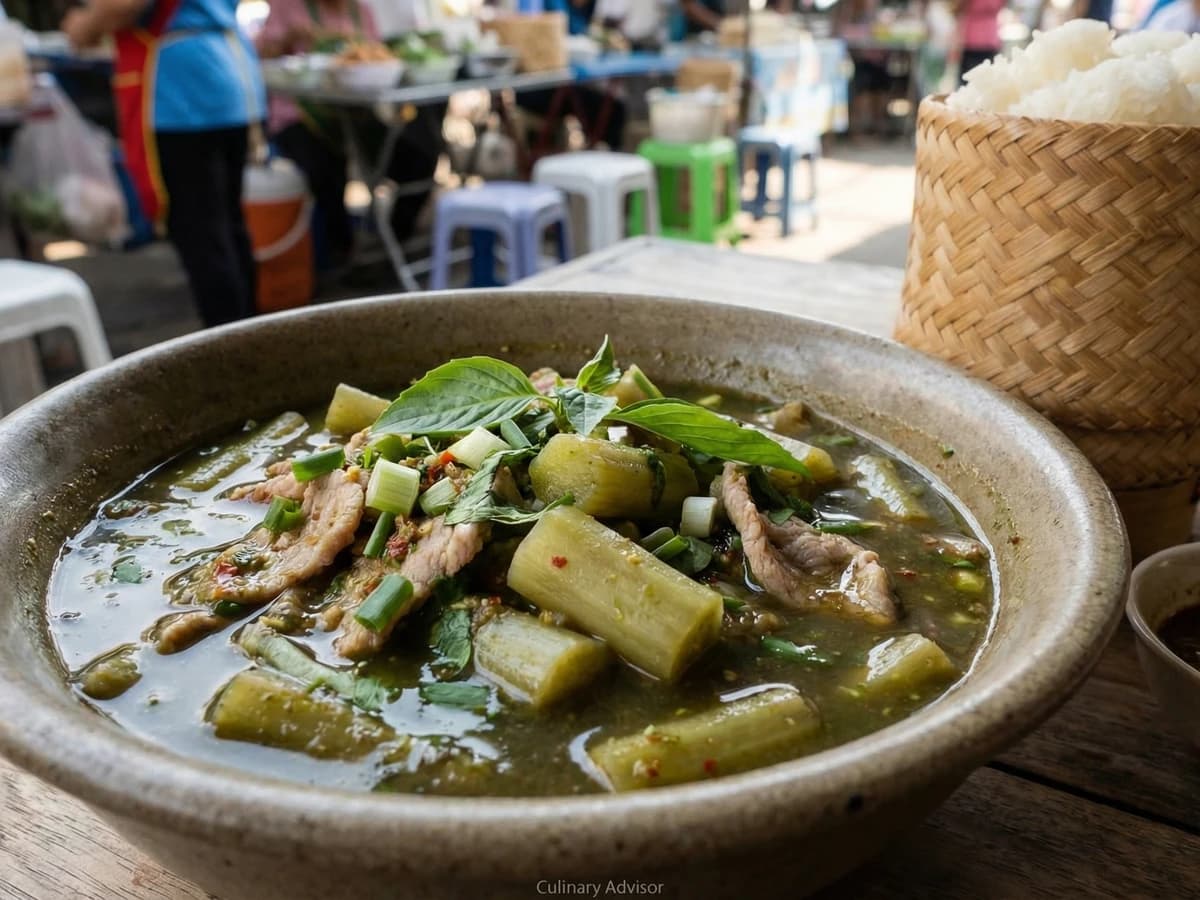
Isan foraging in a bowl: wild taro stems stripped of their sting, simmered in padaek broth with a pounded chili paste and yanang leaf extract. The land feeds you if you know the rules.

Chef Fai
Lanna's kreung tam breaks from Central Thai rules: ginger over galangal, cumin and coriander from Burmese spice routes, tamarind for sour instead of lime. The North has its own system, and this curry is its crown.