
Chef Fai
Dry Egg Noodles (Ba Mee Haeng)
The four pillars live at the bottom of the bowl before the noodles ever touch it: nam pla for salt, sugar for sweet, vinegar for sour, chili for heat. Every noodle cart in Bangkok runs on this principle.
A cooking platform built around craft, culture, and the stories behind what we eat.

Created by
The stir-fry that uses the kreung tam as a live weapon: a rough paste of fingerroot, galangal, garlic, and chili hits screaming oil before any seafood enters the wok. Every aromatic principle Ajarn taught, fired at maximum volume.
Pad cha is the most demanding stir-fry in the Central Thai canon. It's also the one that proves you understand the system.
Here's why. Most Thai stir-fries follow a simple sequence: garlic in oil, protein sears, sauce finishes. Pad cha breaks that sequence wide open. Before the protein touches the wok, you fry a rough paste of krachai (fingerroot), galangal, garlic, dried chili, and young peppercorns in hot oil. The kreung tam hits the wok first. It blooms. The kitchen fills with an aroma that is sharp, earthy, and almost medicinal. That paste is the backbone of the entire dish. Skip it and you have stir-fried seafood with herbs thrown on top. Fry it properly and every piece of squid, every shrimp, every mussel carries the flavor in its surface.
Ajarn always said: "For stir-fries with paste, the paste fries in oil before protein enters." Pad cha is the purest expression of that rule. The krachai is the signature. It's a rhizome that looks like a cluster of skinny brown fingers, tastes like ginger's wilder, more peppery cousin, and does something no other Thai ingredient does: it cuts through the richness of seafood with a clean, sharp bite. You can't substitute ginger for krachai. They're different plants with different volatile compounds. Ginger is warm and round. Krachai is sharp and linear. If you can't find fresh krachai, frozen works. Jarred is a last resort. Dried is useless.
The four pillars hold the dish together. Nam pla (fish sauce) provides salt and umami. Palm sugar gives just enough sweetness to round the edges of all that heat. There's no lime in this dish, but the kaffir lime leaves deliver their citrus oils from the inside, volatile and fragrant, not acidic. And the chili? Dried spur chilies cracked and fried in the paste, plus fresh prik khi nu sliced and tossed in at the end. Heat from two directions, one deep and smoky, one bright and immediate. That layering is not accidental. That's the system working.
I teach pad cha at every Fai Thai workshop because it forces you to use every skill at once: paste-making, wok temperature control, timing, and balance. If you can nail pad cha talay, you can cook anything in the Central Thai stir-fry repertoire. Principles, not recipes.
Pad cha is a Central Thai stir-fry technique defined by its aromatic base of krachai (fingerroot, Boesenbergia rotunda), green peppercorns, and kaffir lime leaves, a combination found nowhere else in the Thai stir-fry canon. The word "cha" (ฉ่า) is onomatopoeic, mimicking the violent sizzle of wet aromatics hitting a screaming-hot oiled wok. The technique is most closely associated with coastal Central Thai cooking, where the abundance of fresh seafood paired naturally with krachai's ability to neutralize fishiness while adding its own sharp, peppery complexity.
Quantity
200g
shell-on or peeled, deveined
Quantity
150g
cleaned, scored crosshatch, cut into pieces
Quantity
100g
scrubbed and debearded
Quantity
3 tablespoons
Quantity
4 cloves
roughly pounded
Quantity
3
soaked in warm water 10 minutes, cut into 1-inch pieces
Quantity
1 tablespoon
julienned into matchsticks
Quantity
3 slices
julienned thin
Quantity
2 tablespoons
on the stem
Quantity
5
torn, central vein removed
Quantity
3
sliced on the bias
Quantity
2 tablespoons
Quantity
1 tablespoon
Quantity
1 teaspoon
Quantity
1 tablespoon
Quantity
1 large handful
Quantity
for serving
| Ingredient | Quantity |
|---|---|
| shrimp (goong)shell-on or peeled, deveined | 200g |
| squid (pla muek)cleaned, scored crosshatch, cut into pieces | 150g |
| mussels (hoi malaeng phu)scrubbed and debearded | 100g |
| vegetable oil | 3 tablespoons |
| garlicroughly pounded | 4 cloves |
| dried spur chilies (prik chee fah haeng)soaked in warm water 10 minutes, cut into 1-inch pieces | 3 |
| krachai (fingerroot)julienned into matchsticks | 1 tablespoon |
| galangal (kha)julienned thin | 3 slices |
| fresh green peppercorns (prik thai on)on the stem | 2 tablespoons |
| kaffir lime leaves (bai makrut)torn, central vein removed | 5 |
| bird's eye chilies (prik khi nu)sliced on the bias | 3 |
| fish sauce (nam pla) | 2 tablespoons |
| oyster sauce | 1 tablespoon |
| palm sugar (nam tan pip) | 1 teaspoon |
| water or stock | 1 tablespoon |
| holy basil leaves (bai kra pao) | 1 large handful |
| steamed jasmine rice | for serving |
In your mortar, pound the garlic to a rough smash. Not a paste. You want chunks, crushed open so they release their oils the second they touch hot oil. Add the soaked dried spur chilies and give them a few firm strikes to break them apart. Scrape this out and set it beside your wok. This is your kreung tam for pad cha: garlic and dried chili, ready to bloom.
Lay each squid tube flat and score the inside surface in a tight crosshatch pattern with a sharp knife. Cuts about 2mm apart, not cutting all the way through. Then cut into roughly 3cm pieces. When the scored squid hits the hot wok, the cuts open up and the pieces curl into textured shapes that grip the sauce. That's structural. It's not decoration. Flat, unscored squid slides off the sauce and tastes like rubber.
Get your wok screaming hot over the highest heat your stove offers. Add the oil. The moment it shimmers and starts to smoke, throw in the pounded garlic and dried chili. Stir it once. The garlic should sizzle aggressively and start to turn golden at the edges within two seconds. Now add the julienned krachai (fingerroot) and galangal. Stir-fry for five seconds. The kitchen will fill with a sharp, earthy, peppery aroma that smells like nothing else in Thai cooking. That's the krachai doing its work. If you don't smell it, your wok wasn't hot enough.
Add the mussels first because they take the longest. Toss once. Then the squid, spread it across the wok surface so it makes direct contact with the metal. You want char. Wok hei. Ten seconds, then toss. Add the shrimp last. Everything moves fast now. The squid should be curling, the shrimp turning pink, the mussels opening. If a mussel doesn't open, throw it away. Total protein cooking time is about sixty to ninety seconds. Don't overcook. Seafood goes from perfect to chewy in the time it takes to check your phone.
Add the fish sauce, oyster sauce, palm sugar, and the tablespoon of water. The sauces hit the hot wok and create an instant glaze. Toss everything to coat. Now throw in the green peppercorns (still on their stems), the torn kaffir lime leaves, and the sliced bird's eye chilies. Toss twice. The peppercorns are bright, floral, and sharp. They pop between your teeth. The kaffir lime leaves release their oils on contact. The bird's eye chilies bring a fresh, immediate heat on top of the dried chili's deeper burn. Two layers of heat, two layers of aroma. That's the complexity of pad cha.
Kill the heat. Add the entire handful of holy basil (bai kra pao) and toss it through twice. The residual heat wilts the basil just enough. The leaves should still be bright green, fragrant, and barely softened. If they go dark and limp, you left them too long. Plate immediately over jasmine rice. This dish does not wait. Eat it the second it hits the plate.
1 serving (about 240g)
Culinary guides, cultural storytelling, and the editorial depth that makes cooking meaningful.
Discover Culinary ExplorerChef Fai
The four pillars live at the bottom of the bowl before the noodles ever touch it: nam pla for salt, sugar for sweet, vinegar for sour, chili for heat. Every noodle cart in Bangkok runs on this principle.

Chef Fai
The kreung tam fried in cracked coconut cream until the oil bleeds red. That's the technique. Concentrated, semi-dry, spooned thick over crispy fish. This is what happens when the four pillars meet restraint.
Chef Fai
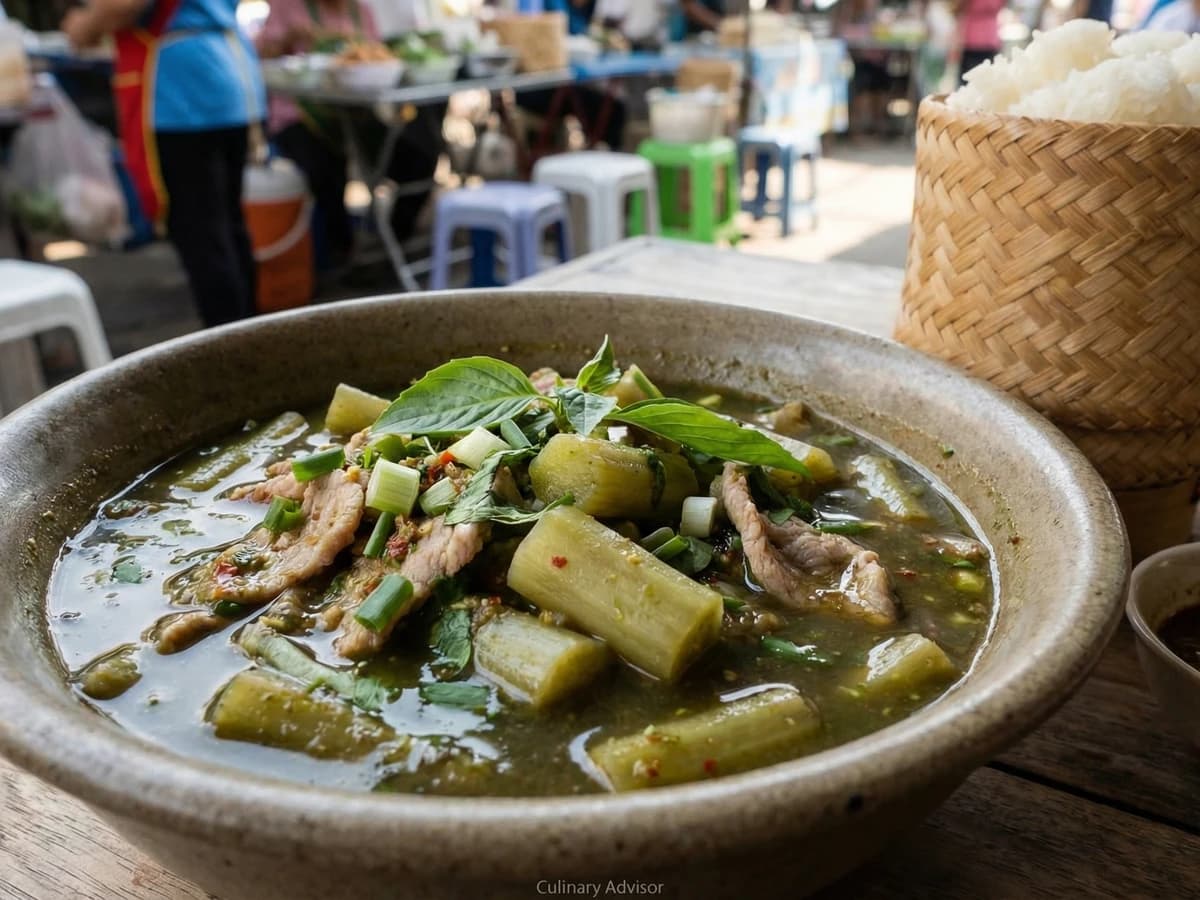
Isan foraging in a bowl: wild taro stems stripped of their sting, simmered in padaek broth with a pounded chili paste and yanang leaf extract. The land feeds you if you know the rules.

Chef Fai
Lanna's kreung tam breaks from Central Thai rules: ginger over galangal, cumin and coriander from Burmese spice routes, tamarind for sour instead of lime. The North has its own system, and this curry is its crown.