
Chef Fai
Dry Egg Noodles (Ba Mee Haeng)
The four pillars live at the bottom of the bowl before the noodles ever touch it: nam pla for salt, sugar for sweet, vinegar for sour, chili for heat. Every noodle cart in Bangkok runs on this principle.
A cooking platform built around craft, culture, and the stories behind what we eat.

Created by
Garlic, cilantro root, white pepper, fish sauce. That's the Isan grill marinade, four ingredients governing every piece of meat that hits charcoal on the plateau. The jaew beside it isn't a condiment. It's the other half of the dish.
Every roadside grill stall in Isan runs on the same formula. Garlic, cilantro root, white pepper, nam pla. That's it. Four ingredients pounded together, rubbed into the meat, left to do their work. It's not a kreung tam in the full sense, not the nine-ingredient paste that governs curries and stir-fries. But it follows the same logic: pound the aromatics, break the cell walls, let the volatile oils penetrate the protein. Simpler paste, same principle.
Ajarn always said the kreung tam is the foundation of Thai cooking. With grilled meat, the foundation is stripped to its bones. You don't need lemongrass or galangal or kaffir lime here. You need garlic for pungency, cilantro root for its earthy depth (not the leaves, the root, where the real flavor lives), white peppercorns for heat that sits underneath rather than on top, and fish sauce for salinity that sugar-salt brines will never match. Pound those four together. Rub the beef. Walk away.
The charcoal matters. I can't say this gently. A gas grill will cook your beef, but it won't give you nua yang. The smoke from natural hardwood charcoal is a flavor component. It gets into the fat, into the char on the surface, into the crust that forms when protein meets open flame. Every grill vendor on Highway 2 between Saraburi and Nakhon Ratchasima knows this. They're not using gas. They're using charcoal that's been burning since before you pulled over.
The beef comes off the grill, rests, gets sliced thick against the grain. Then you eat it with jaew, the roasted chili dipping sauce that accompanies every grilled dish in Isan. Jaew is structural. It provides the sour (lime), the salt (nam pla), the heat (roasted dried chilies), and the toasted rice powder (khao khua) that ties it all to the Isan table. Without the jaew, you have grilled beef. With it, you have nua yang. The dipping sauce completes the four pillars that the marinade alone doesn't cover. Fish sauce for salt. Lime for sour. Chili for heat. Khao khua for that smoky, nutty crunch that says Isan louder than any other ingredient on earth.
Sticky rice. Raw vegetables. A cold beer. That's the full picture. That's what you smell when you pull off the highway and see the smoke rising from a corrugated tin roof with plastic stools out front. That's nua yang.
Nua yang is one of the oldest preparations in the Isan culinary tradition, predating refrigeration as a practical way to cook large cuts of beef in a region where cattle farming has been integral to the agricultural economy for centuries. The dish belongs to a family of Isan grilled meats (gai yang, kor moo yang, pla pao) that share a common marinade logic and are all served with jaew and sticky rice. The rise of highway grill stalls along Thailand's northeastern routes in the 1970s and 80s turned nua yang from village food into a national road-trip ritual, with clusters of vendors near Korat, Khon Kaen, and Udon Thani becoming destinations in their own right.
Quantity
600g
about 1.5 inches thick, whole piece
Quantity
8 cloves
Quantity
3
scraped clean
Quantity
1 teaspoon
Quantity
2 tablespoons
Quantity
1 teaspoon
Quantity
enough to fill grill
Quantity
6
deseeded
Quantity
2 tablespoons
Quantity
3 tablespoons (about 2 limes)
Quantity
1 tablespoon
Quantity
1 tablespoon
thinly sliced
Quantity
1 tablespoon
roughly chopped
Quantity
1 tablespoon
thinly sliced
Quantity
pinch
Quantity
for serving
Quantity
for serving
cabbage wedges, long beans, Thai eggplant, fresh herbs
| Ingredient | Quantity |
|---|---|
| beef flank steak or skirt steakabout 1.5 inches thick, whole piece | 600g |
| garlic | 8 cloves |
| cilantro roots (rak phak chi)scraped clean | 3 |
| white peppercorns (prik thai khao) | 1 teaspoon |
| fish sauce (nam pla) | 2 tablespoons |
| palm sugar (nam tan pip) | 1 teaspoon |
| natural hardwood charcoal | enough to fill grill |
| dried Thai chilies (prik haeng)deseeded | 6 |
| fish sauce (nam pla), for jaew | 2 tablespoons |
| lime juice (nam manao), for jaew | 3 tablespoons (about 2 limes) |
| toasted rice powder (khao khua) | 1 tablespoon |
| shallots, for jaewthinly sliced | 1 tablespoon |
| cilantro leaves, for jaewroughly chopped | 1 tablespoon |
| green onion, for jaewthinly sliced | 1 tablespoon |
| granulated sugar, for jaew | pinch |
| sticky rice (khao niew) | for serving |
| raw vegetablescabbage wedges, long beans, Thai eggplant, fresh herbs | for serving |
In a granite mortar (krok hin), pound the garlic, cilantro roots, and white peppercorns to a rough paste. Not smooth. You want the garlic crushed and the cilantro root fibers broken, not liquefied. The aroma should be sharp and earthy, the peppercorns cracked enough to release their oils but still visible. Stir in the fish sauce and palm sugar. That's your Isan grill paste. Four ingredients. The palm sugar isn't for sweetness. It helps the surface caramelize over charcoal.
Rub the paste all over the beef, working it into any crevices and scoring marks. If your cut is thick, score the surface in a crosshatch pattern about 1/4 inch deep. This isn't for show. The marinade needs pathways into the meat. Cover and refrigerate for at least 4 hours. Overnight is better. The fish sauce is doing two things: seasoning the interior and beginning to break down the surface proteins, which means a better crust when it hits the fire.
If you don't have toasted rice powder ready, make it now. Toast raw sticky rice in a dry wok or pan over medium heat, shaking constantly, until it turns deep golden brown and smells nutty and smoky. About 5 minutes. Let it cool completely, then grind it in a mortar to a coarse powder. Not fine. You want grit. Khao khua should crunch between your teeth.
Light your natural hardwood charcoal and let it burn until the coals are covered in white ash and glowing orange underneath. This takes 20 to 30 minutes. Don't rush it. You want even, intense, direct heat. Spread the coals in an even layer. No cold spots. Hold your hand 4 inches above the grate. If you can't hold it there for more than 2 seconds, that's the right temperature. This is the heat that Isan grill vendors work over all day.
Pull the beef from the fridge 30 minutes before grilling. Cold meat on a hot grill means uneven cooking. Place the beef directly over the coals. Don't touch it. Let the fire do its work. You'll hear it sizzle, you'll see the fat render and drip, you'll get flare-ups. That's good. That's flavor. Grill for 5 to 7 minutes per side for medium-rare, depending on thickness. The surface should be deeply charred, almost black in places, with the crust cracking when you press it. Use a thermometer if you need to: 55°C internal for medium-rare. Isan vendors don't use thermometers. They press the meat and know.
Move the beef to a cutting board and let it rest for 10 minutes. Not 5. Ten. The juices need to redistribute. If you cut immediately, those juices end up on the board instead of in the meat. Slice against the grain into pieces about 1/4 inch thick and the width of two fingers. Not paper-thin. Not thick chunks. You want each slice to show the char on the outside and the pink in the center. That contrast is the whole point.
While the beef rests, dry-roast the dried chilies in a wok over medium heat until they darken, blister, and become fragrant. About 2 minutes, tossing constantly. Don't let them blacken or they'll turn bitter. Pound them in the mortar to flakes, not powder. Combine the chili flakes with fish sauce, lime juice, toasted rice powder, sliced shallots, cilantro, green onion, and a pinch of sugar. Stir. Taste. It should be sour first, salty second, with heat from the chilies and that unmistakable grit of khao khua. If it needs more lime, add it. Jaew should punch you in the mouth. It's the sauce that makes grilled meat Isan.
Arrange the sliced beef on a plate. Set the jaew in a small bowl alongside. Pile raw vegetables on another plate: cabbage wedges, long beans, halved Thai eggplant, fresh mint, and culantro if you have it. Bring out the sticky rice in a kratip basket. You tear off a pinch of sticky rice, pick up a slice of beef, dip it in jaew, grab a piece of raw vegetable. That's a bite. The combination is the design. Cold beer. Open air. This is Isan eating.
1 serving (about 390g)
Culinary guides, cultural storytelling, and the editorial depth that makes cooking meaningful.
Discover Culinary ExplorerChef Fai
The four pillars live at the bottom of the bowl before the noodles ever touch it: nam pla for salt, sugar for sweet, vinegar for sour, chili for heat. Every noodle cart in Bangkok runs on this principle.

Chef Fai
The kreung tam fried in cracked coconut cream until the oil bleeds red. That's the technique. Concentrated, semi-dry, spooned thick over crispy fish. This is what happens when the four pillars meet restraint.
Chef Fai
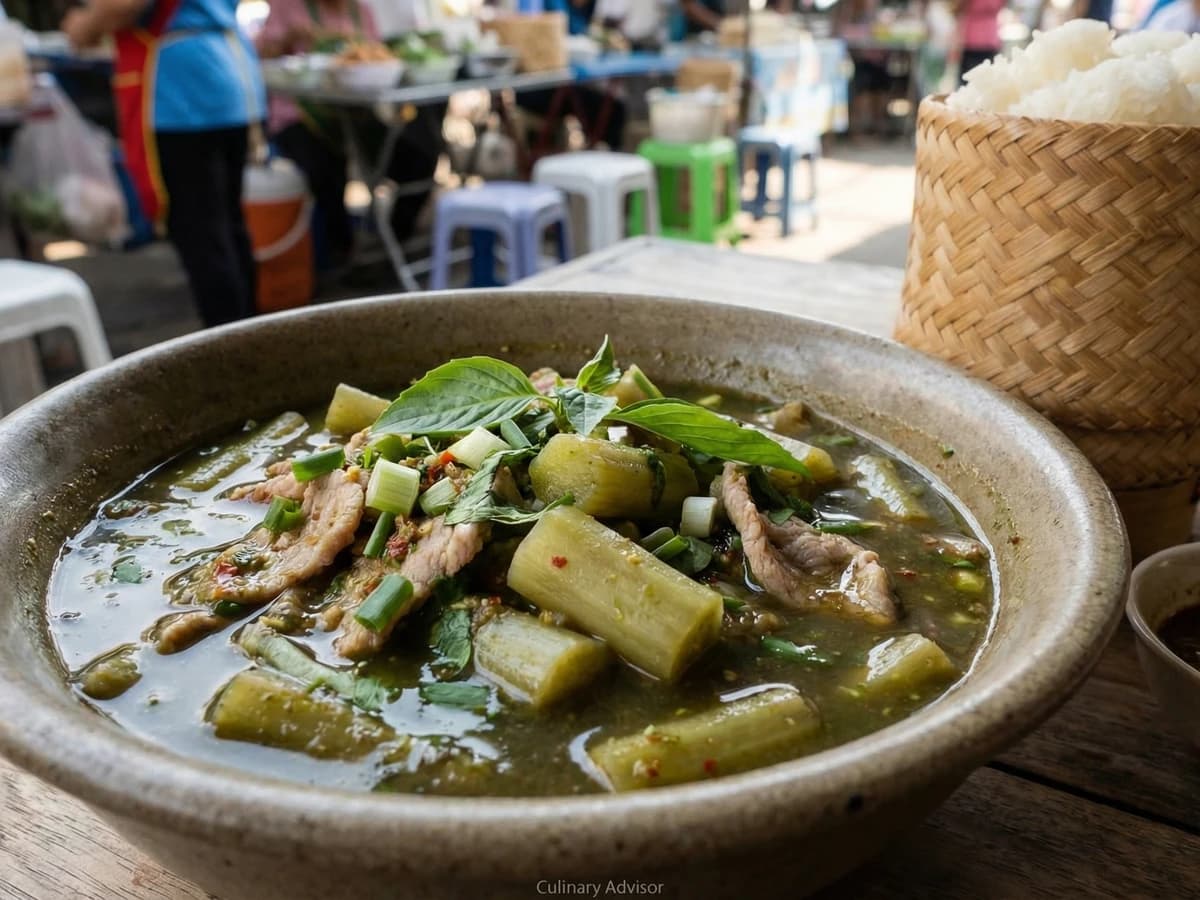
Isan foraging in a bowl: wild taro stems stripped of their sting, simmered in padaek broth with a pounded chili paste and yanang leaf extract. The land feeds you if you know the rules.

Chef Fai
Lanna's kreung tam breaks from Central Thai rules: ginger over galangal, cumin and coriander from Burmese spice routes, tamarind for sour instead of lime. The North has its own system, and this curry is its crown.