
Chef Fai
Southern Cucumber Relish (Ajad)
The one Thai condiment where vinegar replaces lime as the sour pillar, and the system still holds. Palm sugar for sweet, nam pla for salt, prik for heat. Ajad is the four pillars in a jar.
A cooking platform built around craft, culture, and the stories behind what we eat.
Created by
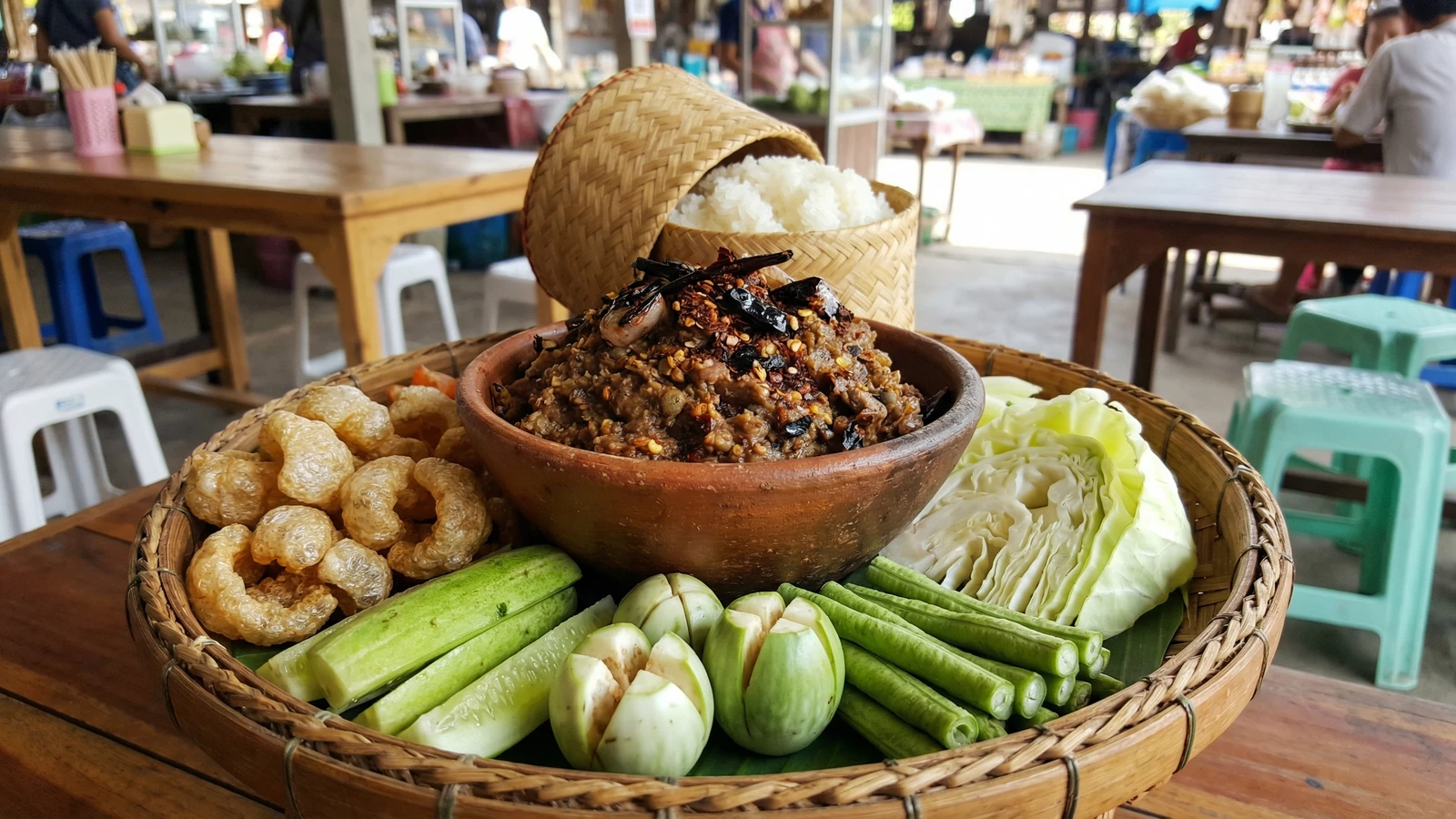
The Lanna ferment that replaces kapi entirely. Tua nao discs crumbled and pounded with chilies, garlic, and shallots in the krok. This is how the North defines its identity in one dip, no shrimp paste needed.
Every region of Thailand has its nam prik. Central Thai builds on kapi (shrimp paste). The South uses shrimp paste and turmeric. Isan has its jaew. But the North, Lanna, does something no other region does: it replaces shrimp paste with fermented soybeans.
Tua nao (ถั่วเน่า). The name literally means "rotten beans." Soybeans boiled, mashed, wrapped in banana leaves, and left to ferment for two to three days until they develop a funky, almost cheese-like depth. Then pressed into flat discs and dried in the sun. Those discs are Lanna's secret weapon. Crumble one into the mortar and you get a fermented umami backbone that's entirely different from kapi. Earthier. Nuttier. No ocean anywhere near it. This is mountain food, landlocked food, and the fermentation reflects the geography.
Ajarn always said: the four pillars are universal, but the specific ferment changes by region. In Central Thai, kapi provides the fermented foundation. In Lanna, tua nao does the same job through a completely different biological process. Bacterial fermentation of plant protein instead of crustacean protein. Different microbes, different amino acids, different flavor. Same structural role. That's the system at work. It adapts without breaking.
Nam prik tua nao is the simplest expression of this principle. Dried chilies, garlic, shallots, tua nao, fish sauce. Pounded in the krok. That's it. Five ingredients and a mortar. The fermented soybean does the heavy lifting, providing the depth that would take kapi or pla ra in another regional tradition. You serve it with sticky rice, raw vegetables, and kab moo (pork rinds), the way it's been eaten on the khantoke for as long as anyone in Chiang Mai can remember. No jasmine rice. No fork and plate. Sticky rice pinched between your fingers, dragged through the nam prik, eaten with a piece of cucumber or a crispy pork rind. That's the design.
Tua nao (ถั่วเน่า) is one of the oldest fermented soy products in mainland Southeast Asia, predating Thai-Chinese soy sauce traditions by centuries. Its production is concentrated in the northern provinces of Chiang Mai, Chiang Rai, Mae Hong Son, and Nan, regions where the Tai Yuan and other Lanna peoples developed soybean fermentation independently of Chinese or Japanese traditions. Anthropologists link tua nao to similar fermented soybean preparations found across the highland cultures of Myanmar (pe poke), Nepal (kinema), and northeastern India (akhuni), suggesting a shared fermentation knowledge corridor along the mountain trade routes of mainland Asia.
Quantity
2 discs (about 30g total)
Quantity
5
stems removed, seeds shaken out
Quantity
5 cloves
unpeeled
Quantity
3 small
unpeeled
Quantity
1 tablespoon, plus more to taste
Quantity
1 teaspoon
Quantity
1 tablespoon (about half a lime)
Quantity
for serving
Quantity
for serving
sliced into spears
Quantity
for serving
quartered
Quantity
for serving
cut into 3-inch pieces
Quantity
for serving
torn into wedges
Quantity
for serving
steamed or blanched
Quantity
for serving
| Ingredient | Quantity |
|---|---|
| tua nao discs (fermented soybean discs) | 2 discs (about 30g total) |
| dried red chilies (prik haeng)stems removed, seeds shaken out | 5 |
| garlicunpeeled | 5 cloves |
| shallots (hom daeng)unpeeled | 3 small |
| fish sauce (nam pla) | 1 tablespoon, plus more to taste |
| palm sugar (nam tan pip) (optional) | 1 teaspoon |
| lime juice (nam manao) (optional) | 1 tablespoon (about half a lime) |
| sticky rice (khao niew) | for serving |
| cucumbersliced into spears | for serving |
| round Thai eggplant (makhuea pro)quartered | for serving |
| long beans (thua fak yao)cut into 3-inch pieces | for serving |
| cabbagetorn into wedges | for serving |
| pak wan (sweet leaf) or morning glory (pak bung)steamed or blanched | for serving |
| kab moo (pork rinds) | for serving |
Set a dry pan or wok over medium heat. Break the tua nao discs into rough chunks and toast them, shaking the pan, until they darken slightly and the smell shifts from raw-funky to nutty and roasted. Two to three minutes. Watch them. They go from toasted to burnt fast. The roasting mellows the raw fermented edge and deepens the umami. Set aside.
Place the unpeeled garlic, unpeeled shallots, and dried chilies directly over a charcoal fire or gas flame. Turn them with tongs. The garlic and shallots should be blackened on the outside and soft inside, about 5 minutes. The chilies need less time: toast them until they puff slightly and darken, turning constantly so they don't catch fire. Thirty seconds to a minute. When they're done, the dried chilies should be brittle and deeply fragrant. Peel the charred skins off the garlic and shallots. The charred aroma is not optional. It's the soul of this nam prik.
Start with the toasted dried chilies in the granite mortar (krok hin). Pound them to flakes first. They need to break down before the wet ingredients go in. Add the peeled charred garlic and shallots. Pound to a rough paste. Not smooth. You want texture, chunks of charred shallot still visible, the garlic smashed but not liquefied. Now crumble in the roasted tua nao. Pound and fold. The tua nao will break apart into the paste, adding its earthy, fermented depth. Ten to fifteen firm strikes and folds. The mortar should smell like smoke and fermented beans. That's how you know you're in Lanna territory.
Add the fish sauce. One tablespoon to start. Stir it in with the pestle. Taste. The tua nao already brings salinity and umami, so go easy. If you want a touch of sweetness, add the palm sugar. If you want brightness, squeeze in the lime juice. But understand: some Lanna cooks add neither. The purest version is just tua nao, chilies, garlic, shallots, and fish sauce. Five ingredients. The ferment and the char do the work. Taste, adjust, stop fiddling when it tastes right. The balance here leans savory and smoky, not sweet and sour like a Central Thai nam prik.
Transfer the nam prik to a small bowl. Arrange it on a plate or khantoke tray with sticky rice, raw vegetables (cucumber spears, quartered Thai eggplant, long bean pieces, cabbage wedges), steamed pak wan or blanched morning glory, and a generous pile of kab moo (pork rinds). Eat with your hands. Pinch a ball of sticky rice, press it flat, drag it through the nam prik, pick up a piece of vegetable or a shard of kab moo. That's a bite. The combination is the point. The nam prik alone is intense. With sticky rice and vegetables, it's a meal.
1 serving (about 25g)
Culinary guides, cultural storytelling, and the editorial depth that makes cooking meaningful.
Discover Culinary ExplorerChef Fai
The one Thai condiment where vinegar replaces lime as the sour pillar, and the system still holds. Palm sugar for sweet, nam pla for salt, prik for heat. Ajad is the four pillars in a jar.

Chef Fai
Every grilled dish in Isan answers to this dip. Roasted dried chilies, nam pla, manao, khao khua, and shallots: the four pillars in a condiment that's structural, not optional.
Chef Fai
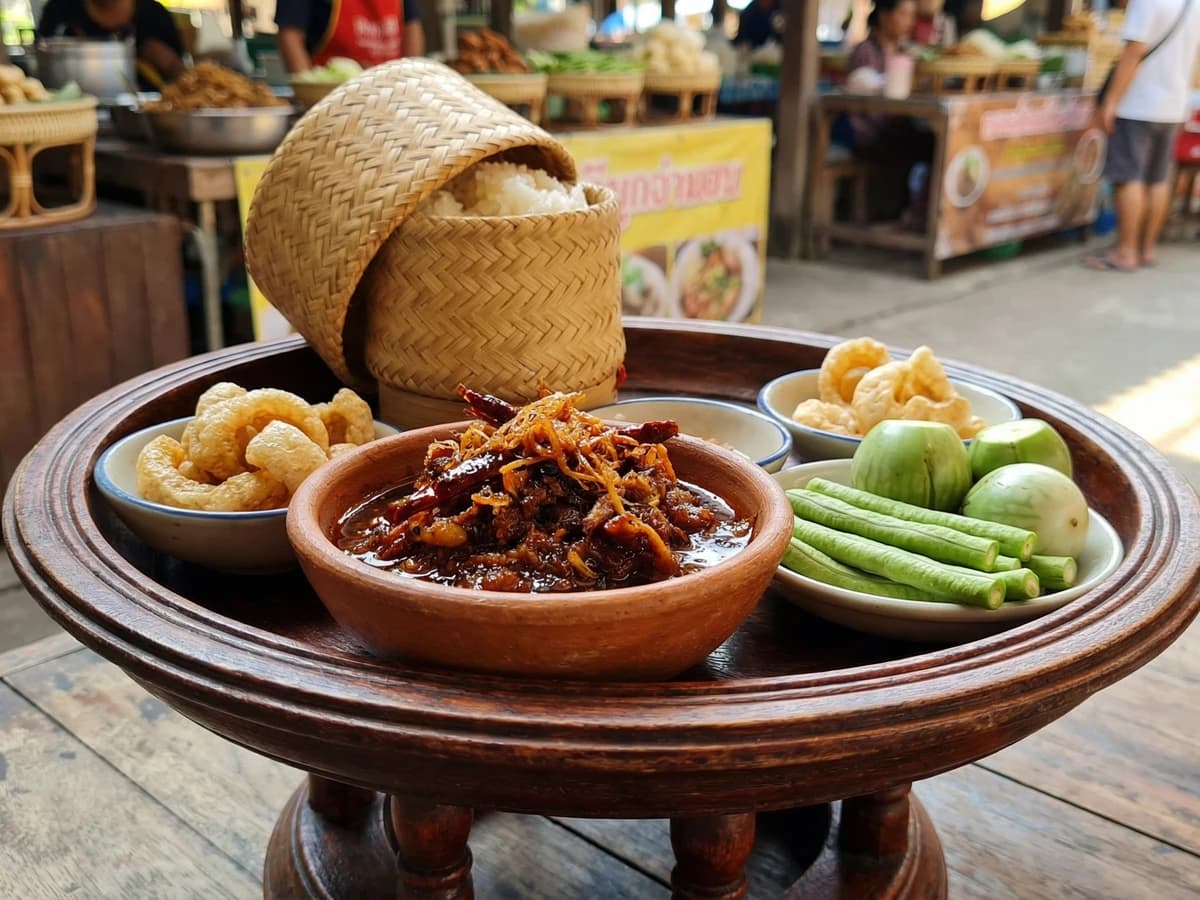
Roasted dried chilies and galangal pounded to a rough paste, folded with shredded pork skin and palm sugar until it becomes something sweet, smoky, and chewy that belongs on every khantoke tray in Chiang Mai.

Chef Fai
The kreung tam that proves the system adapts. Ginger instead of galangal, cumin and star anise alongside lemongrass. Lanna's mortar holds the whole Burma-to-Chiang Mai trade route in a single paste.